Hankyung Research Institute Analyzes 5 Key Characteristics of South Korea's Employment Market
[Asia Economy Reporter Kim Heung-soon] An analysis revealed that the number of large corporations in South Korea is very low compared to major advanced countries such as the United States, and small and medium-sized enterprises (SMEs), which are responsible for most employment, lack the foundation for growth, making it difficult to solve job issues. It was pointed out that the employment burden on companies should be eased to create quality jobs.
The Korea Economic Research Institute (KERI), under the Federation of Korean Industries, announced on the 9th that it analyzed the current status of South Korea's labor market using statistics from the Organisation for Economic Co-operation and Development (OECD) and Statistics Korea, and derived these results.
Proportion of Large Corporations Among All Domestic Companies is One-Seventh of the U.S. Level
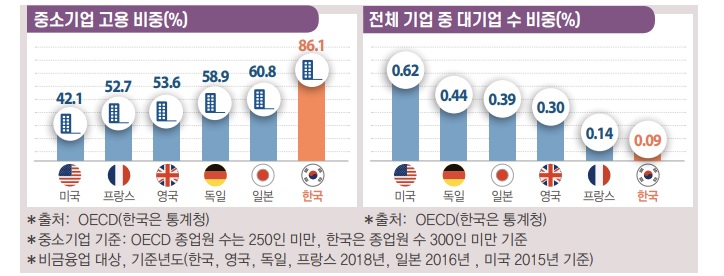
According to KERI, the proportion of large corporations among all companies in South Korea was 0.09%, only one-seventh of the U.S. figure (0.62%). Germany was 0.44%, Japan 0.39%, the United Kingdom 0.30%, and France 0.14%, all higher than South Korea among the major five countries (G5).
Due to the small number of large corporations domestically, the proportion of employees working in SMEs was relatively high at 86.1%, compared to the G5 average of 53.6%. KERI pointed out that these companies face severe restrictions, having to overcome a total of 275 regulations to grow beyond mid-sized companies into global large corporations, which has caused growth to stall. Additionally, since labor productivity in SMEs is only 28.7% compared to large corporations, far below the OECD average of 64.8%, KERI added that investment in human capital such as employee training and support for research and development for SME workers is also necessary.
KERI presented five characteristics of the domestic labor market: 'growth-stalled SMEs,' youth unemployment, women's career discontinuity, saturation of self-employment, and overprotection of regular workers. It argued that job expansion through labor regulation relaxation and strengthening the competitiveness of micro-enterprises is needed.
Number of Young People Giving Up Job Search Increased by 18.3% Compared to 2015
According to KERI, the employment rate of youth (ages 15?29) in South Korea was 42.2%, 14.6 percentage points lower than the G5 average of 56.8%. South Korea's youth economic activity participation rate (46.4%) also lagged significantly behind the G5 average of 62.5%.
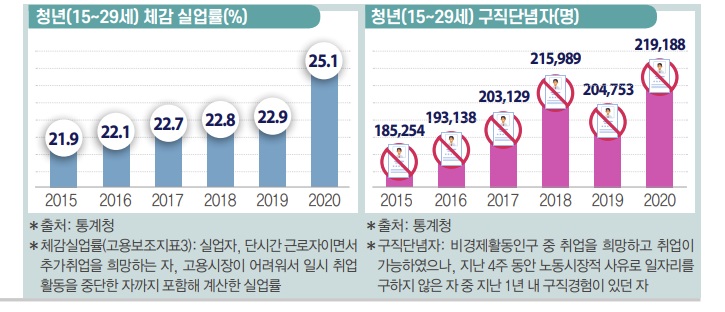
Not only the employment rate but also one in four young people were effectively unemployed, with the youth perceived unemployment rate reaching 25.1%. Last year, the number of young people who gave up job searching was 219,000, an 18.3% increase compared to 2015. KERI analyzed that the prolonged COVID-19 pandemic has caused a sharp rise in young people giving up job searches amid a shortage of quality jobs for youth.
Economic Activity Participation Rate of Women Aged 35?39 is Third Lowest After Turkey and Mexico
South Korea's female employment rate was found to be 56.7%, lower than the OECD average of 59.0%. The economic activity participation rate of women aged 35?39 was 60.5%, ranking third lowest after Turkey and Mexico.
The proportion of female part-time employment among all workers in South Korea was 9.3%, below the OECD average of 11.2%. KERI argued that supporting various forms of employment such as part-time work is necessary so that more women can participate in economic activities without career interruptions.
Among Self-Employed in Daily Life-Related Industries, 4 out of 10 Have Less Than 30% Chance of 5-Year Survival
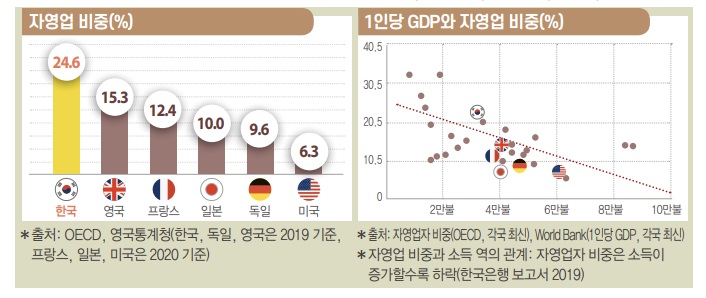
The proportion of self-employed in South Korea was 24.6%, ranking sixth highest among 35 OECD countries. Generally, the proportion of self-employed decreases as income increases, but South Korea is an exception with a relatively high rate. KERI explained that in G5 countries, the proportion of self-employed relative to per capita GDP is lower than the trend line (relationship between per capita GDP and self-employment rate), and in South Korea, it would be about 18.7% if following the trend line.
According to National Tax Service statistics, 43.2% of self-employed operate in daily life-related industries (retail, accommodation, and food services). These industries have low entry barriers but lower profitability compared to general industries, and the 5-year survival rate of new businesses is also low. In particular, the accommodation and food service sector, which includes many micro self-employed, recorded the lowest sales operating profit margin at 1.24% and a 5-year survival rate of 20.5% among all industries.
Overprotection of Regular Workers Increases Corporate Employment Burden
KERI pointed out that the flexibility ranking of regular worker dismissal regulations was 20th out of 37 OECD countries, placing it in the lower middle tier, and the legal dismissal cost was 27.4 times the weekly wage, significantly higher than the G5 average, which increases the employment burden on companies. Therefore, it argued that labor market flexibility should be enhanced by easing dismissal regulations to increase companies' capacity to create jobs.
Choo Kwang-ho, Director of Economic Policy at KERI, emphasized, "The five characteristics of the domestic labor market ultimately point to job expansion," adding, "Labor regulations should be relaxed to ease the employment burden on companies, and discriminatory regulations that increase with company size should be eliminated so that more SMEs can grow into mid-sized or large corporations and create quality jobs."
© The Asia Business Daily(www.asiae.co.kr). All rights reserved.
![Clutching a Stolen Dior Bag, Saying "I Hate Being Poor but Real"... The Grotesque Con of a "Human Knockoff" [Slate]](https://cwcontent.asiae.co.kr/asiaresize/183/2026021902243444107_1771435474.jpg)


















