Rapid Increase in ESG Information Disclosure Companies Based on International ESG Standards
[Asia Economy Reporter Hwang Junho] The proportion of South Korean companies disclosing information aligned with international ESG (Environmental, Social, Governance) standards in their sustainability or integrated reports has tripled. This indicates that ESG is rapidly permeating the ecosystem of domestic companies.
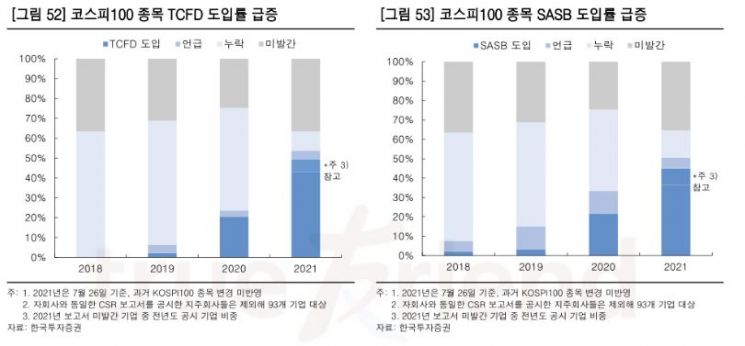
According to Korea Investment & Securities on the 1st, the number of companies among the top 100 KOSPI market capitalization firms that disclosed sustainability reports in accordance with the recommendations of the Task Force on Climate-related Financial Disclosures (TCFD) increased by 200%, from 18 last year to 54 by the end of last month. In 2019, only 2 companies disclosed ESG information based on TCFD standards, meaning non-financial information that could affect stakeholders beyond just the company or shareholders.
The number of companies disclosing according to the recommendations of the U.S. Sustainability Accounting Standards Board (SASB) also expanded to 48, a 167% increase compared to last year. From 1 company in 2019 to 18 last year, the ESG base is gradually broadening. Unlike TCFD, which focuses on climate change, SASB provides standards covering ESG overall.
Specifically, among the top market capitalization stocks, NAVER, Kakao, Samsung Biologics, NCSoft, and Samsung Card began disclosing information applying both standards starting this year. These companies previously did not have sustainability or integrated reports. On the other hand, companies such as Celltrion, SK IE Technology, Amorepacific, Netmarble, and HYBE issued sustainability or integrated reports but did not include ESG information based on international rules.
The trend of companies disclosing ESG information is analyzed to stem from strong demands for ESG disclosure by global investment institutions such as BlackRock and the Canada Pension Plan Investment Board (CPPIB). The asset management industry views ESG as a type of non-financial risk and wants the companies they invest in to demonstrate strong adaptability to environmental, social, and governance issues.
Unlike South Korea, where the concept of ESG was introduced late, most developed countries disclose ESG indicators based on international rules. According to KPMG, 96% of the top 250 global companies by revenue disclosed ESG last year. Companies in Japan, the United States, Germany, France, and the United Kingdom also disclose ESG at rates exceeding 90%.
Jiwoo Lim, a researcher at Korea Investment & Securities, analyzed, "In South Korea, many companies have pyramid-shaped ownership structures centered on the largest shareholder, so ESG improvement demands are often ignored and rarely brought up as board agenda items. However, as the domestic stock market is quickly aligning with global investment trends, ESG standards are expected to improve further."
© The Asia Business Daily(www.asiae.co.kr). All rights reserved.
![Clutching a Stolen Dior Bag, Saying "I Hate Being Poor but Real"... The Grotesque Con of a "Human Knockoff" [Slate]](https://cwcontent.asiae.co.kr/asiaresize/183/2026021902243444107_1771435474.jpg)

















