Rice up 17% · Eggs up 33% ... Both Korean Beef and Imported Meat Prices Fluctuate
Mart "Must Stabilize by the Holiday" ... Market "Waiting for Subsidy Payment"
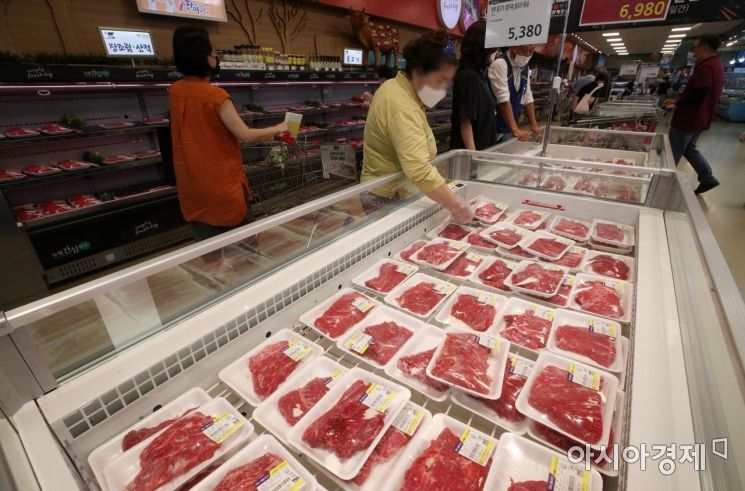 The prices of major ingredients frequently appearing on ordinary people's dining tables continue to rise, which is expected to increase the burden of preparing holiday meals for the upcoming Chuseok. Citizens shopping at the Nonghyup Hanaro Mart Yangjae branch in Seocho-gu, Seoul. Photo by Kim Hyun-min kimhyun81@
With the prolonged heatwaves, typhoons, and the spread of COVID-19, prices are soaring to unprecedented levels. Last year’s highly pathogenic avian influenza (AI) and this year’s ongoing African swine fever (ASF) have caused egg and pork prices to surge sharply. Major agricultural, fishery, and livestock products such as rice and beef are also hitting record highs due to reduced supply. Taking advantage of the disrupted supply caused by COVID-19, even imported meat prices have skyrocketed.
Prices Rise Further Ahead of Chuseok
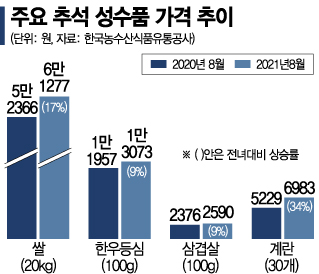
According to the Korea Agro-Fisheries & Food Trade Corporation, the average retail price of rice (20kg) this month is 61,277 won, up 17.0% from 52,366 won in August last year. The price of Korean beef sirloin (100g) also jumped 9.3%, from 11,957 won to 13,073 won during the same period, and pork belly (100g) rose from 2,376 won to 2,590 won. Egg prices (30 pieces), which have been on a high climb since the beginning of the year, surged 33.5% from 5,229 won to 6,983 won.
Fruit prices are also fluctuating ahead of the Chuseok peak season. Apples (10 pieces) are priced at 31,496 won, and pears (10 pieces) at 52,763 won, marking increases of 48% and 66% respectively compared to last year. Spinach (1kg) surged 65.8%, from 14,794 won to 24,531 won.
The main cause of the price surge is supply shortage. Jo, a merchant at Majang-dong livestock market, said, "Feed prices for cattle and pigs have risen sharply, and with the spread of African swine fever, prices for Korean beef and pork have increased by more than 10% over the past year. Since COVID-19, even imported meat supply has been unstable. For example, trimmed LA galbi, which cost 25,000 won per kilogram during last Lunar New Year, now costs up to 38,000 won. The popular tomahawk, which was 35,000 won this spring, has surged to 65,000 won recently," he explained.
Large Supermarkets Make Every Effort to Stabilize Prices
Large supermarkets are making all-out efforts to stabilize prices for Chuseok. They are diversifying contract farming and trading regions in various ways. Ahead of Chuseok, depending on the harvest time, each company stocks products in their warehouses and logistics networks, releasing them at existing prices during price surges to stabilize prices.
For eggs, to stabilize the soaring wholesale prices, the government provides support, and supermarkets sell them at prices lower than the market price through minimum margin policies. At E-Mart, 30 eggs (special grade) are currently sold at a regular price of 6,600 won and a promotional price of around 6,000 won. Compared to the same period last year, this is only a 3.8% increase. Other large supermarkets also minimize margins to supply eggs at relatively affordable prices.
A Homeplus representative said, "We are working hard to adjust prices during the holiday period through discovering alternative production areas, investing in costs, and utilizing affiliated cards." A Lotte Mart representative said, "Large supermarkets have a sense of mission as a 'price defense line' and respond with minimum margins."
Traditional Markets Awaiting National Support Funds
With social distancing at level 4 continuing, traditional markets, which have seen a sharp drop in customers, are reducing the volume of gift agricultural products compared to last Chuseok. They are hoping that the COVID-19 mutual aid national support funds will be distributed quickly to provide temporary relief.
D, the head of the fruit and vegetable section at Gwangjang Market in Seoul, said, "Normally around this time, customers who buy gifts in bulk inquire about market prices and the best fruit combinations, but this year, there are almost no inquiry calls. Even from the seller’s perspective, it’s hard to estimate how many products to prepare." Kim, a merchant selling gift hangwa (traditional Korean sweets), said, "If people could visit their hometowns or relatives’ houses, they would buy more, but since gatherings are banned, there is a growing atmosphere of neither giving nor receiving gifts. I hope the support funds come out soon so that more customers come to the market and we can feel reassured."
© The Asia Business Daily(www.asiae.co.kr). All rights reserved.
![Clutching a Stolen Dior Bag, Saying "I Hate Being Poor but Real"... The Grotesque Con of a "Human Knockoff" [Slate]](https://cwcontent.asiae.co.kr/asiaresize/183/2026021902243444107_1771435474.jpg)
















