Long-term Career Breaks and Concerns Over 'Low-Quality Jobs' Even After Return
"Need for Employment Retention and Career Break Prevention Policies... Urgent Activation of Flexible Work Systems"
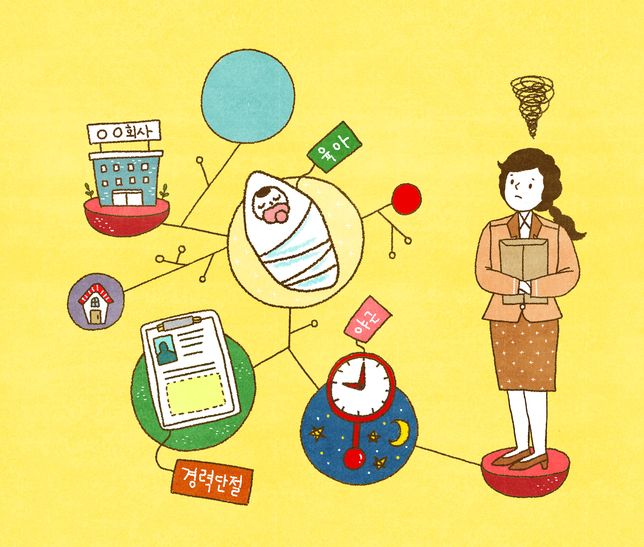
[Sejong=Asia Economy Reporter Moon Chaeseok] It has been analyzed that women aged 35-39 who have experienced career interruptions find it more difficult to return to the workplace during employment recovery periods compared to other age groups. It was also found that women have suffered more severe impacts in the labor market than men since the COVID-19 pandemic.
The Presidential Committee on Jobs published Issue Brief 'Q&A' No. 8 on the 24th containing these findings.
Women Suffer Greater Employment Impact than Men... Serious Situation for Career-Interrupted Women Aged 35-39
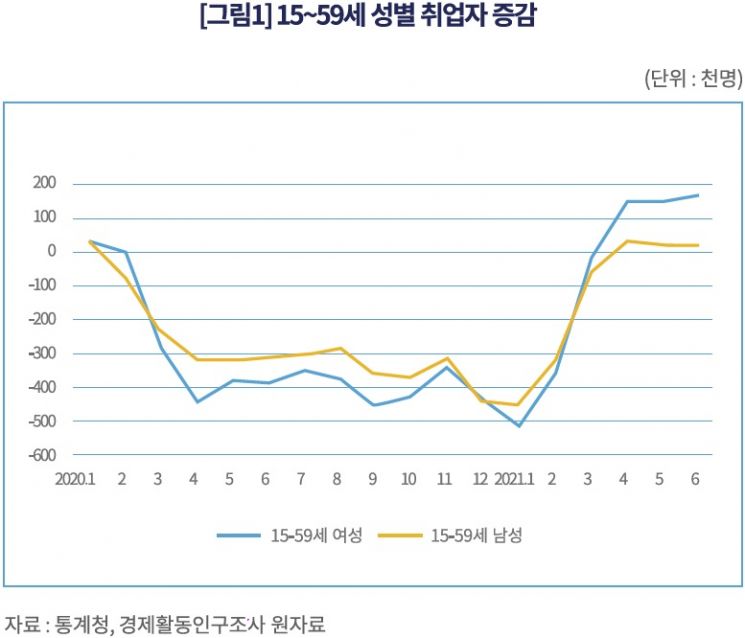
From March last year to February this year, the number of employed women decreased by 395,000, a larger decline than men (335,000). When focusing only on employed persons aged 15-59, who are less affected by government-supported job programs, the employment impact on women appeared even greater. Narrowing down to ages 15-59, who are less influenced by fiscal job programs compared to those aged 60 and above, the gap in employment decline between women and men widens further.
According to the International Labour Organization (ILO), the female employment rate is concentrated in face-to-face industries such as retail (62%), accommodation services (60%), and food and beverage services (53%). This means that since women are concentrated in sectors hit hardest by COVID-19, the impact on them was inevitably greater.
Career-Interrupted Women Aged 35-39 Face Heavy Childbirth and Childcare Burdens
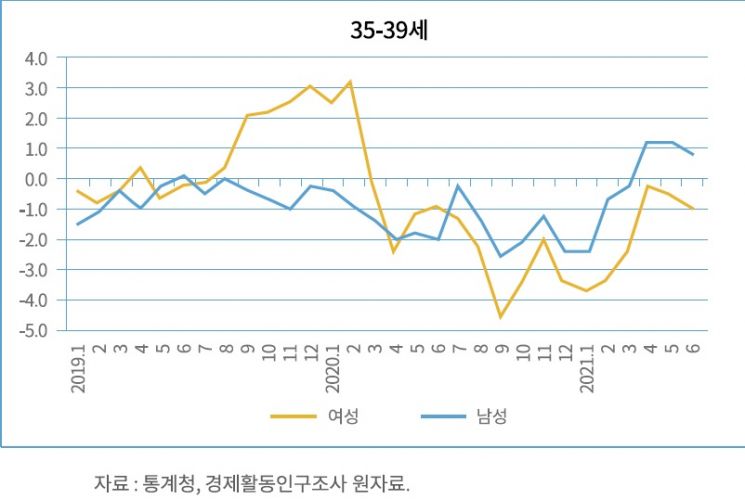
The employment indicators for career-interrupted women aged 35-39 were noticeably lower than those of other age groups. This generation already bears a heavy burden of childbirth and childcare, and the increased emergency care responsibilities due to COVID-19 have further delayed their return to work.
Looking at the employment rate decline among married women, those with elementary school children aged 35-39 dropped sharply from 61.2% in 2019 to 58.5% last year, nearly a 3 percentage point decrease. In contrast, women raising children under 6 years old saw a smaller decline from 49.1% to 47.5% (-1.6%P), and those with middle and high school children decreased from 66.1% to 65.3% (-0.8%P) during the same period.
Career Interruption Measures Should Focus on 'Employment Retention'

The Jobs Committee stated that since the female population aged 15 to under 60 is decreasing from this year, it is necessary to design future women's employment policies accordingly.
In particular, they suggested that policies to prevent career interruptions should focus on 'employment retention,' as women in their late 30s leaving the labor market risk long-term career breaks and reemployment in low-quality jobs.
Additionally, the Jobs Committee emphasized the need for ▲activation of flexible work systems for women caring for children ▲implementation of community-level public childcare services linked to emergency care for women ▲provision of customized vocational training and job placement services for low-skilled middle-aged and older women ▲support for job transitions for workers in industries heavily affected by automation, such as distribution.
Kim Yong-gi, Vice Chairman of the Jobs Committee, said, "We will work with relevant ministries to develop plans to cultivate skilled female workers that contribute to corporate competitiveness and sustainable national development, so that women's participation in the labor market can expand and gender gaps can be reduced."
© The Asia Business Daily(www.asiae.co.kr). All rights reserved.
![Clutching a Stolen Dior Bag, Saying "I Hate Being Poor but Real"... The Grotesque Con of a "Human Knockoff" [Slate]](https://cwcontent.asiae.co.kr/asiaresize/183/2026021902243444107_1771435474.jpg)

















