Business Ended but Operating Expenses Used to Maintain Union
Delayed Liquidation Payments Cause Growing Member Dissatisfaction
Revision of Provincial Ordinance to Mandate Dissolution Within One Year
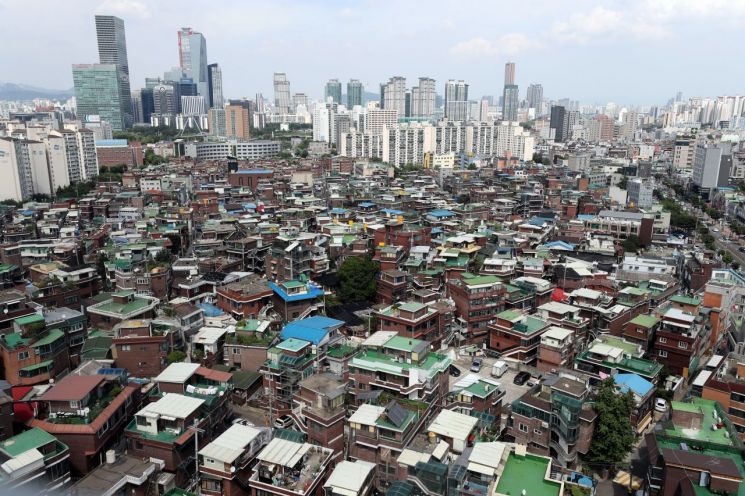 The area of row houses and multi-family housing near Yeongdeungpo Station in Seoul, a candidate site for public housing complex development [Image source=Yonhap News]
To eliminate associations that continue to incur operating expenses and maintenance costs even after the completion of reconstruction and redevelopment projects, the law will stipulate that associations which have completed the ownership transfer notification must be dissolved within one year.
According to the National Assembly on the 24th, Cheon Junho, a member of the Land, Infrastructure and Transport Committee from the Democratic Party of Korea, introduced the "Partial Amendment to the Urban and Residential Environment Improvement Act" containing this provision the day before as the main proposer.
The amendment includes a provision that redevelopment and reconstruction associations that have completed the ownership transfer notification after project completion must, in principle, be dissolved through a general meeting of the association within one year.
The current law does not properly establish legal grounds related to the dissolution of associations. As a result, many associations have remained intact without being dissolved even after the completion of redevelopment and reconstruction project procedures.
According to data submitted by Representative Cheon from the metropolitan area and local metropolitan cities, there were a total of 206 associations that remained undissolved and unsettled for more than one year after completion. Seoul had the highest number with 103, followed by Gyeonggi Province with 35, and Busan with 17.
If associations are not dissolved like this, the remaining association funds that should be returned to the members are not properly paid, which greatly increases the likelihood of conflicts with the members. Association A in Gangdong-gu, Seoul, completed its project in 2016 but has maintained the association with a remaining budget of 64.9 billion KRW until recently.
It is known that some associations have their executives intentionally delaying dissolution while using association funds for executive salaries, excessive retirement pay, and performance bonuses. If the amendment passes the National Assembly, dissolution of associations within one year after project completion will be mandatory, which could reduce such disputes.
Additionally, construction companies will be prohibited from proposing various illicit methods unrelated to construction in order to win contracts. For example, construction companies will no longer be allowed to propose to association members ways to evade the price ceiling system, pay reconstruction charges on their behalf, or reduce rental housing. This aims to enhance transparency during project implementation.
Furthermore, measures to protect owners and tenants are included, such as requiring landowners to be provided with an estimated amount of contributions in advance and prohibiting resident eviction during the winter season. The amendment reflects consultations with the Ministry of Land, Infrastructure and Transport and the Seoul Metropolitan Government. Representative Cheon emphasized, "The benefits of redevelopment and reconstruction projects should go to local residents, not a few association executives or construction companies."
© The Asia Business Daily(www.asiae.co.kr). All rights reserved.
![Clutching a Stolen Dior Bag, Saying "I Hate Being Poor but Real"... The Grotesque Con of a "Human Knockoff" [Slate]](https://cwcontent.asiae.co.kr/asiaresize/183/2026021902243444107_1771435474.jpg)















