Rising Asset Values as Investment Demand Surges in Commercial and Office Buildings
Record-High Transactions of Commercial and Office Buildings in the First Half
‘Balloon Effect’ Due to Housing Market Regulations on Loans and Taxes
[Asia Economy Reporter Ryu Tae-min] Due to the government's continuous tightening of regulations on the housing market, the income-generating real estate market, such as commercial buildings and offices, is enjoying a spillover effect. Investment yields have recovered to pre-COVID-19 levels, and real estate transactions are hitting record highs. Although rental yields decreased due to COVID-19, investment demand has concentrated mainly on offices, leading to an increase in asset values.
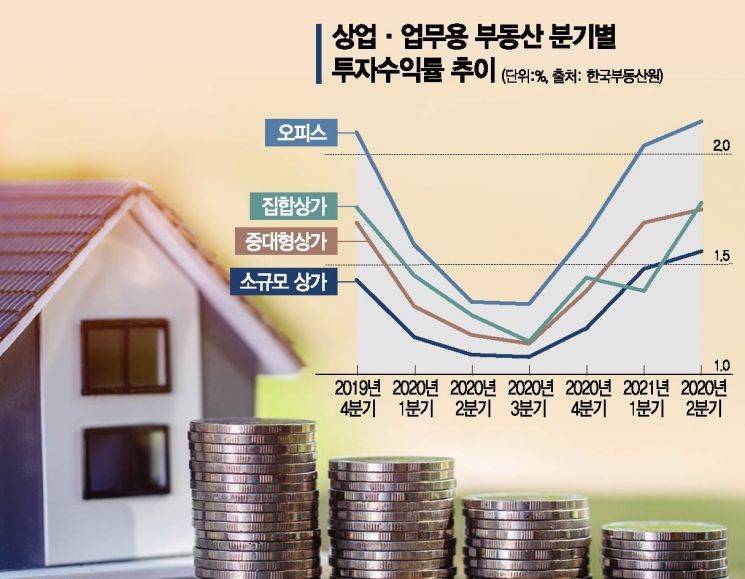
According to an analysis by real estate research firm Realtoday of the Korea Real Estate Board's '2021 Q2 Commercial Real Estate Leasing Trend Survey' released on the 24th, the investment yield on office and commercial real estate was higher than in Q4 2019, before COVID-19. Investment yield is a concept combining income yield generated from real estate operations such as rent and capital yield from changes in real estate prices.
Due to the rapid spread of COVID-19 since last year, the commercial and office real estate market contracted. Office yields soared to 2.10% in Q4 2019 but remained at a low level of 1.32% to 1.64% in Q1 to Q4 last year. However, from early this year, investment demand surged, and yields rebounded to the 2% range in Q1 and reached 2.15% in Q2, marking the highest yield since the 2008 financial crisis.
The recovery trend in collective commercial buildings is also notable. The investment yield for collective commercial buildings fell to around 1.15% in Q3 last year but recovered to 1.78% in Q2 this year. During the same period, mid-to-large commercial buildings rose from 1.14% to 1.75%, and small commercial buildings increased from 1.08% to 1.56%.
Transactions of office and commercial real estate have also increased significantly. According to a market report published by proptech company Real Estate Planet, the number of commercial and office building transactions in Seoul in the first half of this year reached 2,036. This is an increase of 602 transactions (41.9%) compared to the same period last year (1,434 transactions). Transaction amounts reached 18.4 trillion KRW in the first half of this year, nearly double the 9.9 trillion KRW recorded in the first half of last year. Since the Ministry of Land, Infrastructure and Transport began disclosing actual transaction prices in 2006, this is the highest transaction volume and amount for the first half of the year.
In particular, transactions of commercial and office real estate excluding officetels have increased significantly. According to the Korea Real Estate Board, the nationwide non-officetel transaction volume in the first half of this year was 102,048, a 30.9% increase compared to the same period last year. This is the highest since statistics began being compiled in 2017. Meanwhile, officetel transaction volume increased by only 1.25% during the same period. Hwang Han-sol, a research analyst at Economy Man Lab, explained, “The strengthened restrictions on resale rights for officetels with more than 100 units newly supplied in speculative overheated districts and regulated areas, along with the inclusion of residential officetels in the housing count, have shifted officetel demand to the non-officetel market.”
The popularity of commercial and office buildings is interpreted as a balloon effect caused by continuous housing market regulations. Seo Jin-hyung, president of the Korea Real Estate Society (professor at Gyeongin Women's University), explained, “As the loan and tax burdens on high-priced housing increase, abundant liquidity in the market seems to have flowed into the income-generating real estate market.” Kim Byung-gi, head of the research team at Realtoday, said, “The maintenance of ultra-low interest rates, housing market instability due to strong government real estate regulations, and fatigue over rapid housing price increases have also contributed to the popularity of income-generating real estate,” adding, “This upward trend is expected to continue in the second half of this year.”
© The Asia Business Daily(www.asiae.co.kr). All rights reserved.
![Clutching a Stolen Dior Bag, Saying "I Hate Being Poor but Real"... The Grotesque Con of a "Human Knockoff" [Slate]](https://cwcontent.asiae.co.kr/asiaresize/183/2026021902243444107_1771435474.jpg)
















