KIAF Survey of 35 Domestic Companies
Primarily Accumulated for Operations and Facility Investment
74% Hold Less Than 50 Billion Won
77% in Tangible Assets Like Land and Factories
Most Difficult to Liquidate
Current Corporate Retained Earnings Tax System
71% Respond 'Double Taxation'
Point to Weakening Corporate Competitiveness
Domestic companies hold an appropriate level of retained earnings for financial soundness, operations, and facility investments, but half of them report a shortage of funds amid rapidly changing domestic and international environments. Furthermore, the current retained earnings taxation system, which has the nature of double taxation, is criticized for reducing investment efficiency and weakening competitiveness, indicating the need for reform.
This is according to a survey conducted by the Korea Industrial Alliance Forum (KIAF) over a week starting from the 26th of last month, targeting 35 domestic companies. The survey included 3 large corporations, 12 mid-sized companies, and 20 small and medium-sized enterprises (SMEs), mainly reflecting the status of mid-sized and SMEs, which are the backbone of the Korean economy.
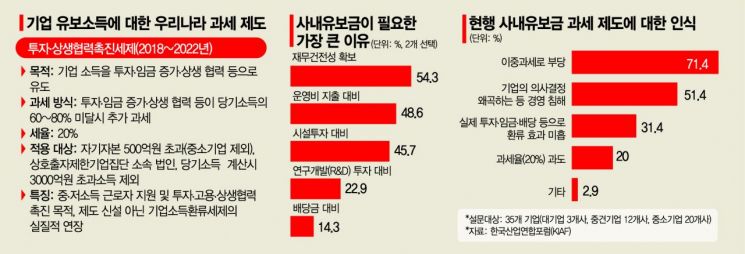
◇ "Facility investment is urgent... 45% say retained earnings are insufficient" = Contrary to the common perception that retained earnings are 'extra money,' these companies hold retained earnings primarily for operating funds and facility investment. The surveyed companies responded in order of priority: securing financial soundness (54.3%), preparing for operating expenses (48.6%), preparing for facility investment (45.7%), preparing for research and development (R&D) investment (22.9%), and preparing for dividends (14.3%).
However, the available funds are not abundant, and even those are assets that are not easily liquidated. 74.3% of the surveyed companies answered that their retained earnings holdings are less than 50 billion KRW, and among the types of retained earnings, the largest proportions (top two choices) were tangible assets such as machinery, land, and factories (77.1%) and non-cash assets such as accounts receivable, notes receivable, and inventory (65.7%).
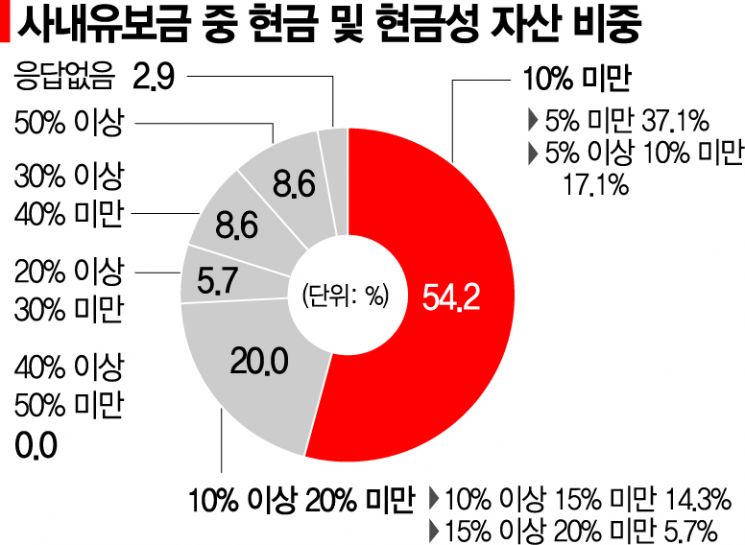
In particular, the proportion of cash assets (cash, deposits, short-term financial products, etc.) within retained earnings was very low. More than half, 54.2%, answered that the proportion of cash assets relative to retained earnings was below 10% (37.1% below 5%, 17.1% between 5% and less than 10%). Additionally, 20.0% reported 10% to less than 20%, 5.7% reported 20% to less than 30%, 8.6% reported 30% to less than 40%, and 8.6% reported 50% or more, with the vast majority of companies not exceeding 50%.
Given this situation, many companies complained about a shortage of retained earnings for facility investment. Among the companies (20) that responded they hold retained earnings for facility investment, 45% answered that their retained earnings were insufficient (35.0% insufficient, 10.0% very insufficient) when asked if their retained earnings were adequate. Regarding methods to procure the shortfall, borrowing (84.6%), paid-in capital increase (15.4%), and bonds (7.7%) were cited. Among the 13 companies planning to borrow, about 24% said the borrowing scale relative to capital was over 200%. Kim Juhong, Executive Director of the Korea Automobile Manufacturers Association (KAMA), stated, "Recently, abnormal market conditions have formed domestically and internationally due to COVID-19 and semiconductor supply shortages, intensifying competition among companies and causing a shortage of retained earnings for facility investment. It was found that companies mainly plan to borrow to cover the shortfall, indicating an urgent need to secure facility investment funds despite the increase in debt ratio caused by borrowing."
◇ Shortage of funds worsened by double taxation = Taxation on retained earnings is tightening the noose around companies. In the survey on the current retained earnings taxation system, 71.4% answered that it is "double taxation." Opinions that it "distorts corporate decision-making and infringes on management" and that the "20% tax rate is excessive" were also 51.4% and 20.0%, respectively.
Experts unanimously agree that Korea's retained earnings taxation system constitutes double taxation, requiring companies to pay taxes again after corporate tax. In the United States and Japan, taxation is imposed only when profits are retained beyond business needs to avoid dividends to shareholders or income tax, but Korea's retained earnings taxation system, the Investment and Win-Win Cooperation Promotion Tax System, is operated to encourage investment and win-win cooperation, thus constituting double taxation in principle.
There are also concerns that the current retained earnings taxation system causes involuntary investments by companies, which could weaken corporate competitiveness. Kim Taedong, a researcher at KAMA, pointed out, "If companies invest to reduce tax burdens, investment efficiency may decline, and if they invest reluctantly to avoid taxes, it could infringe on economic freedom and creativity guaranteed by the constitution."
Lee Manwoo, Chairman of the Private Pension Fund Investment Pool Operating Committee and Professor Emeritus at Korea University, argued, "The retained earnings taxation system negatively affects foreign investment. Corporate investment decisions, which should be based on future prospects, may lead to reckless timing decisions due to awareness of retained earnings taxation, increasing the risk of investment failure and potentially threatening the very existence of companies."
Calls were also made to remove the "colored glasses" through which retained earnings are viewed. Professor Kim Taedong of CHA University said, "It is unfortunate that the widespread misunderstanding that retained earnings are excessive cash hoarded by companies neglecting investment and employment persists. Based on such social misuse, incorrect policies and wasteful debates arise, and social losses accumulate."
© The Asia Business Daily(www.asiae.co.kr). All rights reserved.
![Clutching a Stolen Dior Bag, Saying "I Hate Being Poor but Real"... The Grotesque Con of a "Human Knockoff" [Slate]](https://cwcontent.asiae.co.kr/asiaresize/183/2026021902243444107_1771435474.jpg)
















