[Asia Economy Reporter Seulgina Cho] "It's easy to switch whenever a better plan comes out, and I don't have to worry about the fees." "Some people don't use MVNOs because they think they are slow, but I don't understand that. It seems to have only advantages."
The so-called ‘Godseongbi (God+Cost-effectiveness)’ MVNO market is capturing the hearts of the MZ generation (Millennials + Generation Z) and is smoothly heading toward ‘10 million subscribers.’ This is the result of significantly increasing services that perfectly match the preferences of the MZ generation, such as plans about 30% cheaper than existing ones, large data volumes, and non-face-to-face self-activation. However, as the MVNO market grows, the concentration of subsidiaries of the three major telecom companies leveraging their financial power is becoming more prominent, leading to criticism that the original purpose of promoting competition is not being fulfilled.
◆ Surpassed 9.72 million in June, with MZ Generation at the Center
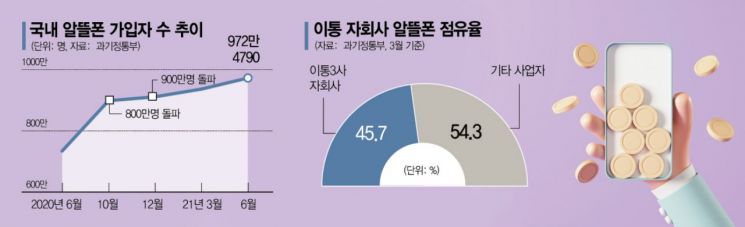
According to the wireless communication service subscriber statistics from the Ministry of Science and ICT on the 5th, the number of MVNO subscribers reached 9,724,790 as of the end of June this year. This is an increase of 144,348 from the previous month. Compared to a year ago, it increased by a whopping 2,385,626. During this period, the proportion of MVNO subscribers among all wireless communication service subscribers expanded from 10.5% to 13.6%. At this rate, surpassing 10 million subscribers within a few months is certain.
At the center of this MVNO craze is the MZ generation, who are familiar with digital technology and value practicality. Especially since the launch of the Apple iPhone 12 in the second half of last year, the combination of unlocked phones with MVNO plans has gained popularity, receiving high responses from the ‘MZ Jjantech’ group that values rational consumption. Dissatisfaction with the contract systems of major telecom companies, expensive 5G plans, and quality issues have also contributed to the preference for MVNOs.
Job seeker Gu Ji-eun (24, female), who switched to an MVNO plan right after the iPhone 12 launch, said, "The fee is half price, but there is no difference in call quality compared to major telecom companies," and added, "I am actively promoting MVNOs to my family and friends." According to market research firm Consumer Insight, the proportion of subscribers in their 20s among MVNO users last year approached 20%.
MVNO operators are also actively responding to the needs of the MZ generation. In addition to affordable 5G plans starting from as low as 4,950 KRW per month (Snowman), recently, a shocking unlimited data plan in the 10,000 KRW range with ‘no-contract lifetime discount’ (SK Seven Mobile) has appeared. Accessibility has also been improved so that SIM cards can be easily purchased at convenience stores and live commerce platforms. An MVNO industry insider said, "Not only customized plans but recently, more customers are subscribing to MVNO plans with premium devices, so the device lineup is also expanding," conveying the atmosphere.
◆ Subsidiaries of the Three Major Telecom Companies Account for 45%
As the MVNO market rapidly grows, the previously concerned reorganization centered on subsidiaries of the three major telecom companies is becoming more apparent. Recently, major marketing efforts to secure subscribers in the MVNO industry have been led by subsidiaries of the three major telecom companies such as U+ Alttel Mobile, KT M Mobile, KT Skylife, SK Telink, and large companies like KB Kookmin Bank’s Livem. Relatively small MVNO operators with less capital and brand recognition have been pushed to the sidelines. This is why Kim Hyung-jin, chairman of the Korea MVNO Association, publicly called for the withdrawal of the three major telecom companies from the MVNO business at the MVNO Square opening ceremony last October.
The concentration of subsidiaries of the three major telecom companies has also been highlighted as an issue in this year’s national audit. Recently, the Legislative Research Office pointed out in its 2021 national audit issue analysis report, "MVNO businesses that lease networks from the three major telecom companies to provide communication services were introduced to promote competition in the telecom market, but subsidiaries of the three major telecom companies occupy nearly half of the MVNO market, which deviates from the original purpose of the business."
Currently, 19 operators, including subsidiaries of the three major telecom companies, are active in the MVNO market. However, as of March, among the 6.06 million MVNO subscribers for mobile phone services, 45.7% (2.77 million) belong to subsidiaries of the three major telecom companies. On the other hand, unlike general mobile phones, the share of subsidiaries of the three major telecom companies in MVNO lines for Internet of Things (IoT) and M2M is only in the 8% range. The Legislative Research Office suggested, "Unlike IoT services, the concentration of subscribers in subsidiaries of the three major telecom companies only in mobile phone services should be analyzed, and policies to prevent the expansion of subsidiaries’ market share should be considered."
Some argue that registration conditions should be changed considering the increasing market share of subsidiaries of the three major telecom companies. Currently, the Ministry of Science and ICT limits the total number of subscribers of subsidiaries to ‘within 50% of the total MVNO subscribers.’
© The Asia Business Daily(www.asiae.co.kr). All rights reserved.
![Clutching a Stolen Dior Bag, Saying "I Hate Being Poor but Real"... The Grotesque Con of a "Human Knockoff" [Slate]](https://cwcontent.asiae.co.kr/asiaresize/183/2026021902243444107_1771435474.jpg)
















