Shipyard Painting Factory Workers Using 'Muyongje Paint' Suffer from Rash
Large Shipyards Use 'Trick' of Changing Paint to Avoid Air Purification Facility Costs
Metalworkers Union Calls for Controlling Air Pollution to Protect Workers and Re
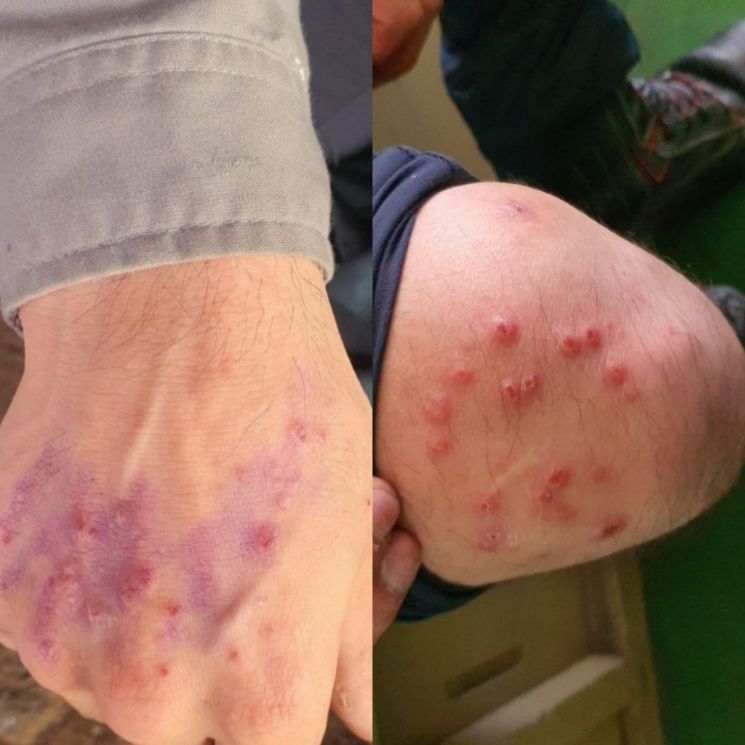 A worker at a shipyard is suffering from a skin disease after painting with Mu Yongje paint. [Image source=Metalworkers' Union]
[Asia Economy Yeongnam Reporting Headquarters, Reporter Kang Sharon] Another disaster is occurring as paint shops at shipyards are replacing the mandatory installation of ‘air pollution control facilities’ with the use of alternative paints.
Recent investigations by authorities revealed that the cause of the skin rash industrial accidents that repeatedly occurred among Hyundai Heavy Industries workers last year was ‘solvent-free paint.’
From February to April, the Ministry of Labor conducted temporary health examinations on 1,080 workers, including those at Hyundai Heavy Industries, and found that 55 workers were suffering from skin diseases.
For 177 workers, although they currently have no skin diseases, it was determined that additional observation is necessary because they experienced skin disease symptoms when handling solvent-free paint.
The labor sector estimates that the actual number of workers suffering from skin diseases is much higher than this.
According to the Metal Workers’ Union, cases of rashes caused by solvent-free paint have been confirmed not only at Hyundai Heavy Industries but also at other shipyards. The temporary health examinations were conducted only on painting workers, but workers in other roles may also be indirectly exposed to solvent-free paint.
‘Solvent-free paint,’ identified as the main culprit of skin diseases, refers to paint containing volatile organic compounds (VOCs) at 5% or less.
Although considered an eco-friendly product that reduces air and environmental pollution, solvent-based paints have been widely used due to quality issues preventing the commercialization of solvent-free paints.
Shipyard officials unanimously point to government deregulation as the reason for the recent increase in solvent-free paint use at shipyards.
In 2016, the government amended the Air Environment Conservation Act to require facilities with painting processes exceeding 50,000㎥ to install air pollution control facilities that reduce VOCs starting in 2018.
The plan was to complete the installation of these facilities by 2022.
This put urgent pressure on workplaces such as shipyards and automobile manufacturers where painting factories are essential.
Facing increased cost burdens, companies negotiated with the government and established the ‘Measures to Revitalize the Shipbuilding Industry’ in April 2019.
That year, the government agreed to recognize the reduction in VOC emissions achieved by using eco-friendly solvent-free paints, and from April last year, the enforcement regulations of the Air Environment Conservation Act reflecting this were implemented.
Following the government’s deregulation, large shipbuilders such as Hyundai Heavy Industries began actively using solvent-free paints on site starting in April last year.
Neither the manufacturers who developed these paints, the shipbuilders who used them, nor the government that encouraged their use sufficiently reviewed their harmfulness.
No one anticipated a mass rash outbreak at shipyards.
Large shipbuilders chose to use solvent-free paints, which were immediately cheaper than installing air pollution control facilities.
There was another reason for the rush to use solvent-free paints without sufficient safety review.
According to Article 51-3, Paragraph 2 of the Enforcement Regulations of the Air Environment Conservation Act, more than 80% of air pollution control facilities that reduce VOCs must be mandatorily installed by 2021.
However, the installation rate at large shipbuilders such as Hyundai Heavy Industries remains at only 30-40%.
They reported using solvent-free paints but are known to be emitting harmful substances without any reduction facilities in 7 out of 10 painting factories.
The amount of solvent-free paint used by these shipbuilders was about 2-5% as of 2020.
Whether workers inside the factory or nearby residents, without installing air pollution control facilities that improve air quality at each factory, legal ‘pass-through’ is possible by simply matching the number of paints used or through deception.
A Mr. A, who has worked in painting at a large shipyard for 20 years, criticized this as favoritism toward large corporations.
Mr. A said, “Neither shipowners nor workers actually want solvent-free paints, and this is nothing but a loophole for large corporations to illegally discharge pollutants without installing air pollution control facilities.”
The argument that installing air pollution control facilities requires a large upfront cost and that solvent-free paints, which neither on-site workers nor shipowners want, are being used as an excuse to dismantle the strict standards originally set by the government is gaining credibility.
Instead, the ‘industrial accidents’ caused by solvent-free paint are being entirely passed on to the on-site workers.
The World Health Organization (WHO) classifies VOCs as major pollutants causing fine dust, and carcinogens that cause lung cancer, respiratory diseases, and nervous system disorders along with odors.
A resident B living near a shipyard in Geoje said, “Not only have they illegally discharged pollutants for over ten years, but large corporations are threatening residents’ health and trying to save investment costs by illegally releasing harmful chemicals. It’s not only a legal violation but also a lack of trust in corporate ethics, which is regrettable.”
An official from the Ministry of Environment only stated, “We will thoroughly manage worker safety measures and raise the use of solvent-free paints to 60% by 2024.”
© The Asia Business Daily(www.asiae.co.kr). All rights reserved.
![Clutching a Stolen Dior Bag, Saying "I Hate Being Poor but Real"... The Grotesque Con of a "Human Knockoff" [Slate]](https://cwcontent.asiae.co.kr/asiaresize/183/2026021902243444107_1771435474.jpg)















