Government, Research Institutes, and 36 Organizations and Companies Sign Business Agreement
[Asia Economy Honam Reporting Headquarters Reporter Seunghyun Jeong] The city of Mokpo in Jeollanam-do has received a green light for its ambitious push to capture the global market in the eco-friendly shipbuilding industry.
Currently, the global market size of the eco-friendly shipbuilding industry reaches 270 trillion won. Just as Ulsan is the hub of the domestic automobile industry, Mokpo has been strategically advancing projects to secure an industrial advantage across the board.
On the 3rd, the city explained that the eco-friendly shipbuilding business is being promoted in connection with government-driven policy projects, which is very encouraging for our city that is striving hard to discover future local growth engines.
▲ Eco-friendly Shipbuilding Industry in the ‘Climate Crisis Era,’ a Global Market Worth 270 Trillion Won
As the climate crisis worsens, eco-friendliness has become essential in industries. The transportation manufacturing sector is no exception. Just as electric vehicles are gaining attention in the automobile industry, next-generation propulsion systems such as low-carbon and zero-carbon, electric and hybrid ships are drawing focus in the shipbuilding sector.
Since the climate crisis is a global issue, the eco-friendly shipbuilding industry has a worldwide market with high demand. It is a promising industry estimated to be worth 270 trillion won globally. The government has also been dedicating special efforts to foster the eco-friendly shipbuilding industry, implementing the ‘Act on the Development and Promotion of Environmentally Friendly Ships’ last year and selecting the ‘Eco-friendly Ship New Market Creation Project’ as part of the Korean New Deal.
▲ Selected as the Optimal Location for Fostering the Eco-friendly Shipbuilding Industry... Expected to Create 49,000 Jobs Annually
Mokpo has seized the opportunity presented by domestic and international responses and market potential, using Namhang Port as a foothold to foster the eco-friendly shipbuilding industry.
At the core is the fact that Mokpo is an ideal location for the emergence of the eco-friendly shipbuilding industry. The southwestern sea region centered on Mokpo has about 1,100 small and medium-sized vessels in operation, accounting for over 60% of domestic coastal passenger ship operations. This makes it the most suitable environment for developing and testing electric-powered ships.
The government has highly evaluated these characteristics and designated Mokpo as a hub for creating an eco-friendly shipbuilding ecosystem.
If the project proceeds as planned, Mokpo will rise as a global eco-friendly shipbuilding city, with an expected annual employment creation effect of about 49,000 people. This is why the eco-friendly shipbuilding industry is attracting attention as a future growth engine industry that will bring a paradigm shift to Mokpo’s industry.
▲ Eco-friendly Ship Research and Development and Specialized Workforce Training in Mokpo
The key to eco-friendly ships is developing and commercializing energy sources that do not pollute the environment. Two projects currently underway in Mokpo are aimed at this and have kicked off in the research and development (R&D) phase, the initial stage of creating an industrial ecosystem.
One is the ‘Electric Propulsion Car Ferry and Mobile Power Supply System Development Project,’ selected in a government competition last year. About 45 billion won will be invested by 2024 in collaboration with the Korea Research Institute of Ships and Ocean Engineering (KRISO). A car ferry is a type of passenger ship that can transport both passengers and vehicles or cargo simultaneously, with about 160 currently operating in Korea.
The electric propulsion car ferry uses 100% electricity, so unlike conventional diesel engines, it does not emit pollutants such as fine dust and exhaust fumes, and it produces less noise and vibration. Notably, this project is the world’s first to produce a mobile and replaceable power supply system (battery) in the form of a vehicle, which means high-voltage facilities do not need to be installed at ports.
By the end of this year, Korea’s first electric ship is scheduled to be built and launched in Mokpo. The government plans to prioritize supplying electric car ferries operating along the coast and then expand to fishing vessels and others, indicating significant growth potential in this field.
The other project, selected in a government competition in April this year, is the ‘Eco-friendly Ship Mixed Fuel Technology Development and Demonstration Project,’ with a total investment of 41.5 billion won by 2025. The core is to develop an eco-friendly fuel system that mixes hydrogen or ammonia, zero-carbon fuels, with existing LNG to reduce carbon dioxide emissions, and to verify the technology at both land-based and maritime test sites.
To facilitate smooth R&D, the Eco-friendly Fuel Propulsion Research Center under KRISO, a government-funded specialized research institute, is scheduled to be established at Namhang Port. Following Daejeon (headquarters), Busan (Deep Sea Engineering Research Center), Goseong (Marine Energy Research Center), and Geoje (Marine Plant Industry Support Center), Mokpo will become a new base leading the development of Korea’s marine industry.
To train specialized personnel to meet industry demand, efforts are underway to attract a campus of the University of Science and Technology (UST). UST is Korea’s only national research institute graduate school jointly established by 32 government-funded research institutes. It aims to open the Mokpo campus in 2023 and plans to introduce a ‘Green Mobility’ major specialized for Mokpo, with student recruitment starting in 2022.
▲ Creating a Specialized Complex with Government, Universities, Research Institutes, and Companies
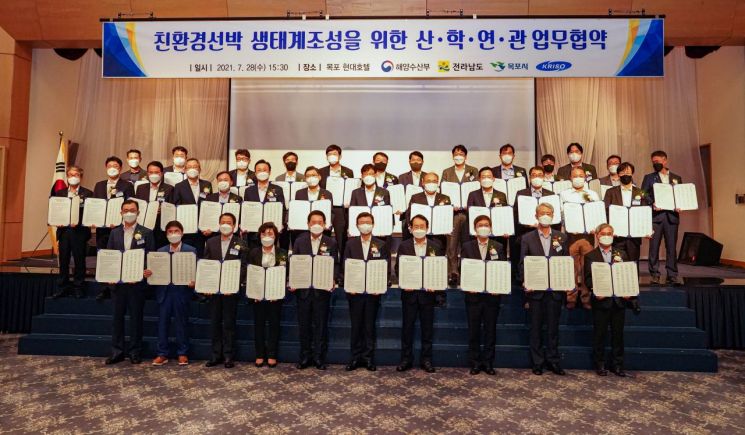
For the eco-friendly shipbuilding industry, which is at the initial stage of growth, to expand, an ecosystem to support it is necessary. To this end, on July 28, a ‘Industry-Academia-Research-Government Cooperation Agreement for Creating an Eco-friendly Shipbuilding Ecosystem’ was signed.
The agreement includes participation from the government, Jeollanam-do, universities such as Mokpo National University and Mokpo Maritime University, three research institutes including KRISO, two public institutions such as the Korean Register, and 26 shipbuilding, equipment, and shipping companies. As a result, a cooperative system covering everything from R&D to demonstration and commercialization has been established, accelerating the creation of Namhang Port as a specialized eco-friendly shipbuilding complex.
▲ Eco-friendly Ship Technology Development, from Start to Finish in Mokpo
The remaining puzzle to enhance the completeness of government policy is the ‘Eco-friendly Ship Full-cycle Innovation Technology Development Project’ (hereinafter Full-cycle Project), which covers all processes of eco-friendly ship technology development.
Co-led by the Ministry of Trade, Industry and Energy and the Ministry of Oceans and Fisheries, the Full-cycle Project is a 254 billion won investment project running from 2022 to 2031, which passed the preliminary feasibility study in June.
The government plans to establish detailed implementation plans by the end of this year. If these projects proceed smoothly, Mokpo will firmly establish itself as the mecca of eco-friendly shipbuilding.
© The Asia Business Daily(www.asiae.co.kr). All rights reserved.
![Clutching a Stolen Dior Bag, Saying "I Hate Being Poor but Real"... The Grotesque Con of a "Human Knockoff" [Slate]](https://cwcontent.asiae.co.kr/asiaresize/183/2026021902243444107_1771435474.jpg)
















