Spinach, Lettuce, etc... Vegetable Prices Soar Due to Heatwave
Citizens Complain, "Everything Except Salary Is Rising"
Experts Urge Government to Ensure Smooth Food Supply Measures
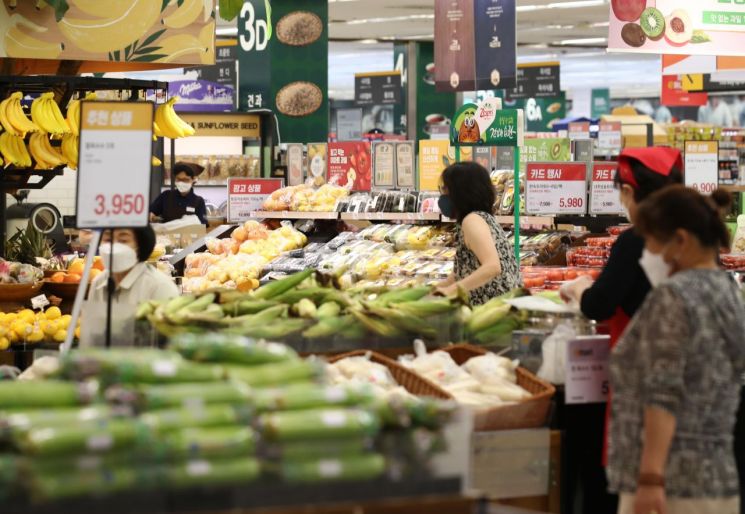 Citizens are shopping at the fresh food section of a large supermarket in Seoul. The photo is unrelated to specific expressions in the article. [Image source=Yonhap News]
[Asia Economy Reporter Heo Midam] # Park Mo (45), a housewife living in Yangcheon-gu, Seoul, recently sighed at the soaring vegetable prices while grocery shopping. Park said, "Nothing hasn't gone up. Not only vegetables but fruits have generally increased a lot," adding, "Sometimes, I barely buy groceries, but the bill easily exceeds 50,000 won." She continued, "Because of COVID-19, we can't dine out as a family, and since the kids are taking online classes, we often have to prepare three meals a day at home," adding, "The rising prices make grocery shopping quite intimidating."
Recently, due to the effects of the heatwave and other factors, food ingredient prices have been rising daily, deepening consumers' worries. Following price increases earlier this year in processed foods such as instant rice, tofu, and canned goods, price hikes for representative staple foods like ramen have begun in earnest, which is expected to further burden consumers.
In particular, with the increase in demand for home-cooked meals due to elevated social distancing levels and the approach of Chuseok, experts predict that price stabilization will not be easily achieved. Among consumers, complaints such as "Salaries remain the same, but prices are rising alarmingly" are emerging. Experts suggest that the government needs to devise measures to ensure a smooth supply of food ingredients.
Recently, as the heatwave continues day after day, prices of leafy vegetables vulnerable to heat are rising sharply. According to the Korea Agro-Fisheries & Food Trade Corporation (aT), the nationwide average price of spinach was 18,277 won per kilogram (as of the 29th of last month), which is 99.9% higher than the average of the past five years.
Lettuce (green leaf lettuce) also typically sees a price increase in summer due to reduced production, but this year it was 1,579 won per 100g, 40.4% higher than the average. Perilla leaves were also priced at 1,814 won per 100g, 9.4% higher than the average.
The sharp rise in table prices is largely due to the persistent heatwave. Broiler chicken prices have also surged significantly due to the heatwave. According to the Ministry of Agriculture, Food and Rural Affairs, from the 1st to the 29th of last month, 189,851 broiler chickens died from the heatwave, accounting for 65.1% of all livestock deaths.
As a result, the price of broiler chicken reached 5,991 won per kilogram as of the 30th of last month, the highest in about two years and six months since January 28, 2019 (5,992 won).
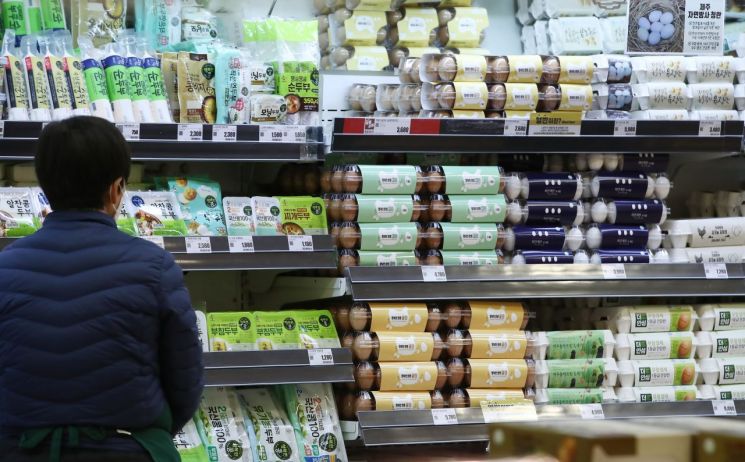 A citizen is shopping at the egg sales counter in a large supermarket in Seoul. The photo is unrelated to specific expressions in the article. [Image source=Yonhap News]
Given this situation, citizens are voicing complaints about the skyrocketing prices. Kim Mo (30), an office worker living alone in Seoul, said, "At the beginning of this year, the price of green onions rose so much that people started 'Pa-tech' (green onion investment). But instead of prices going down, they have risen further, which is surprising," adding, "Chuseok is just a month away, and if prices rise further, they won't go down. Life is getting tougher for ordinary people." He sighed deeply.
Another office worker, Jeon Mo (25), said, "Both housing prices and prices in general have gone up, but salaries remain the same, which is sad," adding, "Actually, isn't the price level more important than the minimum wage? After fixed expenses like rent and phone bills, there's nothing left, and with prices rising, I don't know how we're supposed to live." He expressed frustration and added, "Now they say ramen prices will increase too. The government needs to actively step in to stabilize prices."
Earlier, Ottogi announced it would raise ramen prices for the first time in 13 years, and Nongshim also decided to adjust the price of Shin Ramyun for the first time in 4 years and 8 months. The price increases for major products are 7.6% for Shin Ramyun, 6.1% for Ansungtangmyun, and 4.4% for Yukgaejang Sabalmyeon, based on wholesale prices. Accordingly, the price of Shin Ramyun, currently sold at an average of 676 won per pack in large supermarkets, is expected to be adjusted to about 736 won.
As consumers face difficulties due to rising prices, the government has taken steps to prepare countermeasures. The Ministry of Agriculture, Food and Rural Affairs announced that it will proactively secure government stockpiles and contract cultivation volumes to prepare for supply instability during the summer. Government stockpiles of cabbage and radish will be increased more than threefold compared to last year, and contract shipment volumes of apples and pears before Chuseok will be expanded by 1.3 to 2 times.
Experts suggest that active government measures are necessary from a supply management perspective. Professor Eunhee Lee of the Department of Consumer Studies at Inha University pointed out, "Prices of food ingredients, including eggs, have risen significantly, and there is no sign of them falling currently. Since vegetable prices may rise further ahead of Chuseok, the government needs to manage prices."
She continued, "The government must closely examine both demand and supply aspects," emphasizing, "For food ingredients with supply shortages, the government should facilitate smooth supply through imports and other means. Only then will prices stabilize."
© The Asia Business Daily(www.asiae.co.kr). All rights reserved.
![Clutching a Stolen Dior Bag, Saying "I Hate Being Poor but Real"... The Grotesque Con of a "Human Knockoff" [Slate]](https://cwcontent.asiae.co.kr/asiaresize/183/2026021902243444107_1771435474.jpg)
















