Public Release of KEPCO E&C External Service Report
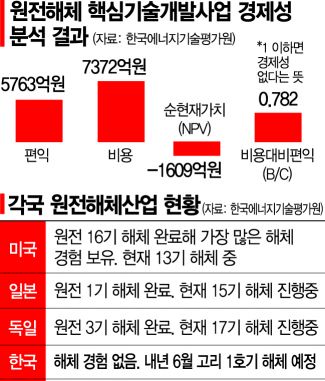
Nuclear Power Plant Decommissioning Technology Development from 2022 to 2029, Total Project Cost 737.2 Billion KRW vs. Benefit 576.3 Billion KRW Resulting in 'Loss'
"Government Overly Optimistic About Decommissioning Market... Prior Resolution Needed for Spent Nuclear Fuel Management Issues"
[Sejong=Asia Economy Reporter Kwon Haeyoung] A government-funded research institute has released a report stating that the nuclear power plant dismantling industry under the Moon Jae-in administration lacks economic feasibility. The nuclear power plant dismantling industry was actively promoted by the current government as an alternative to the nuclear phase-out policy, but even government-affiliated research institutes have judged that the practical benefits of the dismantling industry are currently low. There is criticism that the government may have been overly optimistic about the dismantling market to appease the nuclear industry, which is concerned about ecosystem collapse caused by the "over-speed nuclear phase-out." In particular, there are also calls to urgently resolve the issue of spent nuclear fuel reprocessing before developing nuclear dismantling technology.
According to the "Final Report on the Support Service for Responding to the Preliminary Feasibility Study of the Nuclear Power Plant Dismantling Technology Development Project," released on the 29th by the Korea Energy Technology Evaluation Institute under the Ministry of Trade, Industry and Energy, if a total project cost of 737.2 billion KRW is invested over eight years from next year to 2029 for the development of core nuclear power plant dismantling technologies, the expected benefits are estimated at 576.3 billion KRW (based on present value considering currency value appreciation rates). This means that even with concentrated investment in core technology development, the revenue generated falls short of the costs. The cost-benefit ratio (B/C) is 0.782, below the economic feasibility threshold of 1.
Earlier, the Ministry of Trade, Industry and Energy and the Ministry of Science and ICT applied for a preliminary feasibility study on the core technology development project for nuclear power plant dismantling but failed the review by the Korea Institute of Science and Technology Planning and Evaluation earlier this year. This report was prepared by the Korea Energy Technology Evaluation Institute through an external service to prepare for that feasibility study review.
The nuclear power plant dismantling industry is a new industry ambitiously introduced by the government pursuing nuclear phase-out. Following the permanent shutdown of Kori Unit 1 in June 2017, the plan was to foster the dismantling industry and use it as a foundation for entering overseas markets. To this end, in 2019, the Ministry of Trade, Industry and Energy and related ministries set a goal to achieve a 10% global market share in the domestic nuclear dismantling industry by 2035.
However, since even government-funded research institutes have judged the economic feasibility of nuclear dismantling technology development to be low, there are criticisms that the government may have painted an overly rosy picture of the dismantling market to quell industry opposition amid the rapid nuclear phase-out. The Korea Energy Technology Evaluation Institute report cited external forecasts, projecting the nuclear dismantling market size to be 117 trillion KRW domestically and 549 trillion KRW overseas in the mid to long term. However, the economic effect of developing nuclear dismantling technology is estimated at only 576.3 billion KRW over the next eight years, resulting in a loss of 160.9 billion KRW from this project.
There is also cautious analysis that the negative evaluation of the nuclear dismantling industry is related to the extension of nuclear power plant lifespans. As the role of nuclear power plants in carbon neutrality is highlighted due to zero CO2 emissions, the United States is pushing to extend nuclear plant lifespans to 80 years, and Japan to 60 years. Accordingly, the timing for the global nuclear dismantling market to expand significantly is expected to be delayed compared to initial expectations.
A nuclear expert said, "Research and development of nuclear dismantling technology is essential following the permanent shutdown of Kori Unit 1 and the early closure of Wolseong Unit 1," but added, "Unlike nuclear power countries such as the United States, we have no dismantling experience and low technological capability, and this economic feasibility analysis reveals that the government was overly optimistic about the dismantling market during the rapid nuclear phase-out." The United States has currently completed dismantling 16 reactors, and Germany has completed dismantling 3 reactors.
Some criticize the government for neglecting the issue of spent nuclear fuel treatment while promoting the nuclear dismantling industry. Professor Jeong Dongwook of the Department of Energy Systems Engineering at Chung-Ang University said, "In the case of Kori Unit 1, which will begin dismantling procedures from June next year, spent nuclear fuel stored inside must be processed during dismantling, but there is currently no concrete plan," adding, "While the development of nuclear dismantling technology is essential, a plan for spent nuclear fuel treatment must be urgently prepared first."
© The Asia Business Daily(www.asiae.co.kr). All rights reserved.
![Clutching a Stolen Dior Bag, Saying "I Hate Being Poor but Real"... The Grotesque Con of a "Human Knockoff" [Slate]](https://cwcontent.asiae.co.kr/asiaresize/183/2026021902243444107_1771435474.jpg)















