Gwangju City Begins Construction of Urban Regeneration New Deal Project 'Bitgoeul Startup Station'
35 Billion Won Invested... Supporting Space for Early Startups and Small Venture Companies
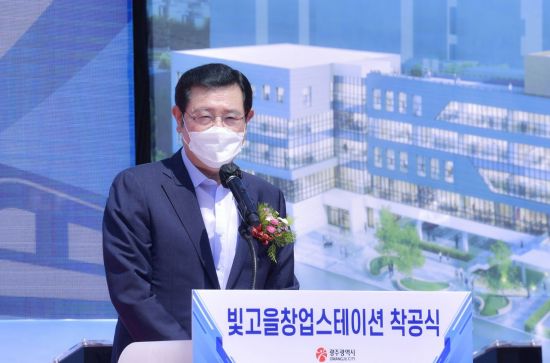
[Asia Economy Honam Reporting Headquarters Reporter Yoon Jamin] The once stagnant area around Gwangju Station is transforming into the largest startup complex in the Honam region.
By 2025, with an investment of 1.2 trillion KRW, three major mega-projects will be promoted: ▲ Gwangju Station Economic Base-type Urban Regeneration New Deal Project ▲ Urban Regeneration Innovation District ▲ Private Complex Development Project, turning the area into the ‘Gwangju-style Silicon Valley’ as the largest startup complex in the Honam region.
Gwangju Metropolitan City announced on the 28th that the groundbreaking ceremony for the ‘Bitgoeul Startup Station,’ a core project of the Gwangju-style Economic Base-type Urban Regeneration New Deal Project, was held on-site at the Gwangju Station parking lot project site.
The groundbreaking ceremony was attended by Mayor Lee Yong-seop, National Assembly member Jo Oh-seop, related organizations, and local residents, and proceeded with a promotional video screening, project progress report, and a blasting ceremony in sequence.
The ‘Bitgoeul Startup Station’ is one of the core projects of the ‘Gwangju Station Economic Base-type Urban Regeneration New Deal Project’ that Gwangju City is promoting to create a creative cultural industry startup valley around Gwangju Station.
The ‘Gwangju Station Economic Base-type Urban Regeneration New Deal Project’ is being implemented to revitalize the area around Gwangju Station, which has seen a sharp decline in users and floating population and a downturn in local commercial districts after the unification of KTX at Songjeong Station. It includes building facilities to support startups and business growth, housing support for entrepreneurs, green space and environmental improvements, and establishing regional hub facilities such as residential, commercial, distribution, and office spaces.
The Bitgoeul Startup Station, whose construction began on this day, will be built with a total project cost of 35 billion KRW on a 5,500㎡ site within the Gwangju Station baggage parking lot, with a total floor area of 8,950㎡ and a five-story single building. It will provide space for early-stage startups and small and medium-sized venture companies in their 1st to 3rd years, including move-in and incubation spaces, a multipurpose hall, coworking spaces, educational spaces, and complex cultural spaces.
Additionally, it will support startup companies closely with offices for startup support innovation institutions, programs to discover and nurture promising companies, and cultural facilities.
Earlier, Gwangju City started the ‘Pedestrian Environment Improvement Project’ last month as one of the five pilot projects of the ‘Gwangju Station Economic Base-type Urban Regeneration New Deal Project’ to ensure pedestrian safety and convenience around Gwangju Station. Next month, the city will complete and operate the Eoullim Factory facility to enhance the competitiveness of local small business owners and support urban-type manufacturing industries.
Along with this, the Urban Regeneration Innovation District project will establish the largest startup complex in the Honam region by 2025 by sequentially building ▲ a Complex Hub Center supporting R&D advancement for startups in their 3rd to 7th years ▲ a Corporate Innovation Growth Center providing space for senior startups in their 5th to 10th years to support scaling and globalization of venture companies ▲ and a Social-Cultural Innovation Center, a platform for social economy enterprises and cultural complex space, eventually expanding into a TIPS (Tech Incubator Program for Startup) Town.
In particular, Gwangju City plans to provide intensive support at the Gwangju Creative Economy Innovation Center during the early startup phase, nurture and grow startups at Gwangju Technopark during the incubation and growth stages, and promote technology support and workforce training centered on major universities such as Chonnam National University to maximize synergy.
Furthermore, a joint complex development project with Korail will be promoted in the space secured by relocating and rearranging railway facilities within Gwangju Station.
The complex development project aims to develop the 200,000㎡ Gwangju Station site into a station area combining transportation, commerce, industry, and residential functions by investing about 700 billion KRW of private capital by 2025.
Along with these three mega-projects, Gwangju City plans to restore Gwangju Station as a transportation hub by significantly improving accessibility and convenience through connections with Urban Railway Line 2, the recently included Dalbit Inland Railway in the 4th National Railway Network Plan, and the electrification project of the Gyeongjeon Line (Gwangju Station to Suncheon).
Through this, the area around Gwangju Station will be reborn as the largest startup town in the Honam region with infrastructure supporting the growth stages of startups and innovative companies.
Mayor Lee Yong-seop said, “The area around Gwangju Station, which has been on a decline since the 2000s, will, by around 2025, break free from stagnation and regain its reputation as an innovation hub attracting people and companies. The development of the Gwangju Station area will generate a production inducement effect of 2 trillion KRW and create 16,000 new jobs. With Urban Railway Line 2, Dalbit Inland Railway, and the Gyeongjeon Line electrification project, Gwangju Station will become the representative gateway of ‘Visiting Gwangju.’ I ask for the citizens’ support for this,” he said.
© The Asia Business Daily(www.asiae.co.kr). All rights reserved.
![Clutching a Stolen Dior Bag, Saying "I Hate Being Poor but Real"... The Grotesque Con of a "Human Knockoff" [Slate]](https://cwcontent.asiae.co.kr/asiaresize/183/2026021902243444107_1771435474.jpg)















