Heavy Rain Ends on the 19th After a Short, Intense 17 Days; Elevated Heatwave Until the 25th with Localized Heavy Rain
Different from the Over-a-Month Heatwave in 2018
Typhoon Passing Draws in Heat, Intensifying the Heatwave
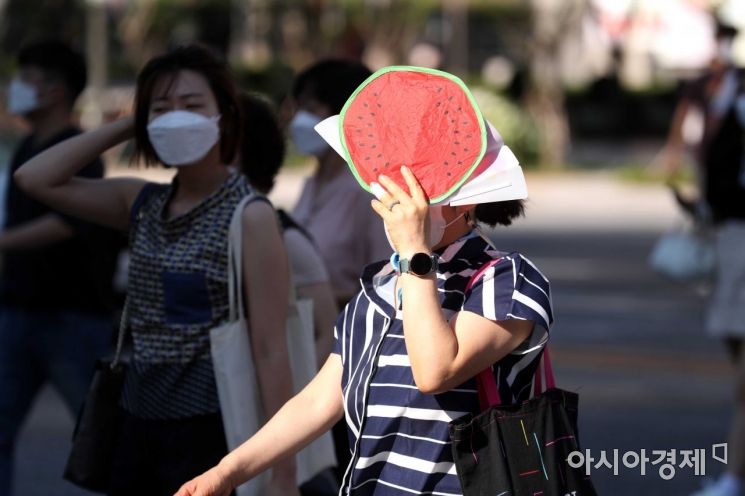 On the 21st, the peak of Jungbok (중복) in the solar terms and scorching heat, a commuter in Gwanghwamun Intersection, Jongno-gu, Seoul, is shielding themselves from the strong sunlight with a watermelon fan. Photo by Moon Honam munonam@
[Asia Economy Reporter Han Jinju] This year's monsoon season was the third shortest on record, with significant rainfall disparities between regions. From today until the 25th, a heatwave with temperatures reaching up to 38 degrees Celsius will continue.
According to the Korea Meteorological Administration on the 21st, under the influence of the North Pacific High, the daytime high temperature will rise to 36 degrees Celsius in Seoul, Suwon, and other areas. The daytime high temperature is expected to reach 36 degrees Celsius until the day after tomorrow, with some inland western areas experiencing temperatures above 38 degrees Celsius. The KMA issued a heatwave warning for the entire metropolitan area starting at 10 a.m. today. Especially, tropical nights will appear mainly in Seoul and Incheon, where temperatures remain above 35 degrees Celsius until 5 p.m. and stay above 25 degrees Celsius at night.
The third shortest monsoon on record... Rain concentrated in the southern regions
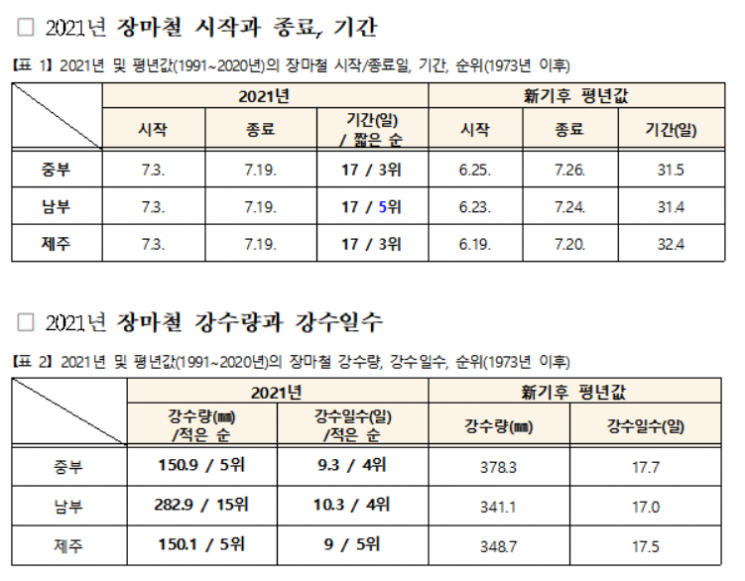
The monsoon, which started simultaneously nationwide on the 3rd, ended on the 19th, marking the third shortest monsoon period on record. The total monsoon duration was 17 days, ranking third shortest for the central region and Jeju, and fifth shortest for the southern regions. Considering that the average monsoon period is 31.4 to 32.4 days based on the normal year, the monsoon duration has been reduced by half.
Rainfall showed about a twofold difference between the southern and central/Jeju regions. The southern region recorded 282.9mm of rainfall, while the central region (150.9mm) and Jeju (150.1mm) had about half that amount, marking the fifth lowest rainfall on record. Compared to the average rainfall (341.1 to 378.8mm), this year's monsoon rainfall was less than half. The number of rainy days was recorded as 9 to 10.3 days, ranking fourth lowest (fifth for Jeju) on record.
Early arrival of 'heatwave' after a short monsoon... Different from 2018
The KMA forecasted that the heatwave will continue in earnest under the influence of the North Pacific High until the 25th. The North Pacific High moves northeastward, and the Tibetan High expands from the west, intensifying the heat. However, even with the ongoing heatwave, localized heavy rain is expected as tropical depressions or typhoons pass near the Korean Peninsula.
Forecast analyst Woo Jin-gyu explained, "From the 21st to the 25th, temperatures will rise significantly, and as the Tibetan High shifts westward and the North Pacific High moves eastward, low-pressure disturbances will appear in the gaps, causing strong localized heavy rain." He added, "However, from late July, the overlapping area of the two highs will disappear, leading to diversified atmospheric pressure patterns."
However, this summer's heat is expected to differ from the extreme heatwave of 2018. In 2018, the two highs were aligned side by side, causing a heatwave lasting over a month, whereas from late July this year, the two highs will be separated east and west, likely shortening the duration of the heatwave.
Analyst Woo added, "Even if a vertical high-pressure pattern forms, whether it results in an extreme heatwave depends on its persistence. Temperatures may rise and fall like a typical summer. This year, since the two highs will be separated east and west from late July, the continuous accumulation of heat seen in 2018 is unlikely."
Getting hotter as typhoons pass by
Typhoon No. 6 'In-fa,' which formed southeast of Okinawa, Japan on the 18th, is unlikely to move northward due to the high pressure over Korea and is expected to turn westward, making landfall in southern China. The KMA explained that the possibility of it changing course toward Korea is low.
Even if the typhoon does not move northward, the heat accumulated in Korea due to the passing typhoon may intensify the heatwave.
Analyst Woo explained, "As Typhoon No. 6 passes near Korea, it can sweep heat into the country, significantly impacting the heatwave. When a typhoon moves westward, the heatwave tends to become stronger."
© The Asia Business Daily(www.asiae.co.kr). All rights reserved.
![Clutching a Stolen Dior Bag, Saying "I Hate Being Poor but Real"... The Grotesque Con of a "Human Knockoff" [Slate]](https://cwcontent.asiae.co.kr/asiaresize/183/2026021902243444107_1771435474.jpg)
















