No-Show Candidates Not Attending Interviews and Increasing Locust Workers Demanding Dismissal After One Year
Job-Seeker Benefits Expenditure Hits Record 6.5 Trillion Won in First Half
Short-Term Employment Aimed at Unemployment Benefits Deepens Struggles for Small Businesses
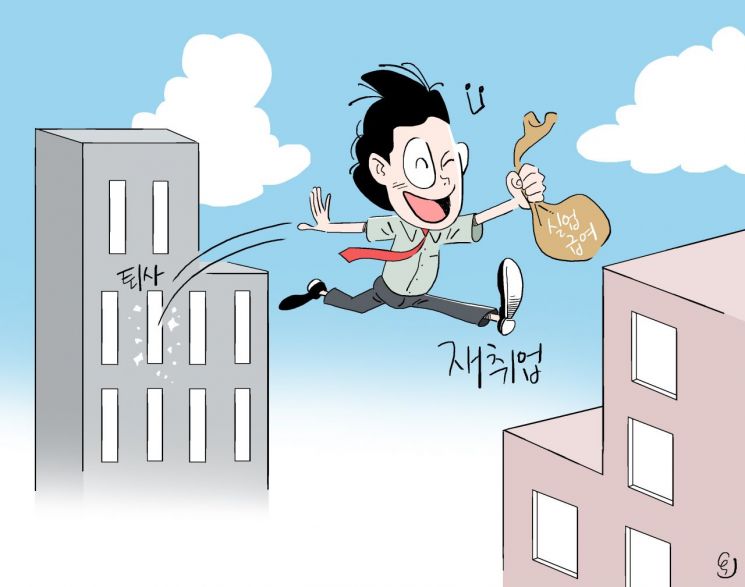 As COVID-19 prolongs, the number of 'No-showjok' who submit resumes but skip interviews to prove job-seeking activity, and 'Grasshopperjok' who change companies annually to receive unemployment benefits, is rapidly increasing, deepening the manpower shortage in small and medium-sized enterprises. Illustration by Seongsu Oh
[Asia Economy Reporter Kim Heeyoon] Recently, automotive parts company A in Ansan, Gyeonggi Province posted a job opening and notified 10 applicants of their interview schedules, but only 2 showed up on the day. The HR manager at Company A said, “No-shows for interviews are actually the lesser evil. There are frequent cases where candidates pass the interview and agree to start work but then disappear on the first day,” adding, “We are hiring for the forging press position, but 3 of the applicants are over 60 years old, 4 are women, and when we called to inform them about the interview, they asked what kind of work it was, which was really discouraging. Isn’t this kind of interview no-show a form of business obstruction?”
Manufacturing company B in Asan, Chungnam Province recently faced a sudden labor shortage after employees hired last year quit all at once. The CEO of Company B said, “New employees tend to stay just long enough to receive 4 months of unemployment benefits after working for a year and then leave. When they start to work properly, they quit. On top of that, foreign workers cannot enter the country, so these days I even help out on the manufacturing line myself.”
The prolonged COVID-19 pandemic has worsened the chronic labor shortage problem faced by small and medium-sized enterprises (SMEs). According to industry sources on the 13th, with the application of the 52-hour workweek system and restrictions on foreign workers’ entry, labor supply has become difficult. Meanwhile, the number of ‘no-show’ applicants who submit resumes just to prove job-seeking activity but skip interviews, and ‘grasshopper’ workers who switch companies yearly to receive unemployment benefits, has surged, deepening SMEs’ woes.
Recently, Saramin surveyed 616 companies that conducted hiring this year on the ‘Status of No-Show Applicants in the First Half Interviews,’ and 83.9% responded that they had no-show applicants. More than half of the companies (63.6%, multiple responses allowed) cited ‘random applications’ as the main cause of no-shows. This was followed by applicants lacking basic manners (58.4%), lack of employment motivation (40%), and the company’s small size and low recognition (34.8%).
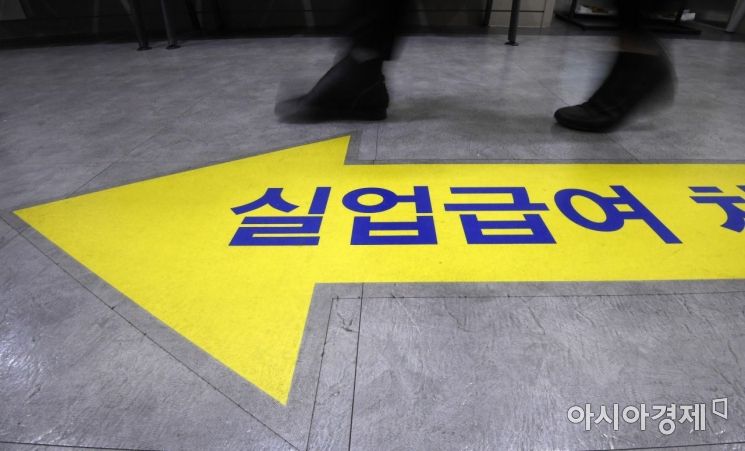 On the 16th, citizens visiting an Employment Welfare Plus Center in Seoul headed to the consultation desk to apply for unemployment benefits. According to the 'September Employment Trends' announced by Statistics Korea on the same day, the number of employed people last month was 27,012,000, a decrease of 392,000 compared to one year ago. This is the largest decline in four months since May (392,000). Photo by Kim Hyun-min kimhyun81@
Unemployment Benefit Payments Exceed 1 Trillion Won for 5 Consecutive Months... Nearly 100,000 Fraudulent Recipients
Lee Hyunji (pseudonym), born in 1997 and preparing for employment, worked at a small company for a year before recently resigning and applying for unemployment benefits. She said, “Although research and development was supposed to be the main task, I ended up doing unrelated work more often, so I started preparing for reemployment after quitting. I submit resumes mainly to receive unemployment benefits, but I also check company atmosphere, welfare, and treatment on sites like Job Planet and Blind, and if it doesn’t seem right, I skip the interview.”
According to the Ministry of Employment and Labor’s announcement on the 12th, last month’s unemployment benefit payments amounted to 1.0944 trillion won, exceeding 1 trillion won for five consecutive months. The total unemployment benefit payments in the first half of this year reached a record high of 6.4843 trillion won. This is a 17.2% increase compared to the same period last year (5.5335 trillion won) and a 59.8% increase compared to the first half of 2019 before the COVID-19 outbreak (4.0567 trillion won).
The average benefit amount per claim for job-seeking benefits, commonly called unemployment benefits, is about 1.43 million won. By submitting resumes through employment sites like Worknet, attending interviews, or certifying job-seeking activities by watching online employment lectures, it is not difficult to receive unemployment benefits.
There are concerns that when the number of working days in the previous company is short, unemployment benefits may exceed the salary earned while employed, encouraging voluntary unemployment through work slowdowns. In fact, among last year’s unemployment benefit recipients, 94,000 people received benefits three or more times over the past five years, with total payments amounting to 480 billion won.
Increase in No-Show and Grasshopper Workers Deepens SME Labor Shortage
The labor shortage in SMEs is not a new issue. However, due to the prolonged COVID-19 impact and expanded unemployment benefit policies since last year, the field is increasingly struggling to secure proper personnel with more than one year of experience, including for interviews.
A CEO of an IT SME in Guro, Seoul, explained, “In the industry, applicants through the Ministry of Employment and Labor’s Worknet are known to apply just to prove job-seeking activity for unemployment benefits, so we rarely call them for interviews. Recently, we have been conducting interviews and hiring by getting recommendations from professors in related fields or introductions from current employees.”
The government has introduced measures to curb the so-called ‘grasshopper workers’ who repeatedly quit after one year of work to receive unemployment benefits and then rejoin employment. Those who receive unemployment benefits three or more times within five years will have their benefit amounts cut by up to 50%. However, after expanding the unemployment benefit period and amount in October 2019 to strengthen coverage, the prolonged COVID-19 pandemic has shaken the financial soundness of the employment insurance fund, leading some to criticize that the measures are too late.
Professor Lee Jung of the Graduate School of Law at Hankuk University of Foreign Studies analyzed, “With the domestic university enrollment rate reaching 70%, educational inflation among youth is intensifying, accelerating the avoidance of manufacturing jobs. The mismatch continues as SMEs struggling with labor shortages face even greater difficulties securing talent due to COVID-19. Young people find it hard to get desired jobs and avoid SME employment, turning to government populist policies like employment stabilization funds and unemployment benefits, losing their will to work.” He added, “From a long-term perspective, the government should focus on establishing systematic vocational education and training infrastructure to cultivate quality talent.”
© The Asia Business Daily(www.asiae.co.kr). All rights reserved.
![Clutching a Stolen Dior Bag, Saying "I Hate Being Poor but Real"... The Grotesque Con of a "Human Knockoff" [Slate]](https://cwcontent.asiae.co.kr/asiaresize/183/2026021902243444107_1771435474.jpg)
















