[Asia Economy Reporter Seulgina Jo] The political sphere is once again accelerating the passage of the so-called 'Google Gapjil Prevention Act (Amendment to the Telecommunications Business Act),' which was the biggest issue in last year's national audit. This move comes as the introduction of Google's in-app payment system is imminent, raising calls from both inside and outside the industry to prevent unilateral commission exploitation. Considering the time required for the enactment of enforcement ordinances, the bill must be passed within this month to complete legislation before October.
According to the National Assembly's Science, Technology, Information and Broadcasting and Communications Committee on the 12th, the committee will hold the 2nd meeting of the Agenda Coordination Committee between the 13th and 14th of this month to decide whether to submit the Google Gapjil Prevention Act to the plenary session. If the agenda referred to the Agenda Coordination Committee is approved by two-thirds or more of the members, it can be submitted to the plenary session. Currently, among the six members of the committee, Democratic Party members Seungrae Jo, Pilmo Jeong, Junho Han, and independent member Jeongsuk Yang have expressed support, making passage highly likely. The process will then proceed to the plenary session, the Legislation and Judiciary Committee, and the plenary session of the National Assembly.
The ruling party, which holds the majority of seats, plans to pass the bill within this month even without opposition cooperation, as the timing for enforcing in-app payments is near. Related bills to prevent Google's commission exploitation were consecutively proposed seven times in the second half of last year alone. However, due to concerns about friction and overlapping regulations, the opposition People Power Party has consistently opposed, resulting in the bills being stalled.
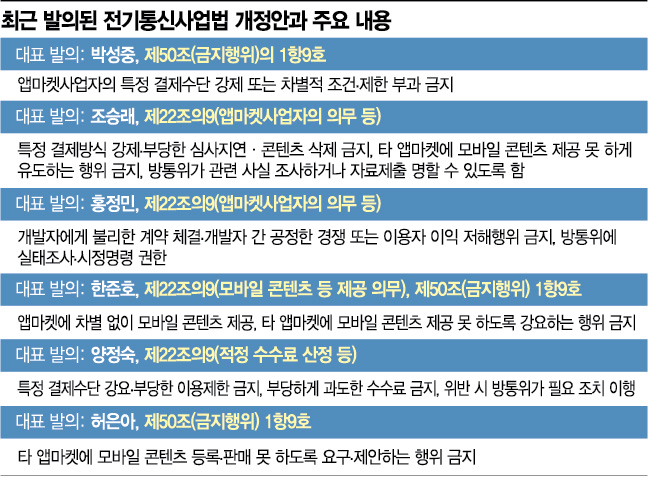 As of mid-October 2020. Subsequently, Assemblyman Jo Myeong-hee of the People Power Party also took the lead in proposing an amendment to the Telecommunications Business Act aimed at prohibiting app market operators from forcing payment methods and resolving related disputes.
However, recently, the urgency of passing the bill has been spreading. Even within the opposition party, which had advocated caution, there is a growing consensus that the in-app payment introduction cannot be left unattended. This is because the burden caused by Google's commission increase will inevitably return to domestic creators and consumers of webtoons, web novels, and the entire digital content industry.
Seobeomgang, Chairman of the Korea Webtoon Industry Association, recently stated at a meeting, "If Google's in-app payment is enforced, e-book prices will increase by up to 40%, and the annual sales reduction in the domestic content industry will reach 2 trillion won, exceeding 5 trillion won by 2025," criticizing that "there is a clear manifestation of unfair practices abusing the monopolistic position of a powerful giant company called Google."
Concerns about potential trade friction with the United States, which some had feared, are also considered unlikely. Regina Cobb, a member of the Arizona House of Representatives who proposed a similar bill in the U.S., and the Coalition for App Fairness (CAF) in the U.S. have also distanced themselves from concerns about trade friction arising from the passage of the Google Gapjil Prevention Act. The Korea Communications Commission, responsible for protecting internet service users, has also decided to support the bill's passage in the National Assembly.
Earlier, Google announced that starting in October, app developers listed on its app market, Google Play, would be required to use Google's payment system when selling content and items, and Google would take a 30% commission in the process. This policy, which had previously applied only to games, has been expanded to all content and apps. This not only threatens the survival of domestic app developers but inevitably leads to price increases for major content such as webtoons, web novels, and music.
Facing widespread criticism, Google later decided to reduce the commission by 15% depending on sales tiers, but this was also criticized as a mere trick. However, if the Google Gapjil Prevention Act passes in the National Assembly this month, all of Google's previous inducements, such as half-price commissions, will become ineffective. A representative from the Korea Internet Corporations Association urged swift passage, saying, "The bill must be passed this month to prepare enforcement ordinances before the in-app payment enforcement."
According to a survey by the Ministry of Science and ICT, the commission paid by domestic companies due to Google's mandatory in-app payment enforcement is estimated to increase from a minimum of 88.5 billion won to a maximum of 156.8 billion won. In response to criticism of unilateral commission exploitation, Google argued that it is a policy to maintain the Google Play ecosystem and support developers.
© The Asia Business Daily(www.asiae.co.kr). All rights reserved.
![Clutching a Stolen Dior Bag, Saying "I Hate Being Poor but Real"... The Grotesque Con of a "Human Knockoff" [Slate]](https://cwcontent.asiae.co.kr/asiaresize/183/2026021902243444107_1771435474.jpg)















