National Assembly Leads Strengthening Control over Financial Supervisory Service
Push to Restore Grounds for Dismissing FSS Chief and Authority for Severe Disciplinary Actions
Concerns over FSS Independence Violation... "Supervisory Function Will Decline"
[Asia Economy Reporters Sunmi Park, Jinho Kim, Hyojin Kim] The financial supervisory system reform being pushed by the political sphere centers on reducing the supervisory functions of the Financial Supervisory Service (FSS) and strengthening parliamentary control. Despite the FSS holding powerful financial licensing authority, which requires high moral standards from its executives, trust has plummeted due to hiring irregularities and bribery scandals. The Audit Board's criticism that the FSS's poor supervision was responsible for the large-scale redemptions caused by private equity funds served as a catalyst.
Internal resistance is expected due to the reduction of the FSS's authority, and controversy is anticipated as the political sphere may intervene not only in the independent FSS but also in the management of financial companies.
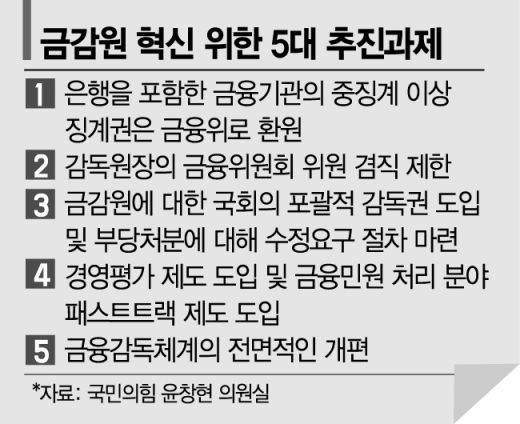
On the 7th, Yoon Chang-hyun, a member of the National Assembly's Political Affairs Committee from the People Power Party, announced five major tasks for FSS innovation, focusing on overhauling the supervisory system, including internal controls. He argued that to allow the FSS to concentrate on its core duties, all disciplinary authority for severe sanctions against financial companies such as banks, insurance, and card companies should be returned to the Financial Services Commission (FSC). If disciplinary authority shifts to the FSC, the FSS's power will inevitably be significantly diminished, prompting strong internal opposition. In fact, disciplinary authority is so powerful that it can determine the fate of a financial company's CEO.
To resolve conflicts of interest within the FSC, restrictions on the FSS chief concurrently serving as an FSC member are also being pursued. According to Article 4 of the 'Financial Services Commission and Its Affiliated Agencies Organization Act,' the FSC consists of nine members: the FSC Chairperson, Vice Chairperson, Vice Minister of Strategy and Finance, FSS Chief, Deposit Insurance Corporation President, Deputy Governor of the Bank of Korea, two financial experts recommended by the FSC Chairperson, and one economic representative recommended by the Korea Chamber of Commerce and Industry. If, as Yoon suggests, the FSS chief is excluded and the FSC operates with eight members, operational issues such as tie votes on important matters could arise.
If these rules are not properly followed, the National Assembly plans to establish grounds to recommend the president dismiss the FSS chief. This could also raise criticism that the National Assembly infringes on the FSS chief's independence by holding their survival rights.
Strengthening parliamentary monitoring of the FSS is also planned. Yoon stated, "Although the FSS's name includes 'service,' it is widely perceived as a dominant authority over financial companies." To correct this, he plans to introduce comprehensive parliamentary supervisory rights over the FSS and establish procedures for requesting corrections of unfair dispositions. He added, "We will introduce a parliamentary approval system for various operational plans to make the FSS a well-performing organization, strengthen monitoring of supervisory fees, and enhance parliamentary control over the FSS's budget."
To improve financial consumers' rights, a new management evaluation system will be introduced to annually check whether the FSS properly implements innovation tasks, and the fast-track system for financial complaint handling, which has been delayed for months, will be immediately pursued.
Growing Concerns Over Excessive Political Intervention
Yoon's proposal is encouraging in terms of resolving the FSS's lax management and negligence. The Audit Board recently pointed out the FSS's comprehensive negligence in inspection and supervision related to the private equity fund fiasco.
However, both the FSS, which has advocated for autonomy and independence, and financial companies wary of excessive political intervention, are expected to strongly oppose, intensifying controversy over the direction of financial supervisory system reform.
A senior FSS official expressed concern, saying, "There is a strong concern about infringement on independence. Especially if disciplinary authority for severe sanctions against financial companies is returned to the FSC, supervisory functions will be significantly weakened, and if the National Assembly gains comprehensive supervisory rights and approval authority over operational plans, the FSS will be subject to political influence."
Professor Minhwan Lee of Inha University's Global Finance Department said, "Discussions on the FSS's functions and financial supervision should be prioritized. In the current structure where policy and supervision are separate, conflicts are inevitable even if the National Assembly intervenes, and excessive interference could cause problems."
The financial sector also views the proposal with caution. An executive from one of the four major financial holding companies said, "Strengthening double or triple monitoring has the positive effect of freeing financial companies from the FSS's unilateral decisions," but added, "However, it is worrisome that financial companies, already wary of the FSS, might now be helplessly swayed by political interests due to excessive parliamentary interference in financial supervisory authorities."
Recurring Demands for Financial Supervisory System Reform
Demands for financial supervisory system reform arise every time the administration changes, based on the argument that the current system fails to properly supervise and manage financial companies, necessitating fundamental surgery. The current system, where financial policy aimed at fostering the financial industry and financial supervision intended to monitor it lack checks and balances, has repeatedly caused major incidents. The private equity fund redemption crisis, which caused damage worth billions of won, is a prime example.
The Moon Jae-in administration also pledged financial supervisory system reform shortly after taking office, but discussions have effectively stalled. The issue resurfaced during the 20th National Assembly and last year when former FSS chief Yoon Seok-heon advocated for FSS independence, but faded amid ongoing FSS scandals.
However, following the Audit Board's report on June 5th that the financial authorities failed to properly supervise Optimus Asset Management, worsening the crisis, the possibility of renewed calls for financial supervisory system reform has increased. Since 2008, 'policy' such as regulations and amendments related to financial supervision has been handled by the FSC, while 'execution' such as investigations and reporting has been carried out by the FSS. This structure inevitably invites criticism that checks and balances between financial policy and supervision are ineffective.
While there is consensus on the need to recognize and improve the limitations of the current financial supervisory system to prevent recurrence of financial accidents and restore trust, the proposed methods differ, making reform difficult.
Yoon's recent proposal differs from the direction of financial supervisory system reform discussions that recently took place in the National Assembly. The National Assembly Research Service, which supports lawmakers' legislative activities, released a report in November last year titled 'The Necessity and Legislative Tasks for Reforming Korea's Financial Supervisory System,' advocating for securing independence and efficiency by separating financial industry policy and financial supervision policy and strengthening the accountability of financial supervisory agencies.
The Research Service argued that in the current system, financial policy may overwhelm supervisory policy, and supervisory policy could be used as a tool to support economic measures. Therefore, all financial supervision-related tasks under the FSC should be transferred to the financial supervisory agency, and the FSC's guidance and supervision regulations should be deleted.
People Power Party lawmaker Seong Il-jong also proposed related legislation last year. His plan involved transferring domestic financial policy functions performed by the FSC to the Ministry of Strategy and Finance, moving financial supervision functions to the FSS, and establishing a Financial Supervisory Committee within the FSS as the highest decision-making body to deliberate and decide on financial supervision and consumer protection matters.
As Yoon proposes strengthening parliamentary control over the FSS against the backdrop of the private equity fund crisis, controversy over financial supervisory system reform is expected to continue.
© The Asia Business Daily(www.asiae.co.kr). All rights reserved.
![Clutching a Stolen Dior Bag, Saying "I Hate Being Poor but Real"... The Grotesque Con of a "Human Knockoff" [Slate]](https://cwcontent.asiae.co.kr/asiaresize/183/2026021902243444107_1771435474.jpg)
















