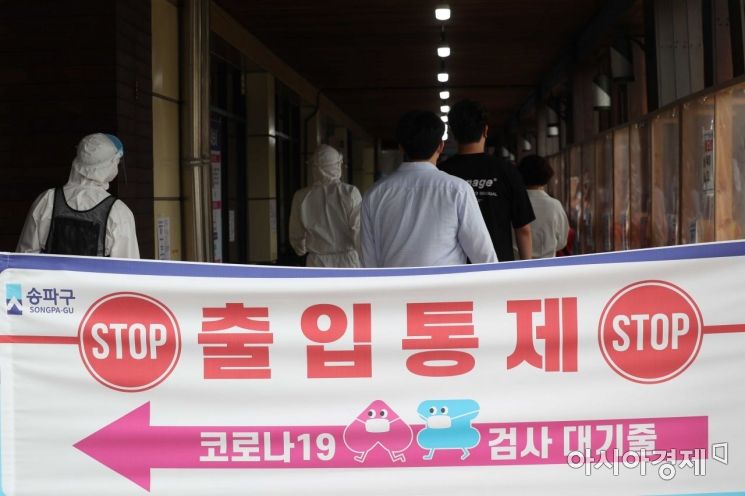
 On the 5th, the COVID-19 screening clinic set up at Songpa-gu Public Health Center in Seoul is crowded with citizens waiting to get tested. Photo by Moon Honam munonam@
[Asia Economy Reporter Lee Chun-hee] The number of new COVID-19 cases in South Korea reached 1,212, the highest this year. This figure is approaching the previous peak of 1,240 cases recorded on December 25 last year, shortly after the first domestic COVID-19 case was confirmed in February last year, raising concerns that the '4th wave' is now in full swing.
The Korea Disease Control and Prevention Agency (KDCA) Central Disease Control Headquarters reported that as of midnight on the 7th, the total cumulative number of COVID-19 cases increased by 1,212 from the previous day to 162,753. Among the new cases, 1,168 were locally transmitted, and 44 were imported from overseas.
Among the locally transmitted cases, about 1,000 cases, accounting for 85%, occurred in the Seoul metropolitan area. Specifically, Seoul reported 577 cases (49.4%), Gyeonggi 357 cases (30.6%), and Incheon 56 cases (4.8%), totaling 990 cases in the metropolitan area alone.
Other regions reported the following cases: Busan 33, Daejeon 29, Jeju 18, Chungnam 16, Gyeongnam 15, Daegu 12, Gangwon 12, Gwangju 10, Jeonnam 10, Jeonbuk 8, Sejong 5, Chungbuk 5, Gyeongbuk 4, and Ulsan 1.
There were 44 imported cases. Among them, 20 were detected during quarantine, and 24 were identified in the community. Of these, 24 were Korean nationals and 20 were foreigners. By country, Indonesia, where the Delta variant (Indian variant) is rapidly spreading, accounted for the highest number with 15 cases, including 8 Koreans and 7 foreigners.
The total number of tests conducted in one day was 86,335. At temporary screening centers set up in the metropolitan area, 52,243 tests were conducted, confirming 295 new cases, while 3,306 tests were conducted at temporary screening centers outside the metropolitan area, confirming 3 new cases.
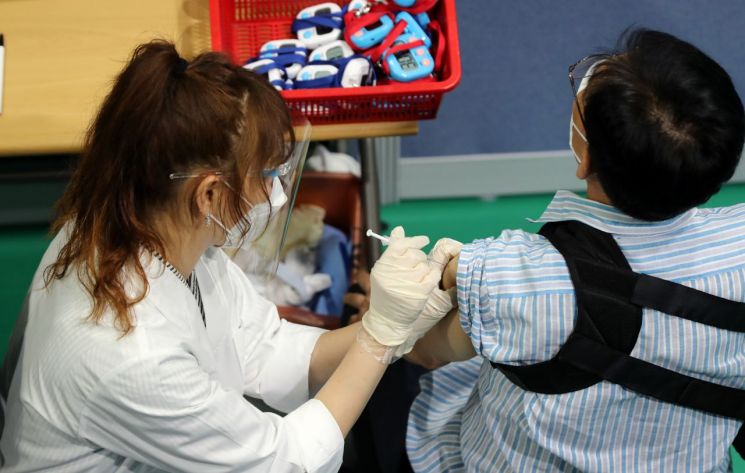 On the morning of the 5th, a recipient is receiving the Pfizer vaccine at the COVID-19 vaccination center in Buk-gu, Gwangju. [Image source=Yonhap News]
Meanwhile, as of midnight on the same day, 37,666 people received new COVID-19 vaccinations. The cumulative number of first-dose vaccinations reached 15,439,910. The vaccination rate relative to the population exceeded 30% for the first time in 130 days since the start of vaccinations. Among the newly vaccinated, 425 received AstraZeneca (AZ), 33,178 received Pfizer, and 4,063 received Moderna vaccines.
The number of people who completed vaccination increased by 62,770 from the previous day to 5,463,292. The second-dose vaccination rate relative to the population is 10.6%. Among those who received the first dose of the AZ vaccine, 6,830 received the second dose of AZ, and 33,931 received the second dose of Pfizer as a mixed vaccination. An additional 22,009 people completed vaccination with Pfizer only, bringing the total to 3,280,708. Moderna second doses have not yet reached the scheduled interval.
Reports of suspected adverse reactions following vaccination increased by 2,665 over two days, totaling 98,043 cases. Reports included 1,672 for AZ, 730 for Pfizer, 204 for Janssen, and 59 for Moderna. The cumulative adverse reaction reporting rates are 0.64% for AZ, 0.25% for Pfizer, 0.62% for Janssen, and 0.52% for Moderna.
Among the new reports, common post-vaccination symptoms such as muscle pain, headache, fever, chills, and nausea accounted for 2,497 cases, making up the majority.
Serious adverse reactions included 2 suspected anaphylaxis cases and 154 additional reports of major neurological and other serious reactions. There were 12 reported deaths following vaccination: 6 after AZ, 5 after Pfizer, and 1 additional death after Janssen vaccination.
© The Asia Business Daily(www.asiae.co.kr). All rights reserved.
![Clutching a Stolen Dior Bag, Saying "I Hate Being Poor but Real"... The Grotesque Con of a "Human Knockoff" [Slate]](https://cwcontent.asiae.co.kr/asiaresize/183/2026021902243444107_1771435474.jpg)
















