Mobile Version, Official Service Launch in Mid-Next Year Gains Momentum
Accounts for 85% of Total Sales... Focus on IP Diversification
Holds 316.2 Billion KRW in Cash Assets, Debt-Free Management
Aggressive M&A and Facility Investment to Expand Scale
China has issued a game license (panho) for the domestic game ‘Black Desert Mobile.’ A panho is a permit required to provide game services within China. Since the THAAD (Terminal High Altitude Area Defense) incident in March 2017, China had not issued panhos for domestic games, but starting with Com2uS’s ‘Summoners War: Sky Arena’ in December last year, it has issued a third panho. The industry is welcoming this development, as there is anticipation that China, boasting a market size of about 50 trillion won, is reopening. Accordingly, Asia Economy analyzed Pearl Abyss, the developer of ‘Black Desert,’ and Wemade, which owns the popular Chinese intellectual property (IP) ‘Legend of Mir.’
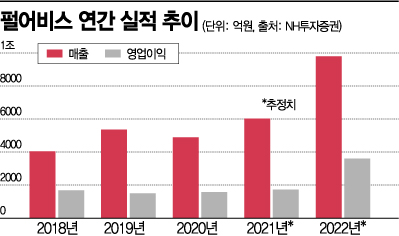
[Asia Economy Reporter Jang Hyowon] Pearl Abyss is gaining attention as it has received a panho allowing ‘Black Desert Mobile’ to be serviced in China. Pearl Abyss is a company generating over 480 billion won in annual sales through the Black Desert intellectual property (IP). With cash generated from stable performance, the company is recently expanding its investment areas and pursuing business diversification. Expectations are high for the future as performance is projected to jump significantly once official service begins in China next year.
Profit Margin Increase through Cost Management
Pearl Abyss is a company primarily engaged in game software development and supply, established in 2010. It launched Black Desert Online domestically in 2014 and currently services games utilizing the Black Desert IP such as Black Desert Mobile and Black Desert Console both domestically and internationally.
Most of Pearl Abyss’s revenue comes from the Black Desert IP. As of the end of last year, 84.8% of Pearl Abyss’s total sales were derived from the Black Desert IP. The remaining 15.2% came from the game IP ‘EVE.’ Before 2018, 100% of sales were from the Black Desert IP.
To reduce the risk of relying on a single IP, Pearl Abyss acquired CCP Games, an Iceland-based developer of EVE, and its subsidiaries for 252.4 billion won in 2018. CCP Games recorded sales of 56.3 billion won in 2019 and 73.6 billion won last year.
Looking at sales by game platform, revenue is generated from various sources. As of the end of last year, Pearl Abyss’s sales distribution was 42.7% online, 45.4% mobile, 11.0% console, and 0.9% others. While the game IP is concentrated on Black Desert, the platforms are relatively well diversified.
Pearl Abyss’s sales have been declining since 2019. Last year, consolidated sales were 488.8 billion won, down 8.8% year-on-year. Sales in the first quarter of this year also decreased by 24.2% year-on-year to 100.9 billion won.
The sales decline is analyzed to be due to the elapsed time since the release of the Black Desert Mobile version. Typically, mobile games record high sales immediately after launch but gradually decline over time. In fact, last year, sales of Black Desert PC and console versions increased by 29.7% and 12.8%, respectively, while the mobile version decreased by 32.2%. Despite the sales decline, operating profit margins have remained in the 40% range on average over the past three years thanks to cost management.
Pearl Abyss uses its own developed game engine rather than commercial engines like Unreal or Unity when developing games, so no separate game engine usage fees are incurred. Additionally, it directly publishes its games, resulting in lower fees paid to publishers. Notably, although sales decreased last year, marketing expenses were also reduced, leading to an increase in operating profit.
Investment Expansion... ‘Level Up’ through Entry into China
Pearl Abyss’s financial structure is very stable. As of the end of the first quarter, Pearl Abyss’s debt ratio was 42.7%. Total borrowings amounted to 54 billion won, but it holds 316.2 billion won in cash equivalents, resulting in net borrowings of approximately -262.2 billion won. The borrowing dependency ratio is 13.4%, indicating effectively debt-free management.
Based on this, Pearl Abyss is engaging in mergers and acquisitions (M&A) and facility investments. In November last year, it purchased a 27% stake in the newly established game company Big Game Studio for 3 billion won, and in May, it acquired 100% of the shares of Factorial Games, developer of ‘Lost Kingdom,’ for 20 billion won. It also acquired a 0.4% stake in the Japanese content company Kadokawa for 12.8 billion won.
Additionally, a new headquarters is under construction in Gwacheon Knowledge Information Town, Gyeonggi Province. Approximately 33.4 billion won was spent on land and construction costs until last year, and a total of 98.6 billion won is planned to be invested by 2022. A scan studio capable of game motion capture is also being built, with an investment of 15 billion won planned.
Seungbeom Kim, Senior Researcher at Korea Ratings, said, "From this year, with concentrated investments in tangible assets and equity investments, short-term free cash flow generation may be constrained. However, in the mid to long term, the trend of free cash flow generation is expected to continue based on excellent operating cash flow."
Furthermore, the issuance of the panho by China is expected to significantly increase performance. On the 28th of last month, China’s National Press and Publication Administration issued a panho allowing Pearl Abyss’s Black Desert Mobile to be serviced in China. This is the first domestic game to receive a panho since the 2017 ban on Korean content in China.
Accordingly, NH Investment & Securities has sharply raised its performance estimates for Pearl Abyss next year to sales of 979.8 billion won and operating profit of 361 billion won, representing increases of 62.8% and 109.9%, respectively, compared to this year. Jaemin Ahn, a researcher at NH Investment & Securities, analyzed, "Black Desert Mobile has accumulated a substantial amount of content over the past four years, making daily sales of over 2 billion won possible in China. Also, ‘Red Desert,’ planned for release in the fourth quarter alongside Black Desert China, aims to target the global market, which will cause a sharp increase in performance."
© The Asia Business Daily(www.asiae.co.kr). All rights reserved.
![Clutching a Stolen Dior Bag, Saying "I Hate Being Poor but Real"... The Grotesque Con of a "Human Knockoff" [Slate]](https://cwcontent.asiae.co.kr/asiaresize/183/2026021902243444107_1771435474.jpg)















