The Economic Justice Network Announces Analysis of Price Changes in 75 Seoul Complexes
Gangnam 1.09 Billion KRW and Non-Gangnam 500 Million KRW Increase for 30-Pyeong Units
30s Without Financial Capacity Flock to Pre-Reconstruction Complexes in Nowon-gu
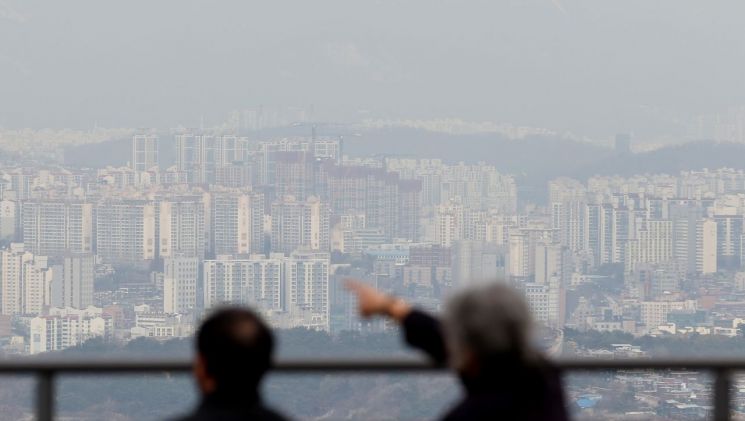
[Asia Economy Reporter Onyu Lim] An analysis by the Citizens' Coalition for Economic Justice (CCEJ) revealed that Seoul apartment prices doubled during the four years of the Moon Jae-in administration. It also explained that the time required to purchase a home increased by more than 10 years. The CCEJ pointed out, "The Moon administration, which prioritized income-led growth, only achieved bubble growth driven by unearned income."
Seoul apartment price per pyeong at 39.71 million KRW... CCEJ: "Moon administration's increase rate 93%"
According to the CCEJ on the 27th, the price per 3.3㎡ (1 pyeong) of Seoul apartments rose from 20.61 million KRW in May 2017, when the Moon administration began, to 39.71 million KRW in May this year, an increase of 19.1 million KRW over four years. The rate of increase reached 93%, nearly doubling. Converted to a 30-pyeong apartment, a Seoul apartment that could be purchased for 620 million KRW before the administration's launch now costs 1.19 billion KRW, an increase of 570 million KRW.
In the Gangnam 3 districts (Gangnam, Seocho, Songpa), the price per pyeong rose from 43.34 million KRW to 79.57 million KRW, an increase of 36.23 million KRW (84%) during this period. The price for a 30-pyeong apartment increased by 1.09 billion KRW (from 1.3 billion KRW to 2.39 billion KRW). The rate of increase was even steeper in non-Gangnam areas. The average price per pyeong in the 22 districts excluding the Gangnam 3 districts rose from 17.51 million KRW to 34.27 million KRW, a 96% increase. The price of a 30-pyeong apartment, which was 530 million KRW, surged to 1.03 billion KRW.
This analysis was conducted using KB Kookmin Bank market price information for a total of 75 complexes, three complexes each in 25 autonomous districts in Seoul, covering 115,000 households, according to the CCEJ.
The CCEJ claims that as Seoul apartment prices soared, the time required for ordinary citizens to purchase a home also increased significantly. During the same period, the disposable income per household rose only 2.98 million KRW (7%) from 45.2 million KRW to 48.18 million KRW. Assuming a household saves all its income to purchase a 30-pyeong apartment in Seoul, the required time increased from 14 years in May 2017 to 25 years last May. For apartments in the Gangnam 3 districts, the time increased from 29 years to 50 years, a 21-year increase.
Kim Seong-dal, Director of the Real Estate and Construction Reform Headquarters at CCEJ, said, "The increase in apartment prices during the four years of the Moon administration was 192 times the increase in income," adding, "They touted income-led growth but only achieved bubble growth driven by unearned income."
"If not now, never" Surge in purchases by the 2030 generation causes outskirts to soar... 'Reconstruction' in Nowon-gu sees record-high prices in June
The rapid rise in Seoul apartment prices has been inducing 'all-in buying' by the 2030 generation since last year. Those with relatively limited funds are investing in mid- to low-priced apartments, causing sharp price increases in outer areas such as Nodobang (Nowon, Dobong, Gangbuk districts) and Geumgwan-gu (Geumcheon, Gwanak, Guro districts). In particular, in Nowon-gu, investment demand has concentrated on reconstruction complexes that avoided the land transaction permit system, maximizing a balloon effect.
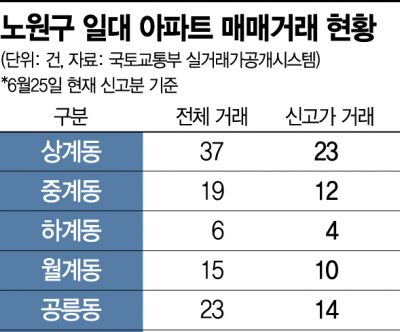
Analysis by Asia Economy of the Ministry of Land, Infrastructure and Transport's actual transaction registration system found that in June, 63 out of 100 apartment sales transactions in Nowon-gu were at record-high prices exceeding previous highs. This phenomenon was observed evenly across all areas of Nowon-gu. In Sanggye-dong, 23 out of 37 transactions (62%) were record-high; in Junggye-dong, 12 out of 19 (63%); in Hagye-dong, 4 out of 6 (66%); in Wolgye-dong, 10 out of 15 (66%); and in Gongneung-dong, 14 out of 23 (60%) were record-high transactions.
On June 12, a 127㎡ (exclusive area) apartment in Hoseong, Hagye-dong, was sold for 1.35 billion KRW. This price is 155 million KRW higher than the previous high of 1.195 billion KRW registered in November last year. Earlier, on June 5, an 84㎡ apartment in Jugong 5 Complex, Junggye-dong, changed hands for 1.26 billion KRW, surpassing the previous high of 1.1 billion KRW registered in March by 16 million KRW. On June 3, a 59㎡ apartment in Jugong 6 Complex, Sanggye-dong, was sold for 870 million KRW. The actual transaction price in November last year was 690 million KRW, marking an increase of 180 million KRW in six months.
With record-high prices emerging one after another, apartment prices in Nowon-gu have shown strong momentum for more than two months. According to the Korea Real Estate Board, the apartment sale price in Nowon-gu rose by 0.25% in the third week of June, the same as the previous week, marking the highest increase rate in Seoul for 11 consecutive weeks. This is the highest level in 2 years and 9 months since the second week of September 2018.
The record-high price trend in Nowon-gu apartments is analyzed to stem from the premium of Seoul Mayor Oh Se-hoon's policy promoting reconstruction activation. Nowon-gu, where 15 housing development districts were created in the 1980s, is densely populated with old mid- to low-priced apartments nearing reconstruction. By 2030, a total of 124 complexes with 112,320 households are expected to be classified as targets for reconstruction safety inspections.
Unlike major reconstruction complexes such as Apgujeong-dong in Gangnam-gu, Yeouido-dong in Yeongdeungpo, and Mok-dong in Yangcheon-gu, Nowon-gu has avoided the land transaction permit system, allowing gap investment, i.e., buying with existing lease deposits. Moreover, since most complexes are still before safety inspections, they are free from regulations on transferring union member status, enabling 'all-in buying' by people in their 30s with insufficient capital. Park Won-gap, Senior Real Estate Specialist at KB Kookmin Bank, said, "People in their 30s with minimal capital accumulation tend to flock to areas like Nowon with many mid- to low-priced reconstruction apartments where they can buy by borrowing or using lease deposits."
As the real estate taxation reference date of June 1 has passed and listings tend to be withdrawn, there are forecasts that the price increase rate, including in Nowon-gu, may rise further. Yoon Ji-hae, Senior Researcher at Real Estate 114, said, "Some properties are withdrawn for tax-saving purposes around the taxation reference date, and the phenomenon of listings being locked up is likely to continue for a considerable period," adding, "As a result, the seller's market will strengthen from June, as in past trends, and the upward trend may accelerate."
© The Asia Business Daily(www.asiae.co.kr). All rights reserved.
![Clutching a Stolen Dior Bag, Saying "I Hate Being Poor but Real"... The Grotesque Con of a "Human Knockoff" [Slate]](https://cwcontent.asiae.co.kr/asiaresize/183/2026021902243444107_1771435474.jpg)
















