Starting with Materials in 2030
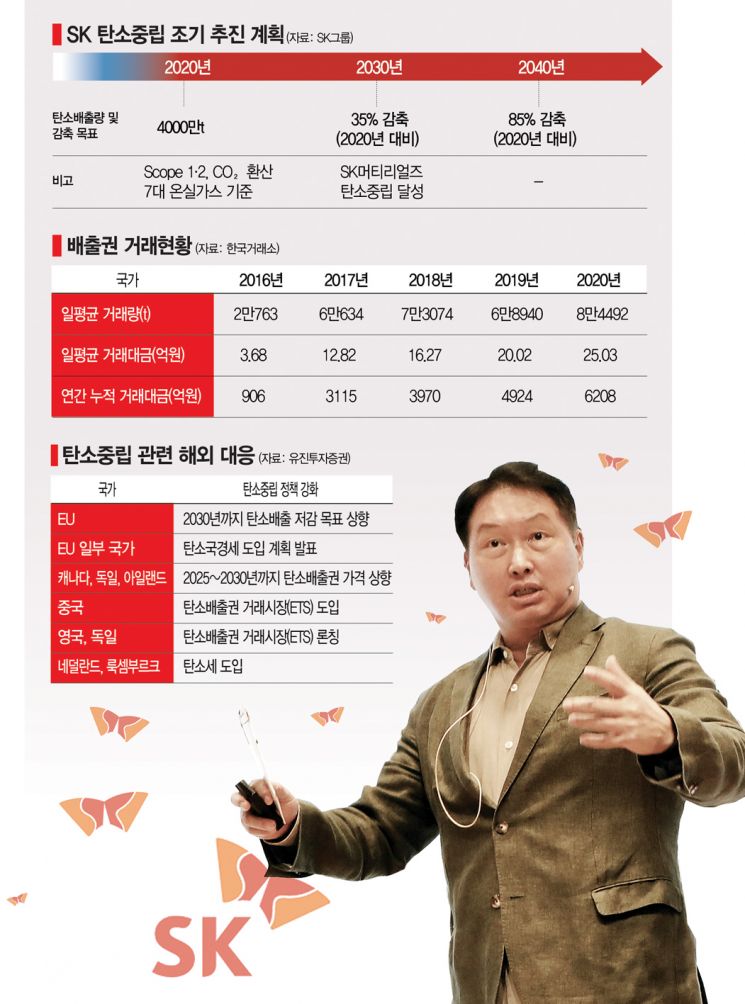
85% Reduction Target by 2040
High Carbon Emissions but Difficult Decision
Business Restructuring from LNG to Hydrogen Energy
Leading Industry-Wide Expansion Beyond Declaration
[Asia Economy Reporters Choi Daeyeol, Hwang Yoonju] SK Group Chairman Chey Tae-won ordered all affiliates to advance the timeline for carbon neutrality (net zero) because he foresaw that the level of response to climate change would become a crucial measure of corporate competitiveness in the future business environment. He believed that responding at the same pace as others would make it difficult to get ahead in the competition.
Chairman Chey has pointed out that companies have neglected issues like global warming due to their focus on profit-making activities, and has emphasized that from now on, companies and entrepreneurs must take a leading role in solving environmental problems. Since carbon neutrality is considered essential for survival rather than a choice, Chey believes that only by taking proactive measures can companies gain a competitive edge.
SK "Reduce Carbon Emissions by 85% Within 20 Years"
Following Chairman Chey's order for early implementation, some affiliates, including SK Materials, have finalized or plan to decide soon on mid-to-long-term plans to advance the carbon neutrality timeline earlier than 2050. Carbon neutrality refers to activities that reduce greenhouse gas emissions as much as possible while applying technologies to absorb or capture and eliminate unavoidable greenhouse gas emissions, effectively bringing net emissions to zero.
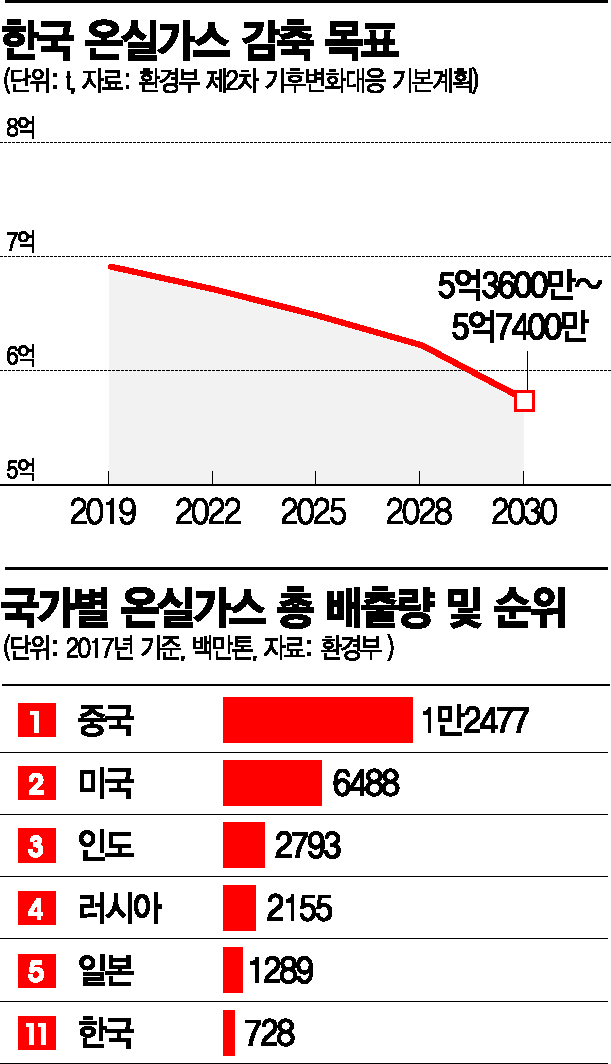
The momentum accelerated after the 2019 Conference of the Parties on Climate Change, where countries agreed to immediate action. The European Union (EU) and Japan declared carbon neutrality by 2050, and China set 2060 as its target year. Former President Moon Jae-in also announced a 2050 carbon neutrality plan during his October 2021 National Assembly policy speech.
Carbon neutrality is a difficult decision for SK, which has affiliates like SK Energy (refining) and SK Hynix (semiconductors) ranked among the top domestic emitters of carbon. Moreover, the plan to advance the timeline by up to 20 years may pose obstacles to current business operations but is deemed unavoidable. According to a joint resolution by the CEOs of each affiliate on this day, SK Group has committed to reducing emissions by 85% from current levels by 2040.
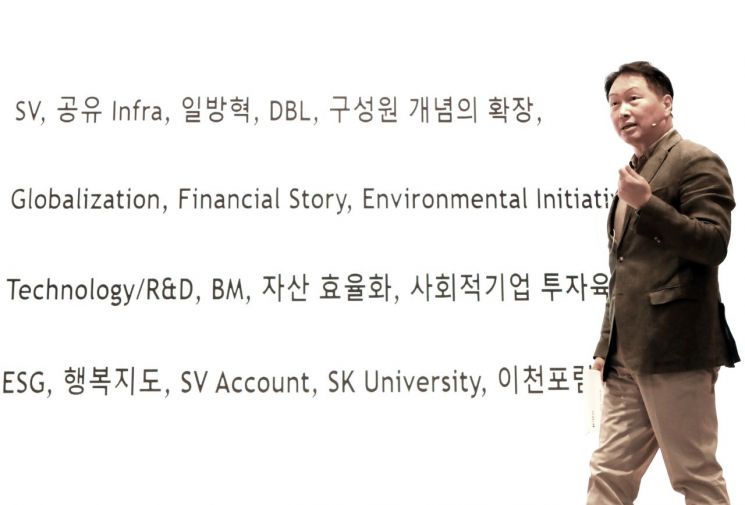 Chairman Chey Tae-won of SK Group, who attended the expanded management meeting held on the 22nd, is explaining the financial story he has emphasized so far. Photo by SK
"Climate Response Must Be Led by Companies" Spreads Across Business Circles
SK E&S, which has focused on power generation mainly using liquefied natural gas (LNG), is completely restructuring its business around the hydrogen sector, identified as a future growth engine at the group level. As hydrogen emerges as an eco-friendly future energy source, the company plans to build infrastructure across the entire value chain, from production to storage, transportation, and charging. SK E&S, along with the holding company SK Inc., is refining detailed business plans.
SK Innovation, which acts as an intermediate holding company for refining and petrochemical affiliates such as SK Energy and SK General Chemicals, is focusing on electric vehicle batteries as part of its own business. Anticipating increased adoption of electric vehicles as future eco-friendly transportation, it is expanding related material businesses including core components like batteries. The group prioritizes environmental issues when selecting new core businesses. Last year, eight major affiliates including SK Inc., SK Telecom, SK Hynix, and SKC joined the Korea RE100 Committee, reflecting the same commitment.
Chairman Chey is also committed to not just declarative statements but leading by example and spreading these efforts throughout the business community. He has advocated quantifying the environmental impact of corporate activities in monetary terms and reflecting them in corporate finances. Recognizing that environmental investments can be burdensome for individual companies, he has proposed incentive-based post-reward systems to encourage such investments. Since actions by individual companies or some countries are inherently limited, he called for cooperation among governments, companies, and civil society worldwide.
Since becoming chairman of the Korea Chamber of Commerce and Industry, the country’s leading economic organization, he has actively promoted ESG principles both domestically and internationally. At the P4G Seoul Summit Business Forum last month, Chairman Chey stated, "For a long time, companies have focused on maximizing profits, which has caused environmental problems such as global warming. At the same time, companies possess the technology and resources for eco-friendly transformation and must take a leading role as agents of problem-solving."
© The Asia Business Daily(www.asiae.co.kr). All rights reserved.
![Clutching a Stolen Dior Bag, Saying "I Hate Being Poor but Real"... The Grotesque Con of a "Human Knockoff" [Slate]](https://cwcontent.asiae.co.kr/asiaresize/183/2026021902243444107_1771435474.jpg)

















