[Sejong=Asia Economy Reporter Son Seon-hee] The government has decided not to reconsider reintroducing the tax credit for third-party logistics costs. Recently, as global cargo volumes surged and the logistics cost burden on Korean small and medium export companies increased, the business community requested the reintroduction of the tax credit, but it appears that the request will not be accepted. This is because it is judged that it does not align with the purpose of the system and its effectiveness is low.
According to materials submitted by the Ministry of Economy and Finance to the office of Ryu Seong-geol, a member of the People Power Party and the National Assembly Planning and Finance Committee secretary, on the 23rd, regarding the reconsideration of reintroducing the third-party logistics cost tax credit, the Ministry responded, "The system has already achieved its intended purpose, and the effect of revitalizing logistics by maintaining the system has been evaluated as not significant, so it was sunsetted. It has only been six months since the sunset, so reintroduction of the system is not being considered."
The third-party logistics cost tax credit is a system established in 2007 to foster the industry, which allows a deduction of 3% (5% for small and medium enterprises) from income tax or corporate tax on the amount exceeding the previous year's expenses when logistics costs are incurred through a third party who is not an in-house logistics company or a related party. Looking at the tax expenditure performance (scale of deductions) so far, it steadily increased from 6.8 billion KRW in 2010, the early stage of the system's introduction, to 12.7 billion KRW in 2011, and 28.6 billion KRW in 2012. After that, it gradually decreased, reaching only 4.04 billion KRW last year.
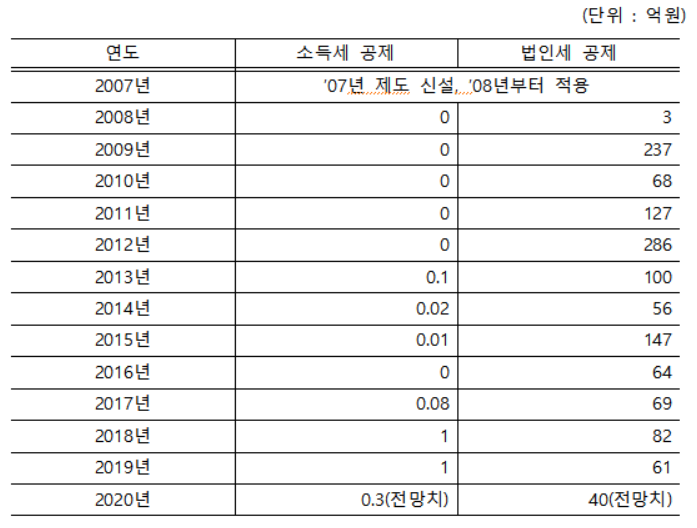 'Third-Party Logistics Cost Tax Credit' Tax Expenditure Performance Details (Source: Office of Ryu Seong-geol, People Power Party)
Meanwhile, the rate of third-party logistics usage significantly increased from 48.2% in 2009 to 69.7% in 2019. This has reached the level of advanced countries (70-90%), and last year, during the regular National Assembly session, it was evaluated that the system's purpose of 'logistics revitalization' was sufficiently achieved, leading to the decision to sunset the system.
The business community has requested the revival of this system considering the current logistics difficulties. Earlier this month, Koo Ja-yeol, chairman of the Korea International Trade Association, directly mentioned the system during a meeting with Prime Minister Kim Boo-kyum, bringing the issue to the surface. However, a Ministry of Economy and Finance official explained, "Reintroducing the tax credit, which was sunsetted last year, as a 'temporary support' for the current logistics difficulties is not appropriate," adding, "Even if it were done, it would take several months to amend the law and apply it in practice, so it would be difficult to resolve the current difficulties."
Instead, the government plans to support import and export logistics through financial support measures such as increasing the supply of temporary vessels on the trans-Pacific route and providing a special logistics loan of 20 billion KRW for small and medium export companies.
© The Asia Business Daily(www.asiae.co.kr). All rights reserved.
![Clutching a Stolen Dior Bag, Saying "I Hate Being Poor but Real"... The Grotesque Con of a "Human Knockoff" [Slate]](https://cwcontent.asiae.co.kr/asiaresize/183/2026021902243444107_1771435474.jpg)















