[Asia Economy Reporter Jeong Hyunjin] In the small- and medium-sized OLED market, dominated by domestic companies such as Samsung Display and LG Display, China's top display company BOE is mounting a threatening pursuit. BOE, which took over the LCD market in just a few years based on massive investments, is continuing bold investments in OLED, raising concerns in the domestic display industry.
According to the display industry and securities firms on the 21st, BOE's shipment growth rate of OLED panels for smartphones this year is expected to reach 50%. BOE's OLED panel shipments, which were around 17 million units in 2019, reached 38.7 million units last year and are estimated to increase to 57.9 million units this year.
Until 2019, BOE mainly supplied OLED panels to Chinese companies such as Huawei and Oppo, but it is expanding its overseas customers such as Apple and Lenovo, increasing its global market share through a strategy of broadening its client base. In particular, at the end of last year, BOE received approval from Apple and has been actively producing panels for the iPhone 12 since the first quarter of this year. In March, news also emerged that some models of Samsung Electronics' Galaxy M series to be released in the second half of the year will be equipped with BOE's OLED panels.
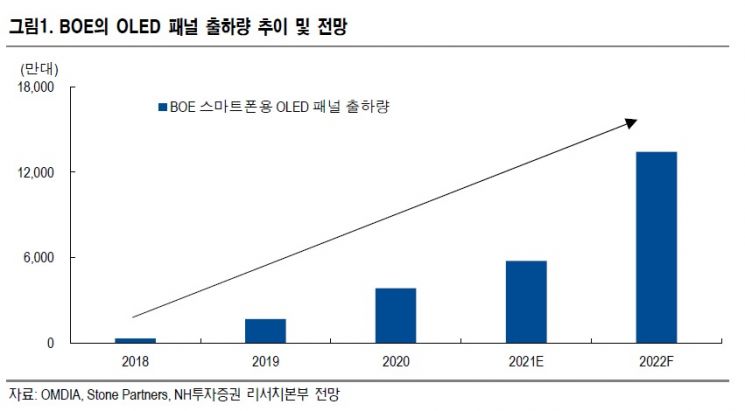
BOE is also expanding its facility investments in line with this OLED panel demand. Currently, it operates two factories, B7 and B11, equipped with 6th-generation OLED panel production facilities, and the industry expects that additional investment in B12 in Chongqing, China, will begin full-scale mass production after the second quarter of next year. It is reported that B12 will involve investment in low-temperature polycrystalline oxide (LTPO) thin-film transistors (TFT) to reduce the power consumption of OLED panels.
The small- and medium-sized OLED panel market used in smartphones and other devices still has a high market share held by domestic companies. However, according to the Korea Display Industry Association (KDIA) and others, Korea's market share in the active-matrix OLED (AMOLED) market applied to premium smartphones was 85.4% last year, down more than 10 percentage points compared to 2018, just two years ago. During the same period, China's market share expanded from 3.6% to 13.6%, an increase of 10 percentage points. In particular, BOE, the number one Chinese display company, had only a 1% share in the small- and medium-sized OLED panel market in 2018, but rapidly expanded to the 8% range last year. Omdia expects BOE's market share to expand to 13% next year.
The reason the domestic display industry is concerned about BOE's initial offensive is because they have already experienced losing the LCD market. Supported by the Chinese government, Chinese display companies such as BOE entered the LCD panel market, taking over the market that domestic companies had overwhelmingly dominated since the mid-2000s after 2017.
Domestic companies such as Samsung Display and LG Display plan to respond to BOE with a super-gap technology strategy, including foldable technology, applied to premium smartphone lineups. An industry insider said, "It will be difficult for BOE to immediately dominate the OLED market, but they are rapidly chasing Korean companies through bold investments," adding, "Developing highly profitable, high value-added technology is the most important thing at this point."
© The Asia Business Daily(www.asiae.co.kr). All rights reserved.
![Clutching a Stolen Dior Bag, Saying "I Hate Being Poor but Real"... The Grotesque Con of a "Human Knockoff" [Slate]](https://cwcontent.asiae.co.kr/asiaresize/183/2026021902243444107_1771435474.jpg)















