[Asia Economy Reporter Choi Dae-yeol] "ESG (Environmental, Social, and Governance) is not something that can be superficially packaged just to make some money. I believe that if a company violates or mishandles ESG, it could directly threaten its survival."
This is part of a conversation between Chey Tae-won, Chairman of the Korea Chamber of Commerce and Industry (KCCI), and Park Byeong-seok, Speaker of the National Assembly, last month. Chey, who has emphasized the social role of companies for several years since the concept of ESG was unfamiliar in Korea, has been actively promoting ESG since taking office as chairman of KCCI, which has emerged as a leading economic organization in the country. He warns that companies harmful to the environment, failing to create social value, or operating with improper governance will not only fall behind or gain a bad image but may be unable to conduct their fundamental profit-making activities.
Globally, beyond declarative statements, there is a growing movement to create guidelines and regulations that quantify individual companies' ESG management activities into indices. After President Moon Jae-in declared this at the Commerce Day event last March, our government has decided to finalize ESG indicators in the second half of this year as part of standardization efforts. While financial and accounting indicators have so far reflected a company's current status, going forward, how actively a company pursues ESG is expected to serve as a measure of its level.
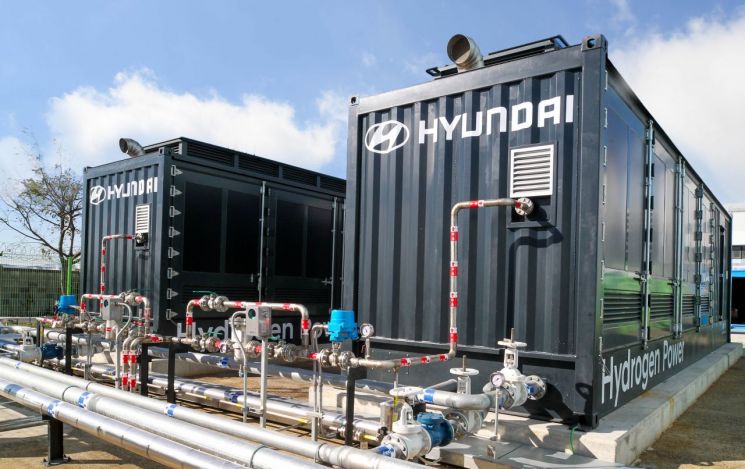 Demonstration of Hyundai Motor Company's domestically developed hydrogen fuel cell power generation system based on independent technology
The most immediately visible aspect is eco-friendliness. Companies must introduce environmentally friendly products and services or minimize environmental impact during production processes to reduce burdens. This condition is inevitably disadvantageous for Korea, where manufacturing and exports still play a significant role in supporting the national economy. Traditional "smokestack industries," including various petroleum products, synthetic resins, and steel, have ranked among Korea's top 10 export items for decades, reflecting their substantial share. Public support is necessary in the process of transforming existing businesses in entirely new ways or exploring completely new ventures.
Ko Jun-hyung, Director of the POSCO Research Institute, said, "The biggest change in manufacturing in the post-COVID era, not only in Korea but worldwide, is the rapid transition to a decarbonized and eco-friendly industrial structure. The enormous costs associated with this transition, such as expenses for converting to eco-friendly energy and research and development (R&D) to achieve carbon neutrality, will inevitably become a burden on manufacturing. Therefore, national-level cooperation will be the most critical issue."
© The Asia Business Daily(www.asiae.co.kr). All rights reserved.
![Clutching a Stolen Dior Bag, Saying "I Hate Being Poor but Real"... The Grotesque Con of a "Human Knockoff" [Slate]](https://cwcontent.asiae.co.kr/asiaresize/183/2026021902243444107_1771435474.jpg)

















