Lotte Courier Worker Who Worked 6 Days a Week Suffers Brain Hemorrhage... Unconscious
21 Courier Workers Died from Overwork Since COVID-19
Ongoing Difficulties with 'Sorting Work'
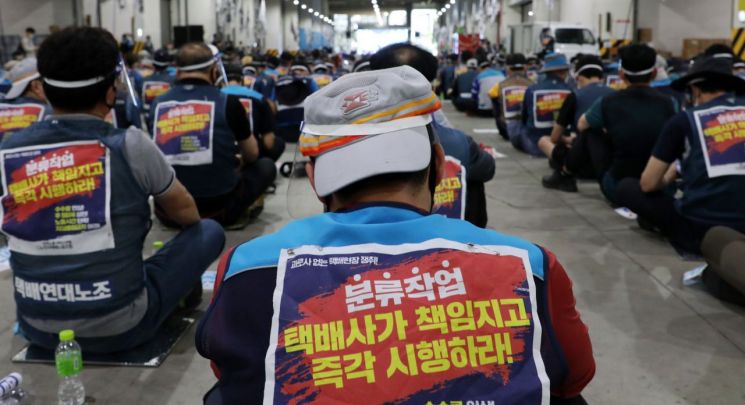 On the 9th, a post office delivery worker attended a strike resolution rally at the Seoul Integrated Logistics Center. The delivery workers' union launched an indefinite full strike starting that day due to the breakdown of the second social agreement. [Image source=Yonhap News]
[Asia Economy Reporter Heo Midam] "Delivery workers are still burdened with sorting tasks."
Recently, as delivery workers have complained of fatigue from long working hours and incidents of collapse due to overwork have occurred repeatedly, it has become a social issue. Especially with the surge in delivery volumes due to the impact of COVID-19, a total of 21 delivery workers have died from overwork since last year. This year alone, it is estimated that five delivery workers have died from overwork, raising voices pointing out structural problems in the delivery industry.
As a result, delivery workers are insisting that delivery companies should take responsibility for sorting tasks to prevent deaths from overwork. Most delivery workers perform sorting tasks themselves, which take 4 to 5 hours, but there is no separate allowance for this, leading to criticism that it is "free labor." The Delivery Workers' Union (the union) also pointed to sorting tasks as the main cause of deaths from overwork.
On the 13th, the Delivery Workers' Overwork Death Countermeasures Committee (the Committee) announced that delivery worker Lim Mo (47), affiliated with Lotte Delivery Unjung Agency, collapsed due to a cerebral hemorrhage and fell into an unconscious state.
According to the Committee, Lim showed symptoms such as twisting his body while sleeping around 4:30 a.m. that day. His spouse, sensing abnormal symptoms, called 119 (emergency services).
Lim, who has worked at Lotte Delivery for over two years, was known to work six days a week and often went to work after sleeping only two hours a day. He frequently had dinner after returning home past midnight and was reported to have often said he was "tired."
The Committee identified that Lim handled about 6,000 delivery items per month and delivered around 250 items daily. The Committee stated, "Doctors diagnosed that Lim's cerebral hemorrhages occurred multiple times and that his condition is very critical. Lim has not regained consciousness in the intensive care unit," adding, "the issue of delivery workers dying from overwork is ongoing."
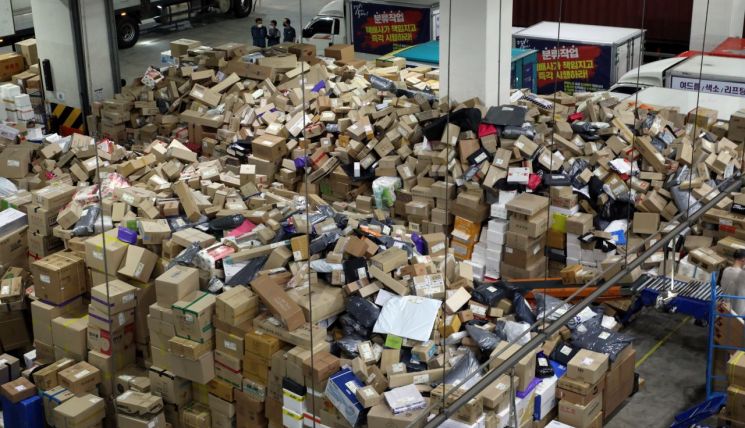 On the morning of the 9th, parcels piled up at the Seoul Complex Logistics Center in Songpa-gu due to the courier union strike.
 [Image source=Yonhap News]
The problem of overwork among delivery workers is not new. Previously, Jang Deokjun, who worked as a daily worker at Coupang Logistics Center in Chilgok, Gyeongbuk, for one year and four months starting June 2019, died after returning home early morning on October 12 last year. It was found that Jang worked "night shifts," staying overnight for 8 to 9 hours from 7 p.m. at the logistics center.
The Korea Workers' Compensation and Welfare Service recognized Jang's death as an industrial accident due to overwork and work-related illness in February, and Coupang later issued an apology.
In this regard, the union points out that the "arduous sorting tasks" are the main cause of long working hours and deaths from overwork. Sorting tasks refer to the work where delivery workers find the items they will be responsible for before transporting the packages. In the industry, this is called "kkadaegi" and usually starts around 7 a.m.
Since its establishment in 2017, the union has consistently defined sorting tasks as "free labor" and has refused to perform them. Delivery workers' main duties are collection and delivery, but the addition of sorting tasks, which are unpaid per item, increases the workload excessively.
The harsh sorting tasks of workers are also reflected in statistics. According to the "Delivery Workers' Overwork Death Survey" released in September last year, the average sorting work per delivery worker increased by 35.8% compared to before COVID-19 and accounted for 42.8% of total working hours.
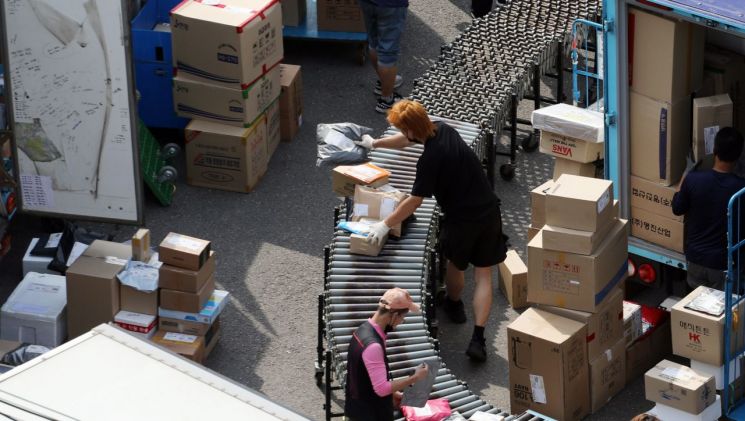 On the morning of the 8th, officials were working at a courier logistics center in Seoul.
 [Image source=Yonhap News]
Accordingly, the government, ruling party, delivery labor and management, and consumer groups formed the "Social Agreement Body for Delivery Workers' Overwork Death Countermeasures" and reached a first agreement in January stating that "delivery sorting tasks are the responsibility of delivery companies." Accordingly, delivery companies agreed to exclude sorting tasks from delivery workers' duties and to ban late-night deliveries.
However, at the second meeting of the Social Agreement Body on the 8th, negotiations among the union, delivery companies, and the government broke down. Delivery companies requested a one-year postponement of the implementation of the social agreement they promised in January, failing to narrow differences. As a result, the union launched an indefinite general strike starting on the 9th.
The union maintains that delivery workers are still performing sorting tasks. According to a survey conducted by the union on the 2nd and 3rd of this month targeting 1,186 delivery workers nationwide, 84.7% (1,005 workers) are still performing sorting tasks. It was also found that 30.2% (304 workers) are solely responsible for sorting tasks without additional personnel.
In response, the union held a rally on the 9th at the Jangji-dong Complex Logistics Center in Songpa-gu, Seoul, stating, "Delivery companies and the Korea Post have made enormous profits for decades by forcing delivery workers into sorting tasks," and raised their voices demanding, "Improve sorting tasks and apply sorting costs retroactively as per the first social agreement."
The union also insists that separate personnel must be deployed for sorting tasks. Kim Taewan, senior vice chairman of the Delivery Workers' Union, appeared on CBS Radio's "Kim Jongdae's News Up" on the 7th and emphasized, "Since sorting tasks are the core issue causing deaths from overwork, deploying sorting personnel is the most important matter."
He added, "Delivery companies are practically neglecting countermeasures against deaths from overwork and are instead raising delivery fees. This attitude of delivery companies prioritizes profit over people's safety and lives," he criticized.
© The Asia Business Daily(www.asiae.co.kr). All rights reserved.
![Clutching a Stolen Dior Bag, Saying "I Hate Being Poor but Real"... The Grotesque Con of a "Human Knockoff" [Slate]](https://cwcontent.asiae.co.kr/asiaresize/183/2026021902243444107_1771435474.jpg)

















