Trendy Tactile Toy 'Fidget Toy'
"Reduced Contact Due to COVID-19," Analysis Shows
Experts Say "No Major Concern... Also Positive Effects"
[Asia Economy Reporter Song Seung-yoon] "You lose track of time when you touch and play with it."
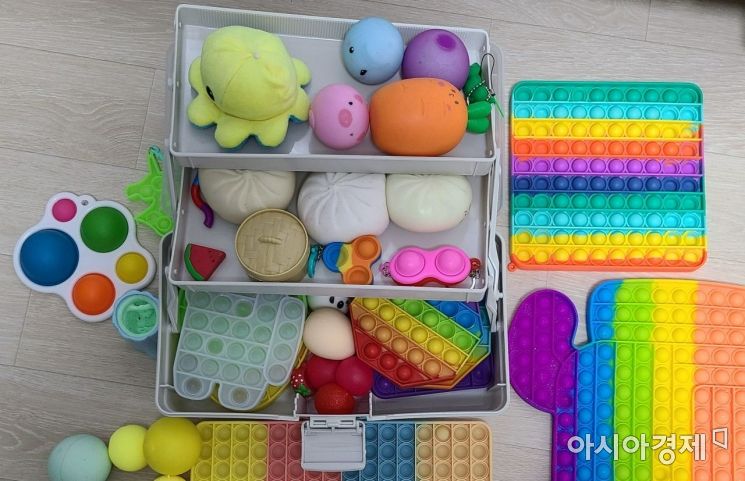
Kim Jae-yeon (9, pseudonym), a third grader at an elementary school in Incheon, has recently become deeply absorbed in a toy called 'Push Pop.' It is a silicone toy that looks like bubble wrap, a cushioning material. It is used to press the protruding parts and feel the texture while playing. According to Kim, there is no friend in her class who does not have this toy. Some even have special bags just to carry them. Kim said, "Since it is difficult to gather and play with friends, everyone plays with this," adding, "Having 2 to 3 is basic, and it is common for friends to carry more than 10 of different kinds."
‘Fidget toys,’ which are toys played with by hand, are gaining great popularity. From young children to adults, it is easy to see people holding and fiddling with them, but especially among elementary school students, they have become an indispensable essential item. Some analysts say that the COVID-19 situation is the background for the trend of fidget toys.
Fidget toy is a compound word of the English word 'Fidget,' meaning to fidget, and 'Toy.' Besides Push Pop, there are various types, sizes, and shapes such as 'stress balls' that are squeezed tightly by hand and 'squishies.' In the past, 'fidget spinners,' toys spun with fingers, were also popular, and these fidget spinners are also a type of fidget toy.
Professor Lim Myung-ho of the Department of Psychology at Dankook University explained, "Before COVID-19, children played with friends and had direct skin contact, but as the frequency of contact decreased, a kind of rebound was formed," adding, "Since situations where children had to play alone were created, playing with soft toys to relieve boredom seems to have spread like a trend."
Shin Soo-yeon (32, pseudonym), a teacher at an elementary school in Gyeonggi Province, said, "Toys are not allowed because they interfere with classes, but many children play with them during breaks or after school," adding, "There are limitations on the types of play possible, so there is a trend aspect, and YouTube also has some influence."
Many parents worry whether their children might become addicted to playing with fidget toys. Parent Jo Sun-jung (39, pseudonym) said, "I bought it because it was trendy, but seeing my child fiddling with it all day makes me worried," adding, "I am concerned that my child might get used to playing alone rather than interacting with friends." On the other hand, Professor Lim explained that these toys also have many positive effects. He said, "This type of play is sometimes used for sensory integration training for children," adding, "Feeling textures is related to emotional development and may help with attachment and sensory development."
© The Asia Business Daily(www.asiae.co.kr). All rights reserved.
![Clutching a Stolen Dior Bag, Saying "I Hate Being Poor but Real"... The Grotesque Con of a "Human Knockoff" [Slate]](https://cwcontent.asiae.co.kr/asiaresize/183/2026021902243444107_1771435474.jpg)















