Comparing Fast Food Kiosks
Complex Ordering Steps and Small Text
Difficult Access for Elderly and Disabled
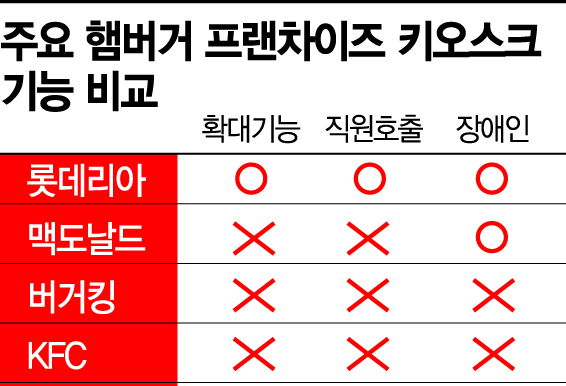
Only Lotteria Offers 'Magnifier and Staff Call' Features
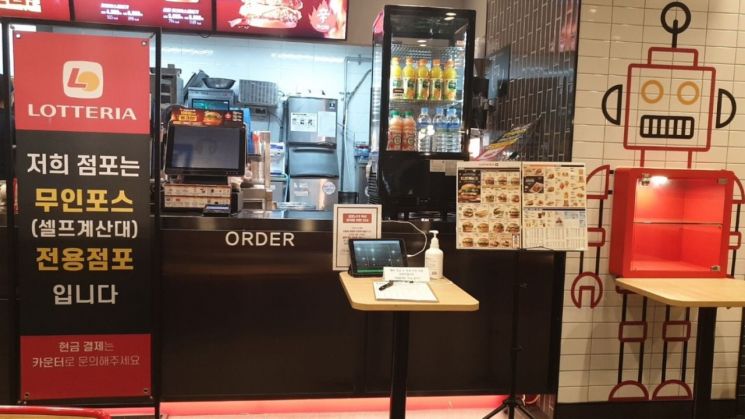 On the afternoon of the 10th, the Lotteria store located in Gwanak-gu, Seoul, is operating as an unmanned POS-only store.
[Asia Economy Reporter Lim Chun-han] # Mr. Park, in his 70s, went to a hamburger restaurant with friends for a cup of coffee but broke into a sweat in front of the kiosk (self-order machine). There were no staff at the store counter, so he had to order through the kiosk, but the menu was complicated and the text was hard to see, so after struggling for a long time, he barely completed the order with the help of a young man who looked like a grandson with a stern expression, as if saying, "If you’re going to wait, I’ll do it for you." Mr. Park said, "The machine is too complicated and the letters are too small," adding, "It basically means people like us shouldn’t come."
On the afternoon of the 10th, an attempt was made to order a BTS set at a McDonald’s store in Gwanak-gu, Seoul, using the kiosk. The BTS set was a popular menu item and could be selected directly from the main screen, but choosing the sauce, drink, and side menu was complicated even for young people. Next to me, an elderly person seemed to have pressed the wrong button and was canceling all the ordered items for a long time, looking embarrassed. Eventually, they left the store without completing the order. Similar scenes were seen at nearby Burger King and KFC stores. Since there was no other way to order besides the kiosk, elderly people asked students to order for them or adjusted magnifying glasses in front of the screen because of the small letters.
The kiosks at Lotteria stores had magnifying glasses at the bottom to enlarge the text and a staff call function. An elderly person tapped the kiosk screen several times before pressing the staff call button. Although the order was completed with the help of staff, the people waiting behind had no choice but to give disapproving looks after a long wait. Even with the functions, the atmosphere made it difficult to use them.
According to a survey conducted last year by the Korea Consumer Agency targeting 300 consumers aged 65 and older with experience in non-face-to-face transactions, kiosks at retail stores were the most difficult to use. The inconvenient aspects of kiosks (multiple responses allowed) were complicated steps (51.5%), feeling pressured by people waiting behind (49%), and unclear pictures and text (44.1%), in that order. Especially, when observing 10 users without prior kiosk experience, all five people aged 70 and above failed to place orders at fast-food restaurants.
As a result, kiosk education programs for the elderly have appeared at senior welfare centers and cultural centers. However, since kiosks differ by store, even this is not easy. Therefore, there is a growing call to expand government-level measures to the private sector to bridge the digital divide. Although public offices have started prioritizing the purchase of products that guarantee information accessibility, there are no guidelines applied to private companies, highlighting the urgent need for countermeasures.
© The Asia Business Daily(www.asiae.co.kr). All rights reserved.
![Clutching a Stolen Dior Bag, Saying "I Hate Being Poor but Real"... The Grotesque Con of a "Human Knockoff" [Slate]](https://cwcontent.asiae.co.kr/asiaresize/183/2026021902243444107_1771435474.jpg)
















