Low interest rates drive demand with improved performance
Signs of rate hikes..."Concerns over interest burden"
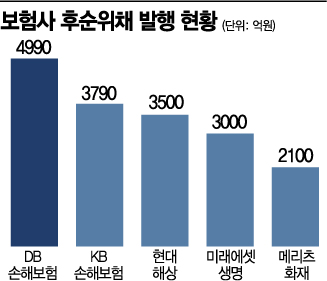
[Asia Economy Reporter Oh Hyung-gil] Insurance companies are continuously increasing the issuance scale of subordinated bonds through successful demand forecasts. This is due to the relatively high interest rates of insurance company subordinated bonds in a low-interest-rate environment and improved performance attracting strong demand.
According to the insurance industry on the 11th, DB Insurance successfully issued subordinated bonds worth 499 billion KRW the day before. Initially, the plan was to issue 300 billion KRW, but due to demand forecasts attracting more than twice the amount, 688 billion KRW, the issuance scale was increased. DB Insurance plans to use this to improve financial soundness. The solvency margin ratio (RBC), which was 195.2% at the end of March, is expected to increase to 209.3%.
Most insurance companies that issued subordinated bonds this year have also succeeded in increasing the issuance scale beyond their targets.
In last month's demand forecast conducted by KB Insurance, purchase orders worth 459 billion KRW were received, increasing the issuance scale from 200 billion KRW to 379 billion KRW. KB Insurance had previously announced plans to issue subordinated bonds worth up to 800 billion KRW divided between the first and second halves of this year.
Mirae Asset Life also received ESG (Environmental, Social, and Governance) certification and secured orders exceeding twice the planned issuance amount, 414 billion KRW, increasing the issuance scale from 150 billion KRW to 300 billion KRW. Hyundai Marine & Fire Insurance conducted a demand forecast for 250 billion KRW but received demand worth 425 billion KRW, resulting in the issuance of subordinated bonds worth 350 billion KRW.
Meritz Fire & Marine Insurance, which aimed to raise capital worth 200 billion KRW, also succeeded in issuing subordinated bonds worth 210 billion KRW after additional subscriptions increased the amount by 10 billion KRW.
Insurance companies are steadily raising their RBC ratios through subordinated bond issuance ahead of the introduction of the new international accounting standard (IFRS17) in 2023. Under IFRS17, the duration of insurance liabilities will be extended from the current 30 years to 50 years, and as the liability duration increases, the RBC of most insurance companies is expected to decline.
Subordinated bonds are recognized as supplementary capital within 50% of equity capital, and if the remaining maturity is within 5 years, the capital recognition amount is reduced by 20% annually. When issued with a 10-year maturity, the entire amount can be recognized as capital for the next 5 years.
However, there are concerns that recent signs of rising interest rates may increase the interest burden on subordinated bonds issued by insurance companies.
No Geon-yeop, a research fellow at the Korea Insurance Research Institute, said, "If the issuance of capital securities such as hybrid capital securities and subordinated bonds expands to defend against a decline in the solvency margin ratio, the rising interest rates will lead to higher interest expenses, reducing profits," adding, "To mitigate the negative impact of rising interest rates, fundamental capital management through liability restructuring is necessary."
© The Asia Business Daily(www.asiae.co.kr). All rights reserved.
![Clutching a Stolen Dior Bag, Saying "I Hate Being Poor but Real"... The Grotesque Con of a "Human Knockoff" [Slate]](https://cwcontent.asiae.co.kr/asiaresize/183/2026021902243444107_1771435474.jpg)















