Korean Air and Others Forecast Strong Earnings
International Passenger-Focused LCCs Face Challenges
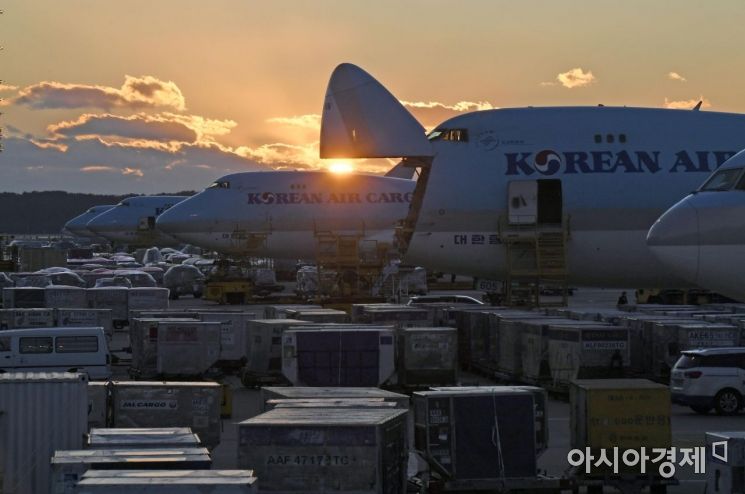 Beyond the Korean Air Cargo Terminal at Incheon International Airport, the eventful year of the Year of the Rat is coming to an end. In the New Year of the Year of the Ox, we hope that the novel coronavirus disease (COVID-19) will disappear and the skies will open wide. Photo by Moon Honam munonam@
[Asia Economy Reporter Dongwoo Lee] Following container ships, air cargo freight rates have reached record highs, widening the performance gap between full-service carriers (FSC) and low-cost carriers (LCC). With expectations that the growth in air cargo volume will continue through the second half of this year, the disparity between airlines benefiting from cargo demand and those left behind is expected to deepen further.
According to the aviation industry on the 14th, Korean Air has implemented a special measure from this month by deploying the A330, a medium-haul aircraft, on cargo routes to the U.S. East Coast. This is the first time Korean Air has used a medium-haul passenger aircraft on the U.S. East Coast route, aiming to respond to the rapidly increasing cargo transportation this year.
According to the Ministry of Land, Infrastructure and Transport, Korean Air accounted for 367,621 tons out of the total 550,822 tons of cargo transported by domestic airlines in the first quarter of this year, representing 66.7%. If the distribution of COVID-19 vaccines accelerates and the real economy recovers in earnest in the second half of the year, Korean Air’s cargo transportation revenue is expected to gain further momentum. This will be directly reflected in its performance. The securities industry forecasts that Korean Air will achieve an operating profit of 142.3 billion KRW (consolidated basis) this year, a 30.6% increase compared to last year.
On the other hand, major domestic LCCs are expected to continue operating losses following last year. According to the industry, Jin Air, Jeju Air, and T’way Air are estimated to record operating losses of 34.7 billion KRW, 52.7 billion KRW, and 31.4 billion KRW respectively in the first quarter of this year.
The delay in recovery of their core international passenger business is worsening profitability. Although LCCs are also strengthening their cargo transportation business, the consensus is that their price competitiveness is weak due to difficulties in acquiring new customers and lack of infrastructure. Jin Air’s cargo sales are expected to account for 2.4% of total sales in the first quarter, while Jeju Air and T’way Air are both expected to have less than 1%.
Jeju Air added the Incheon?Ho Chi Minh City cargo route from March, and T’way Air started operating the Incheon?Hanoi cargo route from last month, but these efforts are insufficient to reverse their performance downturn.
An aviation industry official said, "With over 90% of LCCs’ revenue structure concentrated on international passengers, it is difficult to reorganize into the cargo transportation business within a short period due to practical issues such as aircraft ownership," adding, "If COVID-19 prolongs, the performance gap with full-service carriers is expected to widen further."
© The Asia Business Daily(www.asiae.co.kr). All rights reserved.
![Clutching a Stolen Dior Bag, Saying "I Hate Being Poor but Real"... The Grotesque Con of a "Human Knockoff" [Slate]](https://cwcontent.asiae.co.kr/asiaresize/183/2026021902243444107_1771435474.jpg)















