[Asia Economy Reporter Seongpil Cho] "The session is extended. Defendant, did you have any COVID-related symptoms?" (Judge)
"No, I did not." (Professor Jeong Gyeong-shim, Dongyang University)
"That's a relief." (Judge)
The second hearing of Professor Jeong Gyeong-shim of Dongyang University, held on the 10th at the Seoul High Court Criminal Division 1-2 (Presiding Judge Eom Sang-pil), began this way. Originally, the second appeal hearing was scheduled for the 26th of last month. However, the date was postponed to this day after Professor Jeong was tested for COVID-19 and classified as a two-week quarantine subject. Professor Jeong, who was sentenced to four years in prison and detained in the first trial, is currently serving her sentence at the Seoul Detention Center in Uiwang, Gyeonggi Province. It is known that a lawyer representing an inmate at the Seoul Detention Center tested positive, and Professor Jeong was tested after overlapping movements with the inmate during lawyer visits. The test result was negative.
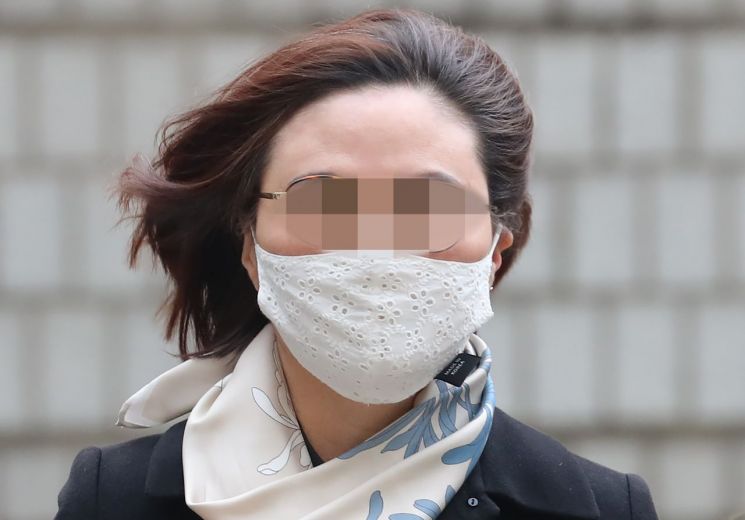 Jung Kyung-shim, a professor at Dongyang University and wife of former Minister of Justice Cho Kuk, who was prosecuted on charges including admission fraud involving their children and suspicions of private equity fund investments [Image source=Yonhap News]
Jeong Gyeong-shim’s Side: "Spec Exchange? ... That Was How It Was Back Then"
At the hearing, Professor Jeong’s defense repeatedly asserted innocence regarding the charges of admission fraud involving her children. The defense stated, "The first trial judgment mentioned 'spec exchange,' which gives a negative impression, but that was the reality at the time." The argument focused on the background where the college admission system shifted from quantitative evaluation to increased extracurricular activities, and students and parents began efforts to build specs (credentials) to apply.
The defense added, "Efforts to build specs had started, but universities and research institutes did not operate experiential activities at the time. Therefore, it was the reality to entrust acquaintances to create programs that did not previously exist, and naturally, there were no evaluation criteria or manuals." They continued, "Since there was no attendance check and no preserved records of how many hours were spent, years later, confirmation documents were created by asking the parties involved, saying 'it was done until this date'."
Previously, the first trial court recognized the so-called 'spec exchange' suspicion as fact, where Professor Jeong allegedly conspired with former Minister Cho to have Professor Jang Young-pyo of Dankook University list Cho’s daughter as the first author of a paper, and in return, Cho promised to provide an internship certificate from the Public Interest Human Rights Law Center to Jang’s son. However, the defense argued, "The defendant made efforts to manage her daughter’s specs, so the term 'spec exchange' is inappropriate."
"First Trial Judgment Is Excessive and One-sided," They Claim
The defense also addressed the first trial’s judgment that deemed the internship certificate from Dankook University Medical Science Research Institute for Jeong’s daughter, Cho Min, as false. They said, "There may be exaggeration or embellishment, but to say it is entirely false is excessive." They added, "The first trial judged that the defendant changed an experiential activity certificate into an internship certificate, but we do not understand what the difference is between the two."
The court then directly asked Professor Jeong why she changed the experiential activity certificate to an internship certificate. She replied, "The experiential activity certificate was in the format of Han Young Foreign Language High School, which Cho Min attended. At the time of requesting the certificate, Cho Min was attending Korea University, so I thought it would be better to change it to an internship certificate." The defense elaborated that the certificate was originally titled experiential activity certificate in 2009 but was changed to internship certificate in 2013, indicating that Professor Jeong did not falsify the content.
The defense also called the first trial’s guilty verdict on the forgery of Dongyang University’s award certificate "somewhat one-sided." They explained, "It is hard to believe that the defendant had a motive to forge the award certificate. Since the relationship between President Choi Seong-hae and the defendant was very good at the time, if she had asked, there would have been no reason not to issue it." They added, "We raise reasonable doubt incompatible with the prosecution’s facts. Apart from the files found on the PC discovered in the Dongyang University lounge, there is no evidence regarding the rest of the process involving the defendant."
Prosecution: "The Original Trial Court Thoroughly Examined the Case"
However, the prosecution rebutted Jeong’s defense by stating, "The original trial court conducted 66 document investigations over 407 hours and more than 200 hours of witness questioning, thoroughly examining this case." They added, "All the reasons for appeal by the defense are identical to those argued at the original trial and were meticulously examined and rejected by the first trial court." The prosecution emphasized, "The award certificate files found on the PC in the Dongyang University instructor lounge are evidence that concretizes the crime."
The prosecution also mentioned charges against Professor Jeong for fraud and violation of the Act on the Management of Subsidies (receiving false subsidies). It is alleged that in July 2013, Professor Jeong received a subsidy of 12 million KRW from the Gyeongsangbuk-do Office of Education for an English gifted program and teaching materials project, and paid 3.2 million KRW in allowances to Cho Min, who did not perform research assistant activities. The prosecution stated, "Cho Min was never a research assistant at Dongyang University. The defendant claims it was a minor procedural violation, but if there was no research assistant, what else could this be but fraud?"
The prosecution reiterated that Professor Jeong and former Minister Cho were in collusion. Related charges include the issuance of a false internship certificate from Seoul National University’s Public Interest Human Rights Law Center for Cho Min. The prosecution argued, "Cho Min did not attend the Seoul National University seminar held on May 15, 2009, and neither the center director Han In-seop nor former Minister Cho met her at that time. The typing of the internship certificate was done by former Minister Cho, establishing joint perpetration of forgery."
Defense: "We Want to Reapply for Han In-seop as a Witness"
The defense expressed their intention to reapply for Han In-seop, whose witness examination was canceled in the first trial. The defense said, "We need to conduct witness questioning, but it seems Han In-seop does not like to appear as a witness or be involved in this case, which puts us in a difficult position. Regardless of his personal will, we believe he should be summoned as a witness."
Previously, in the first trial, the prosecution summoned Han In-seop, the director of Seoul National University’s Public Interest Human Rights Law Center at the time, to question him about allegations of issuing a false internship certificate to Cho Min in 2009. However, Han refused to testify, citing his status as a suspect in the allegations. When Han refused to testify, Professor Jeong’s side agreed to use Han’s prosecution statement as evidence, which ultimately served as evidence for Professor Jeong’s conviction.
Meanwhile, the court announced that it would temporarily deny the Seoul Metropolitan Office of Education’s request to provide the first trial judgment document for Professor Jeong. The court explained, "The request letter did not clearly state the grounds and reasons, so we questioned whether it is necessary to provide the original judgment document."
© The Asia Business Daily(www.asiae.co.kr). All rights reserved.
![Clutching a Stolen Dior Bag, Saying "I Hate Being Poor but Real"... The Grotesque Con of a "Human Knockoff" [Slate]](https://cwcontent.asiae.co.kr/asiaresize/183/2026021902243444107_1771435474.jpg)
















