Young Adults and Office Workers' Virtual Currency Investment Fever
Staring at Coins All Day Due to Extreme Volatility
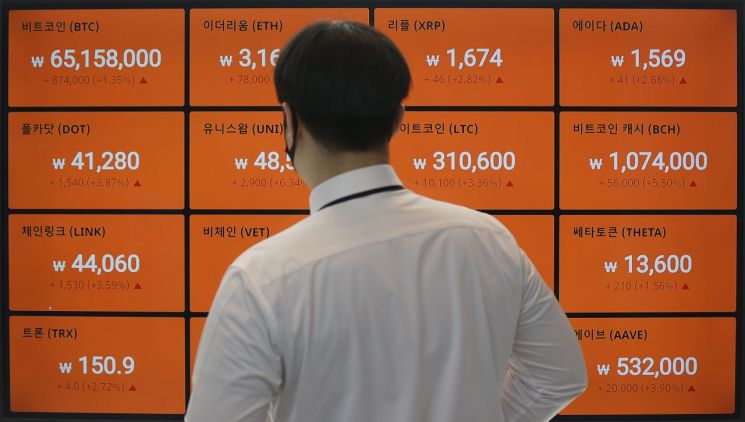 On the morning of the 28th of last month, when Bitcoin, a representative cryptocurrency, started the market with a slight upward trend, the coin prices were displayed on the price board at Bithumb Gangnam Center in Gangnam-gu, Seoul.
 [Image source=Yonhap News]
[Asia Economy Reporter Han Seung-gon] "There are really many friends around me who say it’s hope."
'One shot in life,' 'money duplication,' 'Korin-i' are words that can sum up the recent cryptocurrency craze among people in their 20s and 30s. Young people are fully engaged in coin investment, saying that the 'ladder of social mobility' no longer exists in this lifetime.
The situation for office workers in their 30s and 40s is not much different. They buy coins worth hundreds of thousands of won for purposes such as buying a house and chant "Gaja!" (a kind of coin investment slang hoping the invested coin will quickly enter a rising price trend) like a mantra.
Kim, a man in his 30s who works in Seoul, said, "I recently started investing a large sum of money in coins," adding, "The market itself is so volatile that there is some risk involved." He continued, "But if you think about it the other way, isn’t it a kind of opportunity that is more open? It’s rather hopeful."
The reaction of young people is no different. Lee, a college student in his 20s, said, "There are too many places where money goes, like student loans and job preparation, and even if I get a job at a company with difficulty, buying a house seems impossible in this lifetime," adding, "I hope people see it not as speculation but as a tool for survival."
As young people expect, the cryptocurrency market is attracting the 20s and 30s generation. According to data on investor status received by Rep. Kwon Eun-hee (People’s Party) of the National Assembly’s Political Affairs Committee from the Financial Services Commission from the four major exchanges?Bithumb, Upbit, Korbit, and Coinone?the total number of new subscribers in the first quarter of this year was 2,495,289. New subscribers are users who newly linked real-name accounts.
By age group, the proportion of the 20s and 30s generation exceeded half. People in their 20s accounted for 32.7% (816,039), the largest share. Next were those in their 30s at 30.8% (768,775), 40s at 19.1% (475,649), 50s at 8.8% (219,665), and 60s at 2.1% (51,321). Looking at the generations focused on cryptocurrency investment, it can be narrowed down to those in their 20s to 40s.
However, the cryptocurrency market operates 24 hours a day, 365 days a year, making it difficult to maintain a proper daily life. Among office workers, there are also complaints that they cannot concentrate properly on their work. Lee, a company employee in his 30s, said, "I literally keep paying attention to coin prices, so I can’t focus on work," adding, "I think it’s a problem because it seems addictive."
The risk of cryptocurrency investment lies in extreme volatility and the fact that it can be traded 24/7, making it difficult to continue daily life if one keeps worrying about coins. If losses occur in the process, there is practically no capacity to focus on anything else.
Nassim Nicholas Taleb, a former risk analyst and options trader, has expressed a negative outlook on Bitcoin.
In February, he tweeted that he had sold all the BTC he had held. In an interview with BNN Bloomberg, he explained the reason for selling Bitcoin as, "A currency should not show volatility when buying and selling." He also pointed out, "Bitcoin cannot price goods. In that respect, at least so far, Bitcoin is a failure."
Michael Saylor, CEO of MicroStrategy, who actively supported Bitcoin, also criticized that while Bitcoin is a store of value, it lowers the value of other assets and currencies.
Regarding the extreme volatility and the fact that coin investment requires attention almost all day, in February 2018, a man in his 30s who lost his principal committed suicide. Last month, a man in his 20s, presumed to be despondent over investment failure, also took his own life. Although no suicide note was found at the scene, it was reported that this young man had recently suffered huge losses from cryptocurrency investment failure.
Meanwhile, the government announced that from January 2022, income from virtual assets will be classified as other income and taxed separately at a rate of 20% (excluding local tax). The basic deduction amount is 2.5 million won. Loss offsetting will be applied by summing income and losses from various virtual assets over one year. If profits exceeding 2.5 million won occur from virtual asset transactions next year, they must be reported and paid by May 2023.
© The Asia Business Daily(www.asiae.co.kr). All rights reserved.
![Clutching a Stolen Dior Bag, Saying "I Hate Being Poor but Real"... The Grotesque Con of a "Human Knockoff" [Slate]](https://cwcontent.asiae.co.kr/asiaresize/183/2026021902243444107_1771435474.jpg)
















