[Asia Economy Reporter Kim Jonghwa] As the COVID-19 pandemic has prolonged 'staying at home,' the demand for self-interior design has increased. With more time spent at home, people are decorating their spaces with home cafes and home wine bars, and to break free from the confinement of staying indoors, some are refreshing the atmosphere with nature-inspired interior designs like 'Planterior.'
As a result, the market is gaining momentum with increased purchases of interior products online. According to Statistics Korea, last year, retail sales of furniture exceeded 10 trillion won for the first time, with online transactions accounting for 4.988 trillion won, a 44% increase compared to the previous year.
Previously, customers would check interior goods and furniture in stores before purchasing, but since the COVID-19 situation, online channels have become the main purchasing platform.
Thanks to this, online interior platforms and O2O channels are also experiencing rapid growth. As of the end of last year, 'Oneul-ui Jip' (Today’s House) surpassed 15 million cumulative app downloads, and its monthly transaction volume, which was around 30 billion won at the beginning of last year, grew to over 100 billion won by year-end.
The similar platform 'Jipdak' has also seen about a 20% increase in interior requests from residents over the past two years, with interior-related search volume growing approximately fivefold. The construction amount through Jipdak was about 140 billion won in 2020 and is expected to increase to around 250 billion won this year. The industry analyzes that "the non-face-to-face trend combined with the demand for home decoration has doubled people's interest."
In response, the interior industry is actively expanding online sales channels. Despite premium kitchen and bath brand Kohler mainly supplying high-end products installed in hotels, it opened an official smart store earlier this year.
In April alone, detailed views of 'bidets and bidet accessories' reached 6,000, and online inquiries for bathroom interior products such as shower faucets and washbasins have also increased. Encouraged by consumers' active interest, Kohler continues to update various categories of its products within the smart store.
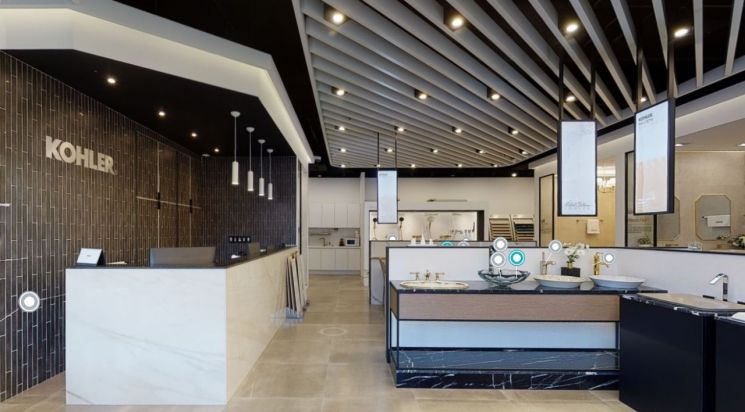
Along with growing consumer interest online, Kohler opened a VR showroom in February. In the era of non-face-to-face interactions, the showroom space has been moved online. The Kohler VR showroom offers everything from viewing actual showroom display products to providing detailed product information and related videos through VR showroom link tags.
Each showroom features different spatial atmospheres and display products, allowing customers to easily gauge how various product styles harmonize with interior design. This enables information exploration for self-interior design from home without needing to go outside.
Park Sunyoung, Marketing Director of Kohler Korea, said, "With the increase in self-interior demand and the non-face-to-face trend, the online market growth in the interior industry is expected to continue," adding, "Kohler will also strive to expand both online and offline sales channels to create opportunities for customers seeking self-interior solutions to experience Kohler products more closely."
© The Asia Business Daily(www.asiae.co.kr). All rights reserved.
![Clutching a Stolen Dior Bag, Saying "I Hate Being Poor but Real"... The Grotesque Con of a "Human Knockoff" [Slate]](https://cwcontent.asiae.co.kr/asiaresize/183/2026021902243444107_1771435474.jpg)















