Domestic reporting rate at 0.47% over two months, similar to overseas
Higher than last year's flu vaccine
But shows a decreasing trend compared to early vaccination stages
[Asia Economy Reporter Kim Ji-hee] Two months after the start of COVID-19 vaccination in South Korea, the cumulative number of vaccinated individuals is approaching 4 million, with an adverse reaction reporting rate of 0.47%. This rate is much higher than the adverse reaction reporting rate for influenza vaccines but is similar to the rates reported overseas for COVID-19 vaccines. ▶Related article page 4
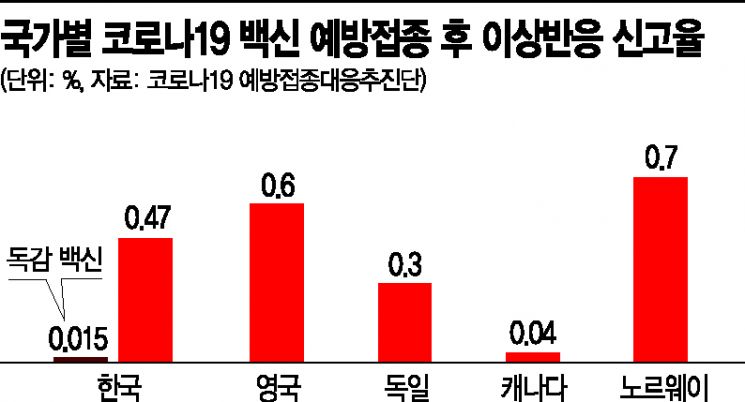
On the 6th, Asia Economy analyzed the adverse reaction reporting rate for COVID-19 vaccines in South Korea and found that as of midnight that day, a total of 18,260 cases suspected of adverse reactions had been reported. The cumulative number of first-dose vaccinations reached 3,883,829, resulting in an adverse reaction reporting rate of 0.47%. This is higher than last year’s influenza vaccine adverse reaction reporting rate of 0.015% (as of midnight December 5 last year, with 13.55 million vaccinations and 2,017 adverse reaction reports).
The medical community assessed that since the typical adverse reaction reporting rate for general vaccines is around 0.1?0.5%, the COVID-19 vaccine’s adverse reaction reporting rate is not significantly high. In major European countries, the adverse reaction reporting rates for COVID-19 vaccines are approximately 0.6% in the UK, 0.3% in Germany, and 0.7% in Canada and Norway. Park Young-jun, head of the Adverse Reaction Investigation Support Team at the COVID-19 Vaccination Response Promotion Team, explained, "The domestic adverse reaction reporting rate fluctuates weekly; it was quite high in the early stages of vaccination but has gradually stabilized." The adverse reaction reporting rate, which was 1.81% in the first week of vaccination, dropped below 1% by the third week (0.74%) and further decreased to 0.12% last week (April 25?May 1).
For the AstraZeneca vaccine, the actual adverse reaction reporting rate was higher compared to the Pfizer vaccine. Both vaccines have been administered to about 1.9 million people each so far, with AstraZeneca showing a 0.8% reporting rate and Pfizer 0.1%. However, the rate of reported severe and fatal cases was similar, at about 4 cases per 100,000 vaccinated individuals.
By age group, the adverse reaction reporting rate was highest among people in their 20s. The reporting rate for the 20s age group was 2.9% relative to the number of vaccinations, followed by 1% for those in their 30s, 0.7% for their 40s, 0.4% for ages 50?64, 0.2% for ages 65?74, and 0.1% for those 75 and older. The severe and fatal case reporting rate was highest among those aged 65 and older, approaching 0.01%, while the rate for people in their 20s was 0.007%, higher than that for those in their 30s and 40s.
© The Asia Business Daily(www.asiae.co.kr). All rights reserved.
![Clutching a Stolen Dior Bag, Saying "I Hate Being Poor but Real"... The Grotesque Con of a "Human Knockoff" [Slate]](https://cwcontent.asiae.co.kr/asiaresize/183/2026021902243444107_1771435474.jpg)















