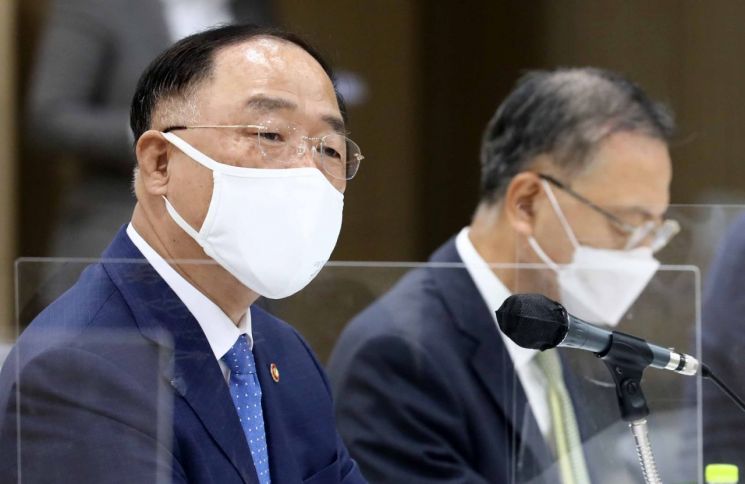
 Deputy Prime Minister for Economic Affairs Hong Nam-ki is presiding over the 9th Innovation Growth BIG3 Promotion Meeting held at the Pangyo System Semiconductor Design Support Center in Sujeong-gu, Seongnam-si, Gyeonggi-do on the morning of the 6th. 2021.5.6
 [Photo by Yonhap News]
[Sejong=Asia Economy Reporter Son Seon-hee] The government is considering expanding tax credits for semiconductor research and development (R&D) and facility investments. This is part of a commitment to drastically foster the domestic semiconductor industry amid intensifying so-called 'semiconductor hegemony competition' in the global market.
Hong Nam-ki, Deputy Prime Minister and Minister of Economy and Finance, chaired the 9th Innovation Growth BIG 3 Promotion Meeting at the System Semiconductor Design Support Center in Pangyo, Gyeonggi Province, this morning. He stated, "We will create a separate track beyond general and new growth source technologies to actively enable companies to secure core technologies and expand mass production facilities, and consider expanding tax credits for R&D and facility investments."
The current tax credit rates generally apply 0-2% for R&D and 1% for facility investments. For new growth and source technologies, 20-30% for R&D and 3% for facility investments are applied, but the industry has raised complaints that these are grossly insufficient compared to the large-scale funds invested. As the government emphasizes 'drastic fostering,' benefits exceeding the existing tax credit scale are expected to be applied.
Additionally, measures under review include ▲support for infrastructure such as power and water supply when establishing semiconductor clusters ▲support for shared utilization facilities such as AI semiconductor design support centers ▲new establishment of a 280 billion KRW semiconductor fund for materials, parts, and equipment and additional long-term low-interest loans for facility funds ▲more than doubling the scale of system semiconductor workforce training and expanding enrollment in semiconductor-related departments.
Recently, due to a shortage of automotive semiconductors causing disruptions in domestic automobile production, the government expects this month to be the peak of supply instability. In this regard, it was decided to actively utilize the quarantine exemption system during vaccination to prevent inconvenience to businesspeople in parts procurement activities and to identify and prioritize support for some items that can be commercialized in the short term.
Deputy Prime Minister Hong also said, "Our semiconductor industry requires a fundamentally different approach from before to maintain the memory semiconductor super-gap and secure system semiconductor competitiveness," adding, "We are preparing the 'K-Semiconductor Belt Strategy' for a leap to a comprehensive semiconductor powerhouse, which will be announced soon."
Semiconductor-related businesspeople attending the meeting included Shim Sang-pil, Vice President of Samsung Electronics; Park Yong-geun, Vice President of SK Hynix; and Jang Jae-ho, Executive Director of Hyundai Mobis.
© The Asia Business Daily(www.asiae.co.kr). All rights reserved.
![Clutching a Stolen Dior Bag, Saying "I Hate Being Poor but Real"... The Grotesque Con of a "Human Knockoff" [Slate]](https://cwcontent.asiae.co.kr/asiaresize/183/2026021902243444107_1771435474.jpg)















