US Equipment Investment 40% Tax Credit Bill Pending in Congress... Our Government Unlikely to Expand from 3% to 50%
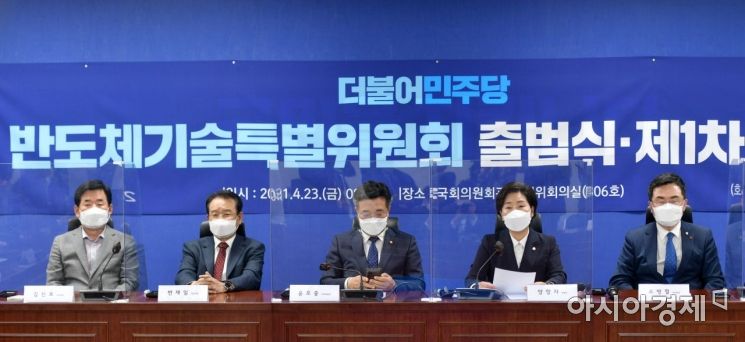 Yang Hyang-ja, Chairperson of the Semiconductor Technology Special Committee of the Democratic Party of Korea, is attending the launch ceremony and the first meeting of the Semiconductor Technology Special Committee held at the National Assembly on the 23rd, delivering a greeting./Photo by Yoon Dong-ju doso7@
[Sejong=Asia Economy Reporter Kwon Haeyoung] The government will unveil the 'K-Semiconductor Belt Strategy' within this month, which includes comprehensive support measures such as expanding tax credits for semiconductor investments, workforce training, and research and development (R&D) investments. The core is the expansion of tax credits for facility investments. Since a bill that refunds 40% of semiconductor facility investments in the U.S. as a corporate tax credit is currently pending in Congress, there are expectations that it will be difficult for the government to expand the tax credit for facility investments to the 50% level requested by domestic companies.
According to related ministries on the 1st, although the U.S. Congress passed the National Defense Authorization Act for Fiscal Year 2021, some semiconductor chapters were excluded. While the budget bill to invest up to $50 billion for semiconductor infrastructure and R&D support was passed, the proposal to provide up to 40% tax credits on facility investments remains pending.
A government official explained, "Regarding the plan to expand semiconductor facility investment tax credits to 40%, the atmosphere in the U.S. Congress is not particularly favorable."
As the U.S. moves to reorganize the semiconductor supply chain led by its own country, the government has also decided to announce semiconductor industry measures within this month. Previously, the industry delivered a petition to the government, citing the U.S. legislative efforts and requesting an expansion of tax credits up to 50% for R&D and manufacturing facility investment costs. Currently, the tax credit rate for large corporations is 20% of R&D investment and 3% of facility investment. However, since the U.S. has not expanded the facility investment tax credit to 40%, it is expected that the government will find it difficult to increase the current 3% rate to the industry's requested 50%.
Deputy Prime Minister and Minister of Economy and Finance Hong Nam-ki has only announced plans to expand R&D tax credits. Last month, Minister Hong said, "We will consider including memory semiconductor design and manufacturing technology in the scope of new growth and original technology R&D tax credits." If recognized as new growth and original technology, large corporations can receive tax credits up to 30% of R&D investment. However, there was no mention of tax benefits related to facility investments.
A government official said, "All related ministries have reached a consensus on the need to expand tax credits for facility investments," adding, "We are discussing ways to provide maximum support so that our companies can secure competitiveness in the global market."
Inside and outside the industry, there are demands for a significant expansion of tax benefits for semiconductor facility investments. Park Jae-geun, president of the Korea Semiconductor Display Technology Society (professor at Hanyang University’s Department of Convergence Electronics Engineering), emphasized at a forum held on the 28th of last month, "Semiconductors are a representative capital-intensive industry where competitiveness is determined by the scale of production facility investments," and "Without active tax benefits from the government, it is impossible to enhance the competitiveness of Korean semiconductor companies." The society argued that ▲ intelligent memory semiconductors require 30% ▲ automotive semiconductors 50% ▲ foundry 40% ▲ materials, parts, equipment, and packaging 40% tax benefits.
Meanwhile, the National Assembly is also actively working to support the semiconductor industry. After launching the Semiconductor Technology Special Committee, the Democratic Party plans to prepare a special law by August that includes tax credits for the semiconductor industry, fast-track approval for semiconductor facilities, and deregulation measures. In the opposition party, Rep. Chu Kyung-ho of the People Power Party has proposed a bill to provide a 50% tax credit on semiconductor R&D and facility investment costs.
© The Asia Business Daily(www.asiae.co.kr). All rights reserved.

![User Who Sold Erroneously Deposited Bitcoins to Repay Debt and Fund Entertainment... What Did the Supreme Court Decide in 2021? [Legal Issue Check]](https://cwcontent.asiae.co.kr/asiaresize/183/2026020910431234020_1770601391.png)