Shipping Rates Hit Record High... US Treasury Yields Stir
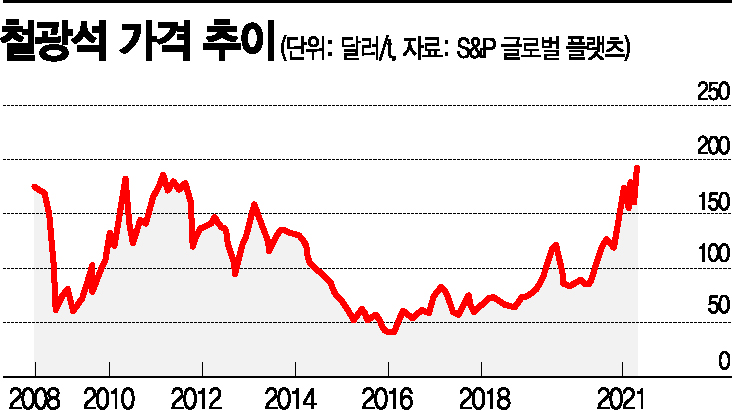
[Asia Economy New York=Correspondents Baek Jong-min, Park Byung-hee, Lee Dong-woo] Prices of key industrial raw materials, iron ore and copper, have soared to record highs, raising the risk of inflation once again. The Baltic Dry Index (BDI), which tracks bulk carrier freight rates transporting raw materials like iron ore, has also been hitting new record highs daily, making an increase in corporate cost burdens inevitable. Rising corporate costs are highly likely to lead to higher consumer prices.
According to Bloomberg on the 27th (local time), copper prices at the London Metal Exchange rose more than 2% intraday to reach $9,965 per ton. This is only 2.25% short of the all-time high of $10,190 recorded in February 2011.
Iron ore prices have even surpassed their all-time highs. According to commodity information provider S&P Global Platts, iron ore prices rose to $193.85 per ton, exceeding the previous record of $193 per ton set in 2011. Copper and iron ore prices rose 90% and 130% respectively last year and have continued their upward trend this year.
The expectation that global demand will increase as the world economy recovers from the COVID-19 phase is driving up raw material prices.
The rise in raw material prices has also affected the bond market. As inflationary pressures increase, bond prices have fallen (yields have risen). The 10-year U.S. Treasury yield, which was 1.568% the previous day, re-entered the 1.6% range and rose to 1.618% on the day.
◆ Raw materials and shipping freight rates hit new record highs daily = Iron ore prices are strong as steel prices in China rise. The Chinese government recently restricted steel production in the Tangshan region, the largest steel-producing area, to reduce greenhouse gas emissions. The reduction in steel supply from Tangshan has pushed steel prices higher, which in turn has driven up prices of raw materials like iron ore.
In the case of copper, benefits from the transition to eco-friendly industries are also expected. Morgan Stanley analyzed in a January report that electric vehicles use about 80 kg of copper, which is four times more than internal combustion engine vehicles. Copper is also widely used in wind turbines and solar energy facilities. Demand for copper is expected to increase up to 12 times due to the transition to eco-friendly energy systems. Morgan Stanley forecasts that copper demand in the electric vehicle sector alone will grow by 7% annually until 2030.
Political issues causing production disruptions in Chile, the world's largest copper producer, are also factors driving copper prices up. Chile has recently been focusing on addressing the legacy of the Pinochet dictatorship. This has led to expectations of delays in mining investments and support. Diego Hernandez, chairman of the Chilean Mining Association, said, "We are currently in a situation where investment decisions are on hold as we watch the political policy process." The Chilean Congress passed a tax increase bill last month targeting copper and lithium producers.
Chile is overwhelmingly the world's largest copper producer. Its production exceeds the combined output of Peru, China, and the Democratic Republic of Congo, which rank second to fourth. However, Chile's copper production fell by 1.6% last year compared to the previous year.
Bulk carrier freight rates transporting raw materials continue to hit new record highs daily. As of the 26th, the BDI index rose 0.72% to 2,808, breaking its record high again just one day after the previous peak. The BDI has surged 324.8% over the past year.
The daily average charter rate for 180,000-ton Capesize bulk carriers also continued its sharp rise, reaching $35,347 on the same day, following a breakthrough of $30,000 on the 21st.
◆ GE and 3M announce price hikes... U.S. Treasury yields stir again = Larry Culp, CEO of General Electric (GE), appeared on CNBC that day and said that rising raw material prices are increasing cost pressures, leading to product price increases. 3M also announced price hikes, citing strong demand this year and rising raw material prices. 3M explained that the rise in raw material prices was due to supply chain disruptions caused by COVID-19 and the impact of cold weather.
The market is showing unease ahead of the Federal Open Market Committee (FOMC) announcement scheduled for the 28th in the U.S. Federal Reserve Chair Jerome Powell is expected to reiterate his stance of tolerating inflation this time as well. However, many market experts believe that the Fed should still reduce its accommodative policies.
A CNBC survey of 34 Wall Street economic experts found that 56% of respondents believe the Fed should respond to the Biden administration's large-scale fiscal stimulus by reducing asset purchases faster and raising interest rates. Respondents expect the Fed not to reduce its monthly bond purchases of $120 billion until January next year. The benchmark interest rate, which was lowered to near zero after the COVID-19 outbreak, is expected to be raised for the first time in December next year.
© The Asia Business Daily(www.asiae.co.kr). All rights reserved.
![Clutching a Stolen Dior Bag, Saying "I Hate Being Poor but Real"... The Grotesque Con of a "Human Knockoff" [Slate]](https://cwcontent.asiae.co.kr/asiaresize/183/2026021902243444107_1771435474.jpg)















