WSJ: "Taiwan's Defense Capability Not Enough to Deter Chinese Invasion"
Defense Ranking Falls from 14th to 22nd Over 10 Years
Conscription Reduction and Defense Budget Cuts Cited as Causes
US Indo-Pacific Commander: "China May Invade Taiwan Within 6 Years"
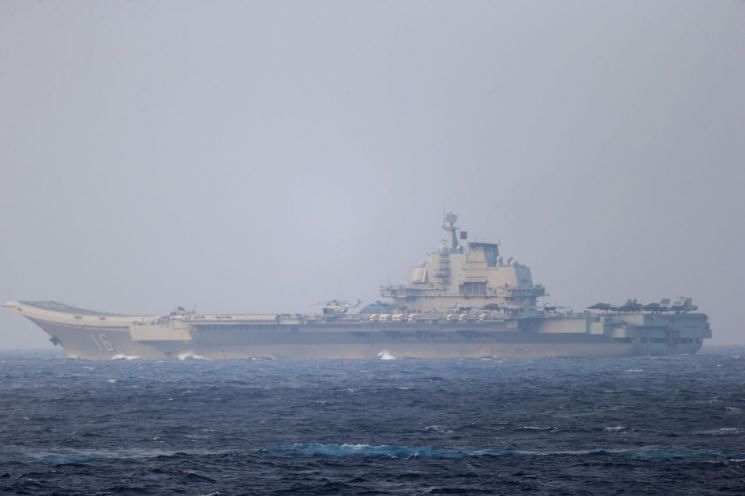
[Asia Economy Reporter Kim Suhwan] "Doubts are growing about whether Taiwan has the capability to defend against a Chinese invasion."
Recently, as China has been conducting consecutive military exercises near Taiwan's waters and frequently intruding into Taiwan's Air Defense Identification Zone (ADIZ), escalating military tensions between the two countries, the Wall Street Journal (WSJ) described Taiwan's current defense status in this way. Despite the conflict between China and Taiwan, the possibility of China immediately invading Taiwan is low, but Taiwan does not have sufficient military capability to deter China's invasion intentions.
Currently, China has 100 times more army personnel than Taiwan and invests 25 times more in its military budget. Shen Yiming, who served as Taiwan's Chief of Staff until 2019, previously stated, "From our perspective, we are far behind the necessary level of defense capability," emphasizing the need to invest in various military assets such as naval mines, missile destroyers, and portable rocket launchers to prepare for guerrilla warfare against China.
Earlier this month, U.S. Secretary of State Tony Blinken also stated that the U.S. would guarantee Taiwan's safety and hinted at the possibility of selling military weapons to Taiwan. However, he did not clearly answer whether the U.S. would intervene if China actually invaded Taiwan. This has led to calls among U.S. diplomatic experts for a clear declaration of intent that the U.S. military would intervene should a Chinese invasion of Taiwan materialize.
In fact, the U.S. Department of Defense is reportedly studying simulated exercises to prepare for a Chinese invasion through virtual scenario training. The WSJ reported, "The Department of Defense is researching scenarios ranging from direct deployment of U.S. troops to naval dispatches supporting missile attacks."
"China will not attack us"…Passive defense budget expansion and reduction of conscription due to public perception
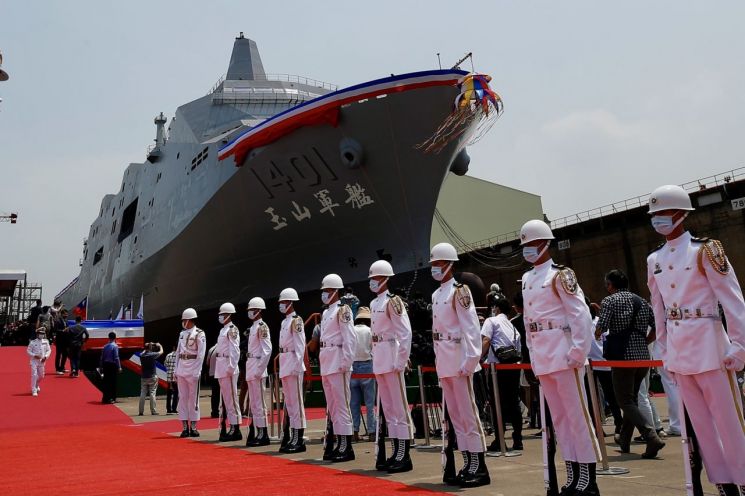 The newly commissioned Taiwanese landing transport ship Yushan on the 13th [Image source=EPA Yonhap News]
So, is Taiwan's defense capability insufficient to deter China? In fact, Taiwan's defense ranking has been on a downward trend over the past decade. According to the Global Firepower (GFP) military strength index, Taiwan ranked 14th in 2011 but has steadily declined to 22nd last year.
The weakening of Taiwan's defense is analyzed to be due to the transition from conscription to an all-volunteer force, which has significantly shortened the military service period. Previously, Taiwan reduced mandatory military service from two years to four months. Consequently, the size of Taiwan's army shrank from 275,000 three years ago to 165,000 last year. Additionally, the training of the 2.5 million-strong reserve forces occurs every two years, raising concerns about the reserves' insufficient capabilities.
Notably, the background of this policy direction by the Taiwanese government includes the fact that Taiwanese citizens perceive the possibility of a Chinese invasion as low, leading to strong public opinion against conscription, which critics say has caused the government to be swayed by public sentiment. Alexander Huang, former chairman of the Mainland Affairs Council of the Republic of China, which oversees Taiwan's China policy, said, "Until recently, the Chinese military has frequently violated our ADIZ and conducted shows of force. However, public opinion polls show that the public believes China will not invade us."
However, U.S. authorities view the possibility of a Chinese invasion of Taiwan as significant. Admiral Phil Davidson, commander of the U.S. Indo-Pacific Command, recently testified before Congress that China could invade Taiwan within six years. Oriana Skylar Mastro, a China military expert at Stanford University, stated at a congressional hearing in February, "According to some Chinese military leaders, China believes it has the capability to forcibly unify with Taiwan within one year."
James Huang, a former Taiwanese army lieutenant colonel, said, "Our own simulations predict that China could neutralize Taiwan's air force control center within one minute," emphasizing that the threat of a Chinese invasion should not be underestimated.
However, there are counterarguments that the theory of a Chinese invasion of Taiwan is exaggerated, given Taiwan's coastline is difficult for amphibious landings and already fortified by Taiwan. Instead, China may still exert indirect pressure on Taiwan by occupying Taiwan-owned islands adjacent to the mainland.
Additionally, the pro-China Kuomintang government's reluctance to increase the defense budget during its tenure is also cited as a factor in Taiwan's weakening defense capabilities. According to the Stockholm International Peace Research Institute, during President Ma Ying-jeou's administration from 2008 to 2016, Taiwan's defense budget increased by only about 3.5% annually. This contrasts with China, whose defense budget roughly doubled each year.
Political analyst Michael Cole said, "The Ma Ying-jeou administration lacked interest in preparing for China's military threat, which led to a loss in Taiwan's defense capabilities."
From the Tsai Ing-wen administration, a renewed stance to check China
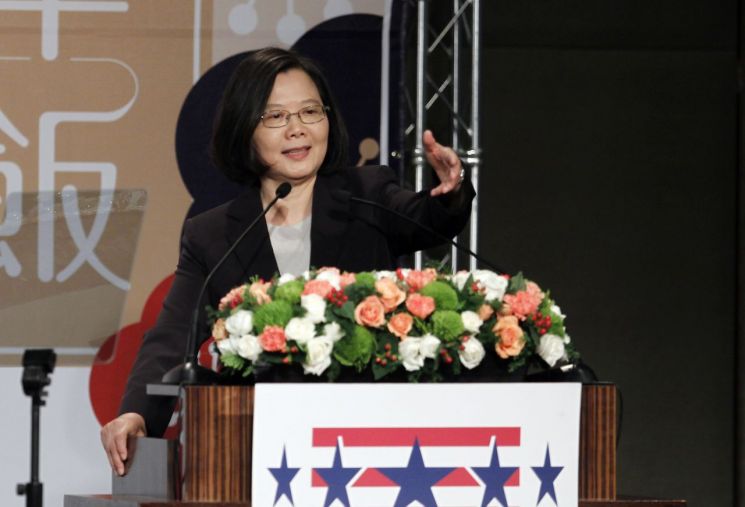
Since taking office in 2016, Taiwan's Democratic Progressive Party President Tsai Ing-wen has broken away from the previous Kuomintang's pro-China stance and focused on strengthening defense capabilities. Since Tsai Ing-wen's inauguration, the defense budget has increased annually, with a planned increase of about 10% this year to $15.4 billion (approximately 17 trillion KRW). Additionally, the Taiwanese government is increasing purchases of various asymmetric weapons from the U.S., including drones, anti-ship missiles, and mobile rocket launchers.
Moreover, Taiwan conducts regular training to prepare for various war scenarios. The annual Han Kuang exercises began on the 23rd, during which Taiwan is running simulations to predict Chinese military actions, conducting cyberattack defense drills, and preparing for potential uprisings by pro-China factions within the country. Taiwan's Minister of National Defense, Chiu Kuo-cheng, stated, "This exercise has been extended by several days compared to previous years to prepare for all possible scenarios." Taiwan has significantly increased the intensity of its training amid rising military tensions with China.
In particular, Taiwan plans to focus on actively countering China's threats in this exercise and the upcoming July drills. Minister Chiu Kuo-cheng said at a press conference before the exercises, "We do not intend to wait for foreign reinforcements to arrive. We will fight to the end for as long as the enemy wants to fight."
© The Asia Business Daily(www.asiae.co.kr). All rights reserved.
![Clutching a Stolen Dior Bag, Saying "I Hate Being Poor but Real"... The Grotesque Con of a "Human Knockoff" [Slate]](https://cwcontent.asiae.co.kr/asiaresize/183/2026021902243444107_1771435474.jpg)

















