Ministry of Employment to Collect Opinions Until the 26th
Economic Organizations like KEC and HKEF Propose Repeated Amendments to Some Clauses
[Asia Economy Reporter Kim Heung-soon] Major domestic economic organizations have raised concerns that some provisions of the amended "Labor Union and Labor Relations Adjustment Act (Labor Union Act)," set to be enforced in July, could cause confusion in the field and have called for supplementary measures. With only five days left until the government’s designated opinion collection period ends on the 26th, the business community is making a final appeal to have their concerns reflected.
"Concerns Over Increased Confusion in Industrial Sites"
"Clarification of Regulations on Non-Employee Access to Workplaces"
According to economic organizations on the 21st, the Korea Economic Research Institute (KERI) under the Federation of Korean Industries recently submitted a letter of amendment and supplementation opinions regarding the "Labor Union Act Enforcement Decree Draft" to the Ministry of Employment and Labor. The Ministry set the legislative notice period (March 17 to April 26) to ensure the amended Labor Union Act, passed by the National Assembly through government legislation last December, is properly implemented in the field, and is collecting opinions from stakeholders such as labor and management before finalizing the decree. Earlier, the Korea Employers Federation also submitted management’s opinions containing supplementary measures for the amended enforcement decree to the Ministry on the 16th.
A representative provision that economic organizations argue needs supplementation is Article 5, Paragraph 2, which stipulates that "non-employees such as dismissed workers and unemployed persons may engage in labor union activities at the business or workplace to the extent that it does not interfere with business operations." The economic organizations are concerned that the scope of "not interfering with the employer’s efficient business operations" is unclear, which could lead to disputes due to strike activities by non-employee union members.
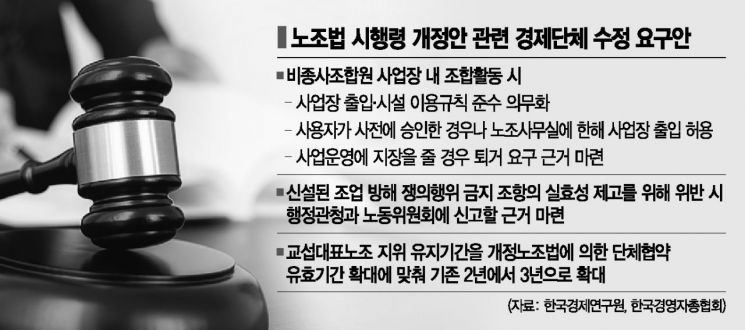
Accordingly, KERI and the Korea Employers Federation proposed a revised draft to the government that explicitly includes ▲mandatory compliance with workplace entry and facility use rules for non-employee union members’ union activities within the workplace ▲allowing workplace entry only with prior employer approval or limited to union offices ▲establishing grounds for requesting removal if business operations are disrupted.
On the other hand, the Ministry of Employment and Labor maintains the position that, contrary to management’s concerns, regulations on workplace entry should be efficiently determined by each company’s internal rules or collective agreements. Kim Yong-chun, head of the Employment Policy Team at KERI, said, "The issue of non-employee union members’ access to workplaces involves differing interests between labor and management, so expecting them to resolve it through consultation is unrealistic. Without clear standards, confusion in industrial sites will inevitably increase."
Will the Government Respond to the Business Community’s Call for Communication?
The current government has been pursuing ratification of the International Labour Organization (ILO) core conventions with the goal of advancing labor rights to a developed country level. Among the core conventions postponed since joining the ILO in 1991, it decided to ratify three: Convention No. 29 on the prohibition of forced labor, and Conventions No. 87 and 98 on freedom of association and protection of the right to organize. Accordingly, domestic laws such as the Labor Union Act, the Teachers’ Union Act, and the Public Officials’ Union Act, which did not meet the standards of these conventions, were amended last December.
Yesterday, as a step to complete the ratification process, the government deposited the ratification documents with the ILO. Consequently, the ratified core conventions will take effect domestically one year later, on April 20 of next year.
During the domestic law amendment process, economic organizations repeatedly requested supplementary measures, arguing that the laws were "excessively unfavorable to employers," but these requests were not accepted. However, with the Blue House recently signaling its intention to strengthen cooperation and expand communication with the business community, there is growing expectation that some of the business community’s appeals to review corporate-related regulations may be partially reflected.
The Korea Employers Federation emphasized, "Supplementary legislation is absolutely necessary to minimize confusion that may arise during the implementation of the amended Labor Union Act and to clarify some ambiguous parts of the legal provisions."
© The Asia Business Daily(www.asiae.co.kr). All rights reserved.
![Clutching a Stolen Dior Bag, Saying "I Hate Being Poor but Real"... The Grotesque Con of a "Human Knockoff" [Slate]](https://cwcontent.asiae.co.kr/asiaresize/183/2026021902243444107_1771435474.jpg)















