Green Alliance Urges "Social Responsibility" in Front of Baemin
"Consumers Feel Guilty Every Time They Dispose of Delivery Waste"
Proposal to Introduce Service Highlighting Restaurants Using Reusable Containers
Coupang Selected as P4G Participant... "Leading Efforts for Carbon Neutrality"
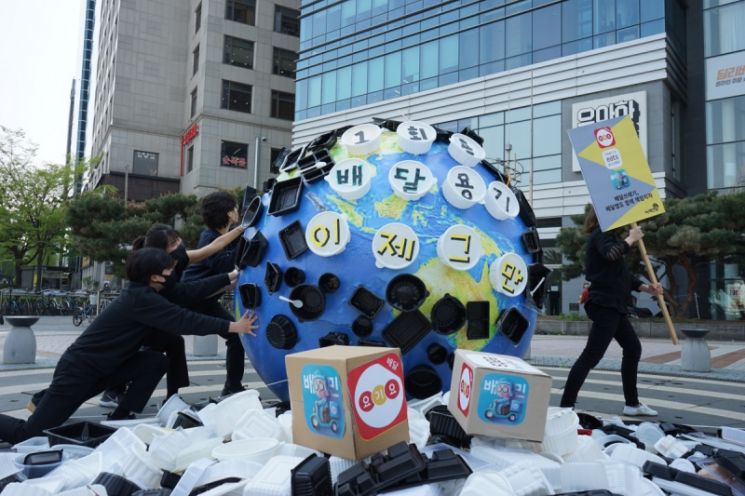
[Asia Economy Reporter Kim Bo-kyung] As the delivery market explodes in growth, the problem of disposable delivery waste is intensifying. According to the statistics released by Statistics Korea, at least 8.3 million disposable delivery containers are discarded daily. There is a growing call for delivery application companies leading the growth of the delivery market to actively address the issue of disposable plastics.
"Consumers do not want disposable containers... Baemin must take the lead"
On the 20th, the environmental group 'Green Korea United' held a press conference and performance in front of the headquarters of Woowa Brothers in Songpa-gu, Seoul, demanding measures against delivery waste. Baedal Minjok, operated by Woowa Brothers, holds the largest market share in the delivery platform market. Heo Seung-eun, team leader of the Green Society Team, said in a phone interview with Asia Economy, "Starbucks announced it will phase out disposable cups in stores by 2025," adding, "Baedal Minjok, which has a powerful influence in the delivery industry, must actively work to solve the disposable delivery waste problem."
According to Green Korea United, the online food service market has grown by 600% over the past three years. It expanded from 2.7 trillion won in 2017 to 17.3 trillion won last year. Based on Statistics Korea's announcement, there are 2.7 million food delivery orders daily, and 8.3 million disposable delivery containers are discarded every day. Since COVID-19, one in two people has increased their food order frequency, and three out of four feel uncomfortable or guilty when disposing of delivery waste.

Baemin is not ignoring the reduction of disposable items. In April 2019, it introduced the industry's first option to decline disposable spoons and forks, and it sells eco-friendly packaging containers through 'Baemin Sanghoe.' In May last year, it signed a voluntary agreement with the Ministry of Environment to reduce plastic. Recognizing these efforts, Baemin was selected in October last year as the first delivery company to be in the top group of the 'UN Sustainable Development Goals Management Index.'
However, Green Korea United pointed out, "In the serious situation of delivery waste, the only thing citizens can do is choose not to receive disposable spoons when ordering delivery." This restricts consumers' choice not to use disposable delivery containers. They argue that services should be implemented to allow consumers to select franchisees (restaurant owners) who use reusable containers by giving them higher exposure. Team leader Heo urged, "Baedal Minjok has benefited with annual sales reaching trillions of won due to COVID-19," adding, "They must take social responsibility and solve the waste problem as much as they earn." Especially, since Woowa Brothers operates Baemin Sanghoe, which sells disposable items necessary for delivery and has built the market structure, they demand measures against delivery waste.
Coupang selected as official participant of P4G... "Expanding investment in eco-friendly technology"
In this situation, e-commerce giant Coupang has attracted attention by being selected as an official participant in the P4G (Partnering for Green Growth and the Global Goals 2030) summit to be held in Seoul next month. Coupang's Rocket Delivery service will be introduced as an eco-friendly model through logistics innovation. Coupang stated, "Through innovative technology and logistics systems, we have significantly reduced carbon emissions compared to traditional e-commerce models and received global recognition." The existing e-commerce model involves sellers receiving products from manufacturers, repackaging them for delivery to customers, and sending them to courier companies. This requires passing through multiple logistics companies and uses a lot of cushioning and packaging materials to prevent product damage.
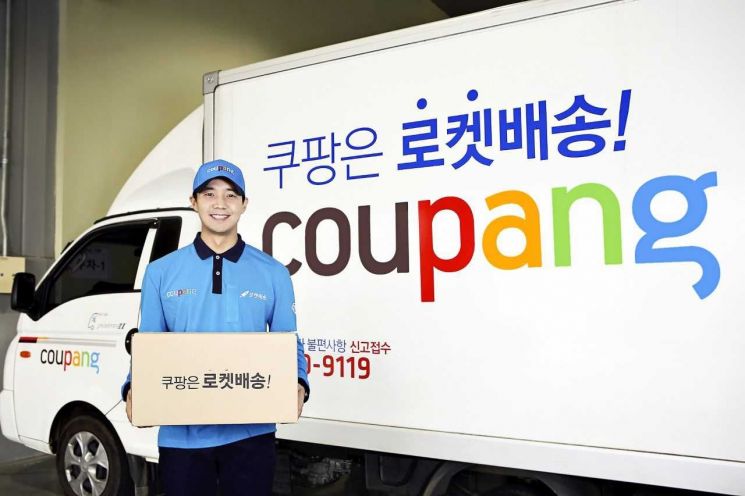
On the other hand, Rocket Delivery operates on an 'end to end' basis by directly purchasing products and managing all processes itself, greatly reducing packaging consumption. Using artificial intelligence (AI) technology, it optimizes delivery routes and even specifies the loading position of individual products inside vehicles to ensure safe delivery. To deliver fresh food, it has phased out the styrofoam boxes traditionally used in the industry and introduced a self-developed reusable eco-bag. Customers place the eco-bag at their door, and Coupang delivery staff collect it during the next delivery.
Kang Han-seung, Coupang's Chief Operating Officer, said, "Awareness of the importance of ESG (Environmental, Social, and Governance) is increasing day by day," adding, "We will lead the e-commerce industry's carbon neutrality efforts by expanding investments in eco-friendly technologies such as eco-bag usage and electric vehicle delivery." Coupang's actions are expected to signal the start of an eco-friendly wave in the e-commerce and logistics markets.
Delivery agency Barogo is building eco-friendly mobility infrastructure through its electric two-wheeler subsidiary 'Moving.' Moving is developing a domestic standard e-mobility swappable battery charging system (BSS) solution. On the 15th, it signed a business agreement with Hyundai Electric and plans to actively build infrastructure for electric delivery two-wheelers. In particular, it plans to unify Hyundai Electric as the sole electric power supplier, a key element of the BSS business, to achieve domestic BSS standardization. This is expected to promote the supply of eco-friendly two-wheelers in the last-mile mobility market (transportation used for short distances to the final destination). Receiving renewable energy from Hyundai Electric, it may even achieve RE100 compliance. RE100 is a voluntary commitment and global campaign by companies to source 100% of their electricity from renewable energy such as solar and wind by 2050.
A Moving official said, "We will prepare to supply eco-friendly electric two-wheelers nationwide based on shared BSS for e-mobility in cooperation with local governments and major partners," adding, "We are accelerating the construction of eco-friendly last-mile mobility infrastructure."
© The Asia Business Daily(www.asiae.co.kr). All rights reserved.
![Clutching a Stolen Dior Bag, Saying "I Hate Being Poor but Real"... The Grotesque Con of a "Human Knockoff" [Slate]](https://cwcontent.asiae.co.kr/asiaresize/183/2026021902243444107_1771435474.jpg)
















