Investors Suffering Principal Losses from Cryptocurrency Investments Appeal
"I Think I Was Crazy," "If I Can't Recover, I'll Do XX"
Dogecoin with High Price Volatility, a Typical High-Risk Asset
Lee Ju-yeol, Bank of Korea Governor, "Excessive Investment Increases Financial Safety Risks"
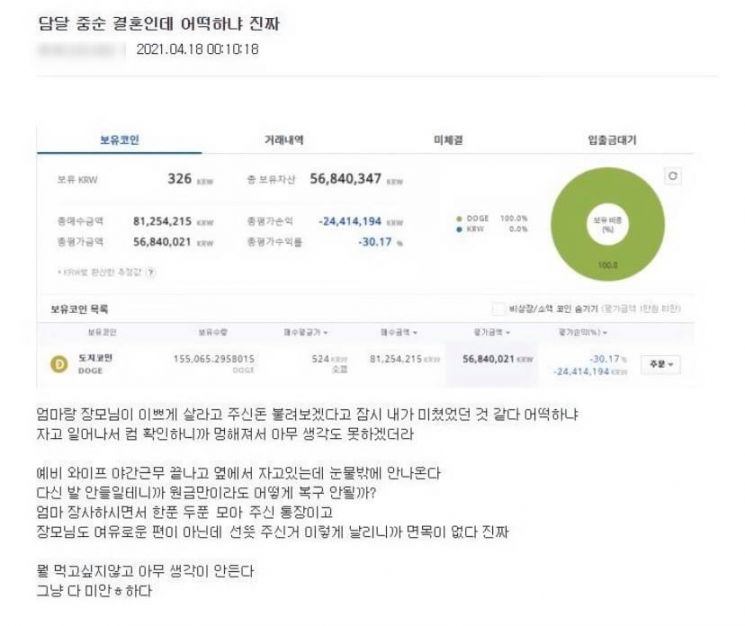 A cryptocurrency investor lamented losing a significant amount of money after investing in 'Dogecoin.' / Photo by Internet Community Capture
[Asia Economy Reporter Lim Juhyung] "I will never invest in coins again. Is there any way to recover at least the principal?"
This post was uploaded on the 18th to an online community related to cryptocurrency investment. The author is an investor who poured about 81 million won into a type of cryptocurrency called 'dogecoin,' and recently revealed that they suffered about a 30% (24 million won) loss on the principal due to the consecutive crashes in the currency's value.
He said, "The money was given by my mother and mother-in-law so that we could live well, but I think I was temporarily crazy," adding, "My fianc?e is sleeping beside me, and I feel ashamed. I can only cry."
The cryptocurrency investment craze is sweeping the 20s and 30s generation. Not only the representative cryptocurrency 'Bitcoin' but also so-called 'altcoins' like Dogecoin are attracting novice investors.
The problem is that due to the nature of cryptocurrencies, which fluctuate by nearly 10-20% at a time, there are many cases of principal loss. Experts classify current cryptocurrencies as 'high-risk assets' and warn that since it is impossible to know when the bubble will burst, careful investment decisions are necessary.
Cases of people losing large sums of money after investing in cryptocurrencies continue to appear. On the 14th, an online community post by internet broadcaster Shin Taeil raised concerns among netizens by implying an extreme choice after losing principal in cryptocurrency investment.
Shin said, "I lost 1.3 billion won gambling, and since Bitcoin is booming these days, I threw everything into Dogecoin today, but I fell into the abyss," adding, "If the coin price doesn't reach 180 won by 9 o'clock, I will just XX."
Shortly after he wrote the post, Dogecoin began to rebound, rising to 182 won as of 9 p.m. that day. It slightly exceeded the 180 won 'deadline' set by Shin. However, if Dogecoin's price had not recovered that day, Shin could have suffered enormous financial damage.
 A post by famous internet broadcaster Shin Tae-il on a cryptocurrency-related investment community / Photo by Internet Community Capture
Dogecoin, a type of cryptocurrency, is also called an 'altcoin.' This term refers to followers after the representative cryptocurrency Bitcoin. These altcoins are characterized by high price volatility, with rebounds and crashes reaching tens of percentages. However, the returns are also large, classifying them as 'high-risk, high-return' investment assets.
Despite the high risk of principal loss, the 'Dogecoin craze' is ongoing in Korea. On the 17th, Dogecoin's daily trading volume exceeded about 17 trillion won, surpassing the average trading volume of the KOSPI (14.9372 trillion won). Cryptocurrency trading volume has grown rapidly to exceed that of Korea's representative stock market.
Nevertheless, the reason the 20s and 30s generation is going 'all in' on cryptocurrency investment seems to be the expectation of high returns. According to the report 'Millennials, the Emergence of a New Investment Tribe' published by Mirae Asset Retirement Research Institute, the 20s and 30s millennial generation pursues medium to high returns of about 5-10% or more when making financial investments and shows strong interest in technology-related issues such as the Fourth Industrial Revolution.
On the 20th, netizens in various domestic cryptocurrency investment communities expressed expectations of 'making a fortune' with comments like "I can't sleep thinking about coins," "Even though the coin market is risky, where else in Korea can you make this much money?" and "I will make exactly 10 billion won with Dogecoin and retire in my 30s."
However, experts warn that this 'coin craze' can cause significant damage to investors.
British investment expert David Kimberly pointed out in an interview with the US 'CNBC' on the 18th (local time) that "the 'greater fool theory' blindly following market trends is appearing in cryptocurrency investment." The greater fool theory refers to the phenomenon of justifying any price with the belief that a later investor will buy the asset at a higher price.
Kimberly said, "If everyone behaves like this, the bubble will inevitably burst," warning, "The problem is that it is impossible to predict when that will happen."
Lee Ju-yeol, Governor of the Bank of Korea, expressed concerns at an online press conference held after the Monetary Policy Committee meeting on the 15th, saying, "It is very difficult to estimate the appropriate value and price of crypto assets, so their price volatility is very high," adding, "If investment becomes excessive, there is a high possibility of loan defaults to investors, and the risk is also significant from the perspective of financial stability."
© The Asia Business Daily(www.asiae.co.kr). All rights reserved.