Criticism of 'Northeast Asia Financial Hub' Strategy Failure
Impact of Citi Bank's Retail Banking Withdrawal Becomes Visible
Complete/Partial Sale, Gradual Closure Discussed
Internal and External Factors Including Union Opposition
[Asia Economy Reporters Kwangho Lee, Hyungil Oh, Hyojin Kim] As Citigroup decides to completely exit the retail banking business of Korea Citibank, concerns are rising that the withdrawal of global financial firms from Korea may be repeated once again. In the process of restructuring their overseas operations, global financial firms are prioritizing the Korean market for downsizing, leading to criticism that the government's strategy to make Korea a 'Northeast Asia financial hub' has failed.
Experts point out that measures should be taken to prevent the departure of foreign financial firms and attract investment by moving away from excessive regulation-focused policies.
According to the Financial Supervisory Service's Financial Hub Support Center on the 19th, the number of domestic branches (branches and offices) of foreign banks in Korea has been decreasing annually. The number of foreign bank branches, which was 60 in 2016, decreased to 54 by the end of last year. The situation is similar not only for banks but also for securities, asset management, investment advisory, life and non-life insurance, and savings banks. The number of domestic branches of foreign financial firms decreased from 168 in 2016 to 163 at the end of last year.
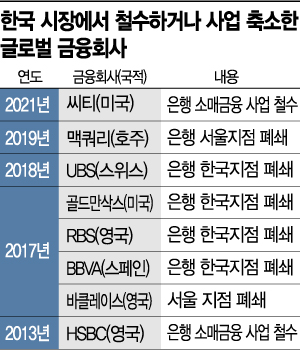
In 2017, American Goldman Sachs, British Royal Bank of Scotland (RBS) and Barclays, and Spanish Bilbao Vizcaya (BBVA) closed their Korean branches. Following that, Swiss bank UBS closed in 2018, and Australian Macquarie Bank in 2019. After British HSBC exited domestic retail banking in 2013, Citigroup decided on the 15th to withdraw from Korea Citibank's retail banking business.
Among insurance companies, starting with Dutch ING Life in 2013, German Ergo and Allianz Life, British PCA Life in 2016, and Prudential Life in 2020 have exited the Korean market. Recently, French AXA Group attempted to sell AXA Non-Life Insurance but the deal fell through, though behind-the-scenes negotiations continue. Additionally, American LINA Life and MetLife, Chinese ABL Life and Dongyang Life, and Hong Kong AIA Life have rumors of sales that have subsided but could resume at any time.
Delayed Economic Recovery... Difficult to Find New Growth Amid Various Regulations
The continuous withdrawal of foreign financial firms from Korea is analyzed to be due to delayed economic recovery and various regulations by financial authorities making it difficult to find new growth opportunities. A banking official pointed out, "The current government tends to emphasize the role of the financial sector as a public good supporting companies with funds rather than viewing it as an industry that creates added value." An insurance official said, "The main reason foreign insurers are turning their backs on the Korean market is deteriorating profitability due to low growth, low birthrate, and low interest rates," adding, "Recently, rapidly growing Asian markets, especially Southeast Asia, have become a priority over Korea."
Experts advise that financial authorities should carefully listen to the financial sector's concerns about the declining vitality due to financial environment challenges and various regulations. Professor Tae-yoon Sung of Yonsei University's Department of Economics expressed concern, saying, "Citigroup's withdrawal from retail banking in the Korean market is not an easy decision," and "It shows that the domestic financial environment is deteriorating." He also pointed out, "Chronic financial regulations by the authorities are particularly problematic," noting, "The 52-hour workweek is a regulation unique to Korea, and the highest corporate tax rate is excessively high compared to Singapore and Hong Kong." He emphasized that improving Korea's unpredictable and rigid financial regulatory system should be a priority.
Financial authorities are also considering measures to prevent the departure of global financial firms but have yet to present any effective solutions. The government's roadmap to attract global financial firms' Asia-Pacific headquarters in 2003 and make Korea an Asian financial hub remains unfulfilled. Financial Services Commission Chairman Sung Sung-soo recently acknowledged the criticism that "there has only been outflow of foreign financial firms for years with no inflow," but said, "Whether foreign financial firms come or not ultimately depends on their business models."
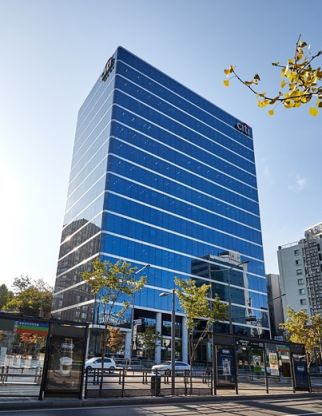
Korea Citibank's Retail Banking Exit: What Is the Exit Strategy?
Meanwhile, the decision by Korea Citibank to exit the domestic retail banking business has sparked strong opposition from labor unions and growing concerns among consumers, with the aftermath becoming apparent. The confusion is expected to continue for some time as it remains unclear when and how the exit will take place.
Since Citigroup announced its plan to withdraw from Korea Citibank's domestic retail banking on the 15th, consumer inquiries about whether they should withdraw deposits in advance have surged. It is reported that inquiries have increased by about 20-30% compared to usual.
The Korea Citibank branch of the National Financial Industry Labor Union (Financial Union) formed an emergency response committee on the same day and began countermeasures. The union is keeping all options open, including strong disputes such as general strikes and public opinion campaigns through the media and political circles.
The biggest concern is the method of Korea Citibank's exit. So far, options being considered include selling the retail banking sectors such as wealth management (WM) and credit cards separately or as a whole, or gradually downsizing and liquidating the business, ultimately leading to closure.
Within the financial sector, there are voices estimating the price of Korea Citibank's retail banking division at around 2 trillion won. There is also speculation that some regional financial groups and savings bank financial groups may attempt to acquire it. DGB Financial and OK Financial are specifically mentioned.
Korea Citibank will hold a board meeting on the 27th. It is expected that the board will discuss specific methods for business liquidation based on Citigroup's policy.
If Sale Fails, Gradual Business Closure Expected
If a sale proves difficult, gradual closure is the only remaining option. HSBC previously restructured its retail banking in 2013 through workforce reductions and asset transfers.
This is expected to intensify opposition and conflicts with labor unions. Korea Citibank employs about 3,500 people, of whom over 70%, approximately 2,500, work in the retail banking sector. Retail banking accounts for about half of the total revenue.
The union has previously taken a strong stance, stating, "Neither sale nor withdrawal will be decided solely by the headquarters' will."
© The Asia Business Daily(www.asiae.co.kr). All rights reserved.
![Clutching a Stolen Dior Bag, Saying "I Hate Being Poor but Real"... The Grotesque Con of a "Human Knockoff" [Slate]](https://cwcontent.asiae.co.kr/asiaresize/183/2026021902243444107_1771435474.jpg)
















