Road Traffic Act Amendment to Take Effect from the 13th of Next Month
'Helmet Non-Wearing' Fine Up to 200,000 KRW
Effectiveness Questioned... 'Hygiene, Loss, Inconvenience'
Experts: "Nudge Effect Can Encourage Helmet Use"
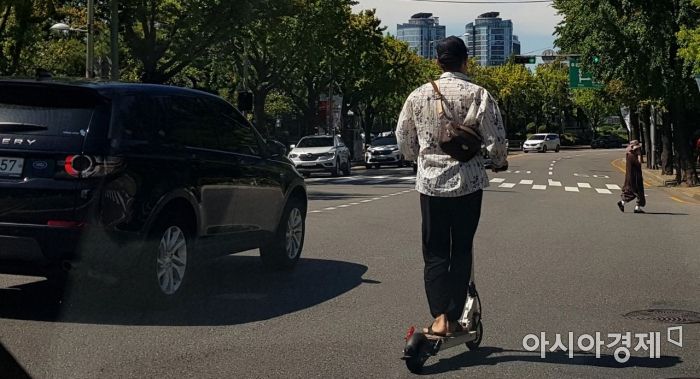
[Asia Economy Reporter Joo-mi Lee] Starting from the 13th of next month, the Road Traffic Act with strengthened safety regulations related to electric kickboards will be enforced, but concerns about the effectiveness of the 'mandatory helmet' regulation continue to arise.
Critics argue that the rule requiring kickboard users to carry and wear helmets individually is unrealistic, and even if helmets are provided, usage rates will be low due to hygiene and loss issues. There are calls for more practical policies.
As kickboard accidents have not ceased, the government introduced a law that significantly strengthens safety rules. With the enforcement of the amended Road Traffic Act from the 13th of next month, those caught riding a kickboard without wearing a safety helmet will face a fine of up to 200,000 KRW. Unlicensed driving and two-person riding will also incur fines of up to 200,000 KRW if caught. Currently, there are no penalties such as fines for violating these regulations.
Among citizens, opinions are divided on the effectiveness of the law even before its enforcement. Particularly, critical voices against the 'mandatory helmet' rule are strong. Jeong (23), a university student who frequently uses kickboards, said, "The biggest reason I enjoy using kickboards is because I can ride them anywhere," adding, "But who would deliberately carry a helmet around? It’s cumbersome, so I think people won’t wear them."
Park (20), another university student who rides a kickboard to school every day, said, "I think I would wear a helmet if one was provided," but also expressed concern, "Considering the risk of COVID-19 infection, hygiene is a bit worrisome."
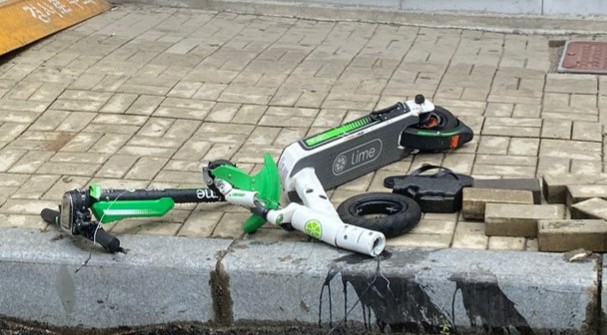 Electric scooter destroyed in an accident. Electric scooter accidents are increasing.
 [Image source=Yonhap News]
Considering that Seoul’s public bicycle system 'Ddareungi' faced similar issues, these criticisms are valid. When bicycle helmet wearing was made mandatory in 2018, Seoul City conducted a pilot project to provide helmets. However, after placing rental helmets at rental stations in Yeouido, Seoul, and checking whether they were worn, the helmet usage rate was only 3%.
At that time, citizens responded that they did not wear helmets due to reasons such as 'hygiene,' 'weather,' and 'hairstyle.' The helmet non-return rate was also about 24%. Ultimately, Seoul City discontinued the project after two months due to budget issues and decreased usage rates.
The problem is that the risk of not wearing a helmet is very high, making it unacceptable to neglect users who do not wear helmets for these reasons. Kickboards have a high center of gravity and small wheels, making it easier to lose balance compared to other means of transportation, increasing the risk of accidents. Also, unlike cars that provide protection through the vehicle body, kickboards have no protective devices, so the impact of an accident is directly applied to the rider.
When users ride kickboards without helmets, accidents often result in head and facial injuries, and in severe cases, death. Since kickboards are ridden standing up, the risk of head and facial injuries is relatively high in accidents. According to the Korea Consumer Agency and the Fair Trade Commission, among 1,252 kickboard accidents from 2017 to November 2020, about 36% involved injuries to the head and face, the highest proportion. At that time, the Fair Trade Commission emphasized the necessity of wearing protective gear such as helmets to prevent fatal injuries.
In December last year, a man in his 40s died after being hit by a motorcycle while riding a kickboard without a helmet, suffering severe head injuries. The previous month, a high school student was hit by a taxi while riding a kickboard without a helmet and died. This underscores the need to encourage helmet use among users to establish a safe riding culture.
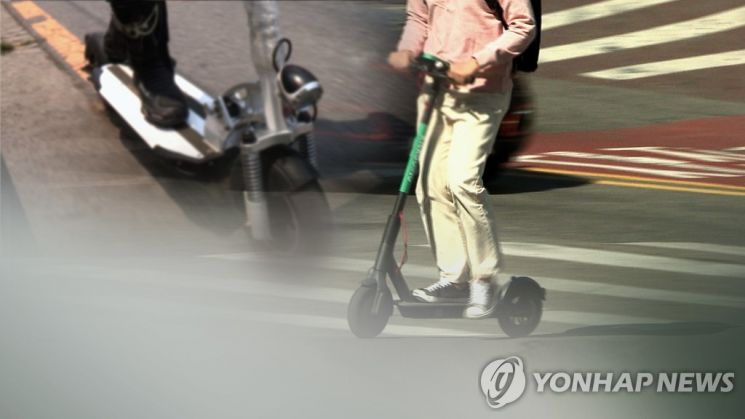 From the 13th of next month, a fine of up to 200,000 KRW will be imposed if you do not wear a helmet when using a kickboard.
 [Image source=Yonhap News]
Some suggest that instead of ineffective enforcement, campaigns should be used to encourage riders to wear helmets. A representative opinion is to implement campaigns using the 'nudge effect.' A nudge means 'a gentle poke in the side.' It refers to inducing behavioral change through soft intervention rather than coercion.
Brazil successfully used a campaign employing the nudge effect to encourage taxi passengers to wear seat belts. In 2015, the car manufacturer Fiat, recognizing that 92% of its citizens did not wear rear seat belts in taxis, launched a campaign offering free Wi-Fi to passengers who fastened their seat belts.
Although it only provided free Wi-Fi, the effect was remarkable. During the campaign, about 4,500 passengers in these taxis all wore seat belts. Citizens who ignored various warnings and advertisements about the dangers of not wearing seat belts voluntarily buckled up due to this small idea. It is a clear example of inducing effective change without coercive penalties.
Experts also emphasize that the nudge effect can be used to spread a safety culture. Jong-hyuk Lee, director of the Public Communication Research Institute and professor of Media Communication at Kwangwoon University, who has conducted various nudge projects, suggested, "If helmets become a fashion item, such as using unique helmets instead of public helmets, wearing helmets itself can trigger the nudge effect." He believes that helmets reflecting individual uniqueness can instill the image of "stylish me, a person who observes safety culture."
Professor Lee stressed, "Like public bicycles such as Ddareungi, kickboards have gradually prioritized 'convenience' over 'safety.' We need to use the nudge effect to lead a helmet-wearing culture."
© The Asia Business Daily(www.asiae.co.kr). All rights reserved.
![Clutching a Stolen Dior Bag, Saying "I Hate Being Poor but Real"... The Grotesque Con of a "Human Knockoff" [Slate]](https://cwcontent.asiae.co.kr/asiaresize/183/2026021902243444107_1771435474.jpg)

















