K Semiconductor Engulfed in Turmoil
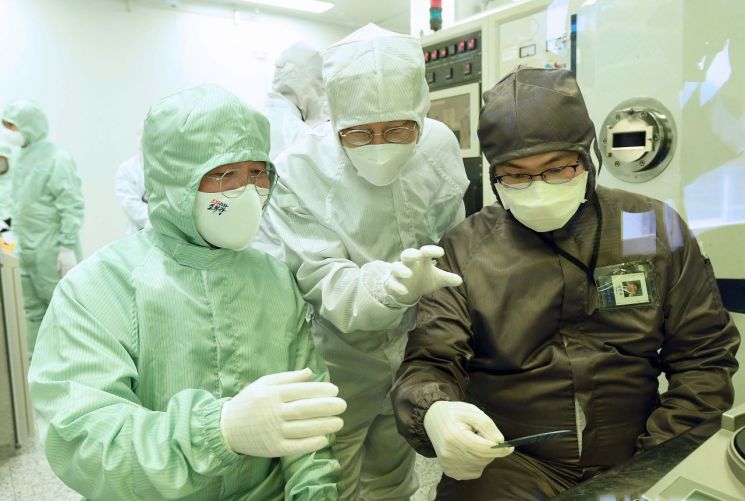 Seong Yun-mo, Minister of Trade, Industry and Energy (left), is inspecting the surface of a metal-deposited semiconductor wafer at the Semiconductor Joint Research Center of Seoul National University in Gwanak-gu, Seoul, on the afternoon of the 14th. In the center is Lee Jong-ho, Director of the Semiconductor Joint Research Center at Seoul National University.
 [Photo by Yonhap News]
[Asia Economy Reporters Kim Heung-soon and Jang Se-hee] On the afternoon of the 15th, the Blue House arranged a meeting to discuss strategies with related companies to address the semiconductor industry, which is escalating into an inter-country diplomatic and security competition. However, the industry is criticizing the response as belated and the support measures as insufficient. Unlike competing countries such as the United States, Europe, and China, which have declared plans to invest tens of trillions of won in government-led semiconductor development and have announced active support measures such as tax benefits and incentives, South Korea relies mainly on investments from major companies and indirect support plans like fund creation. The semiconductor industry emphasized that the government should take the lead in setting policy directions to prevent companies from being swept up by international trends and focus government-wide capabilities on nurturing talent and research and development (R&D).
Overseas Support Measures Worth Tens of Trillions of Won
U.S. Plans Support Worth 56 Trillion Won
Europe Agrees on Investment Plans Up to 67 Trillion Won Including Germany, France, Italy, and the Netherlands
Taiwan Offers 15% Tax Credit on Investment Amounts
The expanded economic ministers' meeting chaired by President Moon Jae-in attracted attention with the attendance of presidents from semiconductor companies such as Samsung Electronics and SK Hynix, as well as from the automotive and shipbuilding sectors including Hyundai Motor, Infac, Korea Shipbuilding & Offshore Engineering, and Samsung Heavy Industries. It was also an opportunity to confirm the government's stance as it sought to address current issues and countermeasures in the semiconductor industry amid a global supply shortage and the U.S.-China hegemony competition.
Earlier, Blue House Chief of Staff Yoo Young-min and Policy Chief Lee Ho-seung discussed semiconductor issues with senior executives from Samsung Electronics on the 9th, and Minister of Trade, Industry and Energy Sung Yun-mo held a meeting with representatives from the Semiconductor Industry Association, signaling communication with the industry. However, considering the urgent international situation competing for semiconductor dominance, the prevailing view was that these moves were a step late.
Meanwhile, competing countries have rolled out aggressive support measures. The United States, with President Joe Biden expressing a strong commitment to strengthening its semiconductor supply chain, proposed a government support plan worth $50 billion (approximately 56 trillion won) last month. This funding is intended for semiconductor manufacturing and research support. At the state level, various incentives are also being prepared to attract foreign companies' foundry (semiconductor contract manufacturing) plants.
In Europe, Germany, France, Italy, and the Netherlands recently agreed on investment plans totaling up to 50 billion euros (approximately 67 trillion won). These governments plan to provide subsidies covering 20-40% of the investment amounts made by semiconductor-related companies. Taiwan is also leading negotiations among countries to respond to the semiconductor shortage and plans to offer tax credits up to 15% of semiconductor R&D investment amounts. China moved earlier, aiming for a 'semiconductor rise,' investing 1 trillion yuan (approximately 170 trillion won) from 2015 to 2025 under government leadership and introducing new tax benefits.
Previously, in 2019, the South Korean government presented the 'Korea Semiconductor Vision,' a strategy to systematically nurture the semiconductor industry. The core plan is to invest 133 trillion won in the system semiconductor sector aiming for global No. 1 in the non-memory field by 2030 and to build a semiconductor cluster industrial complex worth 120 trillion won in Yongin, Gyeonggi Province, to foster the semiconductor ecosystem. However, this is mainly led by large corporations such as Samsung Electronics and SK Hynix, with the government's role limited to supporting smooth private investment. The remaining support measures mainly consist of indirect support such as creating public-private funds for R&D and talent development.
Professor Jung In-gyo of Inha University's Department of International Trade said, "Since advanced industries heavily depend on large corporations, it has been difficult to rely on government support so far," but added, "Many countries perceive the semiconductor industry as a security issue and make decisions from this perspective, so we also need more proactive government-level responses."
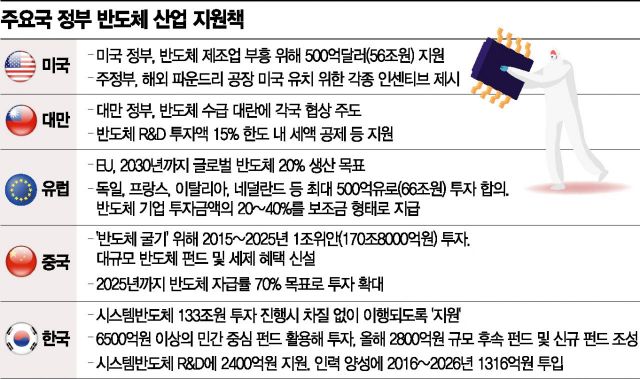
South Korea Supports Mainly Private-Led Projects Like Semiconductor Clusters
Government: "Will Reflect Suggestions Collected at Expanded Economic Ministers' Meeting in Measures"
Industry: "Doubtful About Effectiveness of Measures, Calls for Government-Wide Response Including Special Legislation"
Following the expanded economic ministers' meeting, the government appears to be rushing to prepare countermeasures. A government official stated, "We plan to reflect the suggestions collected during this meeting in future measures." It is expected that the issues discussed will be included in the second half economic policy direction announced annually by the Ministry of Economy and Finance in June or July.
However, it is uncertain how much the industry’s opinions will be reflected. Although the government declared last December that it would strengthen communication with the semiconductor industry and others, demands from the industry such as expanding tax credits have yet to be incorporated. The industry's mood is also skeptical. A business official said, "The government ignored the voices of economic organizations concerned about corporate activity contraction last year and consecutively introduced regulatory bills," adding, "Recently, the government has shown efforts to address strategic industry issues and communicate, but it is doubtful how effective the measures will be."
The Korea Semiconductor Industry Association recently submitted a petition during a meeting with the Minister of Trade, Industry and Energy requesting support for semiconductor talent development, tax benefits, and infrastructure construction. Since these matters require support at the government-wide level including the Ministry of Education, Ministry of Economy and Finance, and Ministry of Science and ICT, they also proposed enacting a 'Special Act for Semiconductor Industry Development' to accelerate policy speed and effectiveness.
In this regard, the government announced plans to implement customized talent development policies for bachelor's, master's, doctoral, and practical personnel, aiming to produce about 4,800 semiconductor professionals from this year through next year. Additionally, support for R&D and talent development in the electric vehicle and shipbuilding sectors will be expanded. An industry official emphasized, "The government's important role includes not only R&D funding, tax benefits, and talent development but also resolving regulations necessary for infrastructure construction," and stressed, "Considering future competitiveness, a government-wide approach is necessary."
© The Asia Business Daily(www.asiae.co.kr). All rights reserved.
![Clutching a Stolen Dior Bag, Saying "I Hate Being Poor but Real"... The Grotesque Con of a "Human Knockoff" [Slate]](https://cwcontent.asiae.co.kr/asiaresize/183/2026021902243444107_1771435474.jpg)
















