[Asia Economy Reporter Lee Chun-hee] Last year, both the smoking rate and drinking rate among adolescents decreased compared to the previous year.
The Korea Disease Control and Prevention Agency (KDCA) announced the '16th (2020) Youth Health Behavior Survey Statistics' containing this information on the 30th. The Youth Health Behavior Survey was introduced in 2005 and annually surveys about 60,000 middle and high school students nationwide to understand their health behavior status. It serves as basic data for establishing and evaluating school health policies.
Last year, considering the COVID-19 situation, the KDCA conducted the survey while complying with quarantine rules in cooperation with sample schools. Among 57,925 students targeted from 800 middle and high schools across 17 cities and provinces, 54,848 participated in the survey.
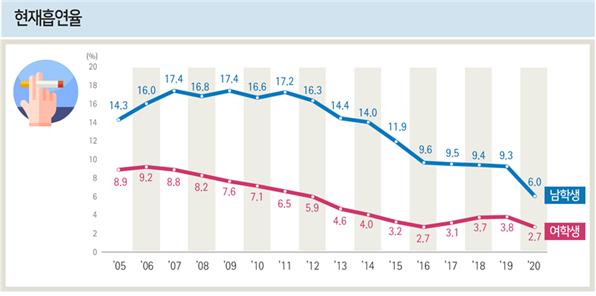
The survey results showed that adolescent health behaviors such as smoking and drinking generally improved in 2020 compared to 2019. The 'current smoking rate,' defined as the proportion of those who smoked at least once a day in the past 30 days, decreased from 9.3% to 6.0% for male students and from 3.8% to 2.7% for female students. The current usage rate of electronic cigarettes also declined from 4.7% to 2.7% for males and from 1.5% to 1.1% for females.
Similarly, the 'current drinking rate,' defined as the proportion of those who drank at least one drink in the past 30 days, decreased from 16.9% to 12.0% for males and from 13.0% to 9.1% for females. The 'risky drinking rate,' defined as drinking five or more glasses for males and three or more glasses for females per occasion (based on soju), also decreased from 8.2% to 5.6% for males and from 7.5% to 4.8% for females.
The ease of purchasing cigarettes and alcohol at convenience stores or shops also declined, with cigarette purchase ease dropping from 69.0% to 67.0% and alcohol from 66.2% to 63.5%.
This survey also investigated adolescents' physical activity and dietary habits. Overall, physical activity decreased, and there is a need to improve dietary habits.
The practice rate of engaging in physical activity for 60 minutes or more at least five days a week was 19.9% for male students and 7.7% for female students. Compared to the previous year, the rate slightly decreased for males and remained in the 7% range for females.
The number of adolescents who engaged in high-intensity physical activities such as jogging, soccer, or basketball at least three days a week in the past seven days decreased for both males and females compared to the previous year. In particular, male students showed a significant decrease from 44.8% to 37.8%. Among male middle school students, the rate dropped from 52.0% in the previous year to 40.8% last year.
The rate of skipping breakfast five or more days a week continued to increase, rising from 35.7% in 2019 to 37.3% last year, with female students (39.2%) having a higher rate than male students (35.5%). Although the rates of consuming sweetened beverages and carbonated drinks three or more times a week decreased, they remained high at 45.8% and 35.5%, respectively, and the fast food consumption rate was similar to that of 2019.
The practice rate of handwashing with soap at school or home increased compared to 2019. Especially, the rate of handwashing with soap after returning home from outside increased by 12 percentage points from 77.4% in 2019 to 89.4%.
Mental health indicators showed some improvement. The perceived stress rate decreased from 48.8% to 40.7% for females and from 31.7% to 28.1% for males. The experience rate of depression also decreased from 34.6% to 30.7% for females and from 22.2% to 20.1% for males.
Through the newly introduced smartphone overdependence screening tool, one in four adolescents was identified as being at potential risk or higher for smartphone overdependence. The proportion scoring 23 or higher out of 40 points was 25.5%, with 30.0% for females and 21.2% for males.
Jo Myung-yeon, Director of the Student Health Policy Division at the Ministry of Education, said, “Considering the difficulties in conducting school health-related preventive education and lifestyle guidance due to non-face-to-face classes caused by COVID-19, it is necessary to closely examine the impact of the health behavior changes revealed in this survey on student health and to actively provide guidance and education at schools and homes.”
Jung Eun-kyung, Commissioner of the Korea Disease Control and Prevention Agency, stated, “The 2020 survey showed improvements in adolescent smoking and drinking indicators, while physical activity decreased. It is necessary to conduct in-depth analysis to determine whether these results are due to the impact of COVID-19, and we plan to continuously monitor the long-term effects of changes in health behaviors.” She added, “In particular, to examine adolescent mental health amid the spread of COVID-19, we added questions on experiences of loneliness and a generalized anxiety disorder screening tool, and we plan to conduct surveys through this year to perform an in-depth analysis of changes in mental health.”
The detailed report of the 2020 Youth Health Behavior Survey will be released along with raw data on the Youth Health Behavior Survey website.
© The Asia Business Daily(www.asiae.co.kr). All rights reserved.
![Clutching a Stolen Dior Bag, Saying "I Hate Being Poor but Real"... The Grotesque Con of a "Human Knockoff" [Slate]](https://cwcontent.asiae.co.kr/asiaresize/183/2026021902243444107_1771435474.jpg)















