Full Effort to Increase Voter Turnout
Warning to Prevent Backlash from Verbal Slip-ups
[Asia Economy Reporter Naju-seok] The People Power Party is focusing on a ‘consolidation’ strategy that turns public sentiment confirmed through polls into election results. The goal is to directly translate the widespread public demand for regime judgment into votes. The only remaining task is to minimize verbal missteps to prevent backlash.
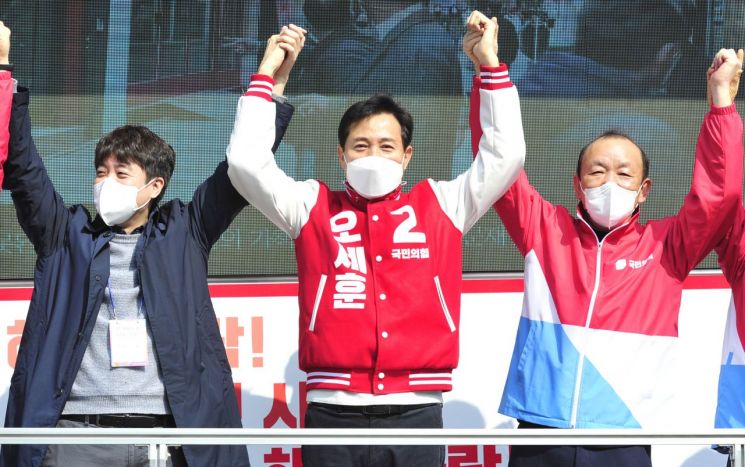
On the 27th, Kim Geun-sik, head of the Vision Strategy Office of the People Power Party, said regarding election strategy, "As the public approaches the end of the term, dissatisfaction, disappointment, and frustration with the progressive government have escalated to anger over the speculative actions of Korea Land and Housing Corporation (LH) executives and employees, so we must follow this public sentiment wind."
Under this strategic plan, the People Power Party intends to maximize the strong public opinion favoring regime judgment while fully focusing on preventing sudden adverse events. Oh Shin-hwan, former People Power Party lawmaker and co-chairman of the Oh Se-hoon campaign, said, "This time, the People Power Party’s best effort and strategy will be to show a more humble, serving attitude and a changed image."
The flow of public sentiment was confirmed through polls. The day before, Korea Gallup announced the results of a survey conducted from the 23rd to 25th targeting 1,001 people nationwide aged 18 and over, evaluating President Moon’s job performance. The positive rating was 34%, and the negative rating was 59%, the lowest level in Gallup surveys since President Moon took office. The Democratic Party’s support rate was also at a historic low of 32%. In contrast, the People Power Party’s support rate has risen for five consecutive weeks, reaching 29%, the highest since the 2016 political scandal. Consequently, the gap between the two parties narrowed to 3 percentage points. Regarding the by-elections, 33% expect the ruling party to win the majority, while 57% expect the opposition to win the majority. (Telephone interviewer format, 95% confidence level, sampling error ±3.1 percentage points. For details, refer to the Central Election Poll Deliberation Commission website.)
Kim Jong-in, chairman of the People Power Party’s Emergency Response Committee, also urged at the election committee meeting on the 25th, "We must not be complacent and must be very careful with our words and actions," adding, "One wrong word can lead to losing many votes."
After losing the unification, the party plans to actively utilize the support of Ahn Cheol-soo, leader of the People’s Party, who is assisting candidate Oh. The plan is to create more than just an election-engineered unification and maximize the synergy of candidate unification. There is also an underlying analysis that showing a dedicated attitude in supporting the election would not be disadvantageous for Ahn’s future political activities. Kim said, "If Ahn works hard to support the election and candidate Oh achieves a landslide victory, there will be a future for Ahn as well," and added, "We appreciate his self-sacrificing attitude to become the foundation for the entire opposition’s victory and regime change after conceding."
Additionally, the party is adopting an approach that divides roles between the regime judgment argument and the candidate’s policy and vision proposals. While Chairman Kim and Leader Ahn deliver messages appealing for regime judgment, candidate Oh focuses on regional development and criticizing the administration of former Mayor Park Won-soon.
The People Power Party believes that a high voter turnout is essential for public sentiment to translate into actual election results. This is because the Democratic Party, which dominates local government heads, the National Assembly, and local councils, can leverage its organizational strength more effectively when turnout is low.
Professor Shin Yul of Myongji University’s Department of Political Science and Diplomacy said, "The Democratic Party’s strong organizational power could lead to election results different from expectations," but added, "If turnout exceeds 50%, the current trend will likely be maintained." Professor Shin also said, "Behind the People Power Party is a very strong regime judgment sentiment, so given this atmosphere, it seems no special strategy is needed. Now, the only thing left for the People Power Party is to avoid verbal mistakes."
Meanwhile, candidate Oh faced criticism after saying during a campaign speech in front of Jungmi Station in Gangseo-gu, Seoul, the previous day, "When I criticized the Moon Jae-in government’s real estate policy by saying, ‘It’s not like a severe dementia patient, but the people are in an uproar over rising house prices while the president says real estate is stable,’ I was told it was an excessive expression," and added, "Can the opposition not even use such expressions?" This was a defense after his 2019 October speech at the Taegeukgi rally in Gwanghwamun Square, where he said, "The president says our economy is going well, but it sounds like the ramblings of a severe dementia patient," which had sparked renewed controversy. In response, former Dongyang University professor Jin Joong-kwon criticized candidate Oh on Facebook that day, saying, "If you want to win, shut your mouth," and "This person has no sense at all. The party even issued a warning about his reckless remarks."
© The Asia Business Daily(www.asiae.co.kr). All rights reserved.
![Clutching a Stolen Dior Bag, Saying "I Hate Being Poor but Real"... The Grotesque Con of a "Human Knockoff" [Slate]](https://cwcontent.asiae.co.kr/asiaresize/183/2026021902243444107_1771435474.jpg)
















