12,209 Drug Offenders Last Year...16.9% Increase from Previous Year
Lower Entry Barriers, Lack of Rehabilitation Facilities and Budget Among Causes
Experts "Focus on Transactions in Cyberspace...Need for Changes in Investigation Techniques"
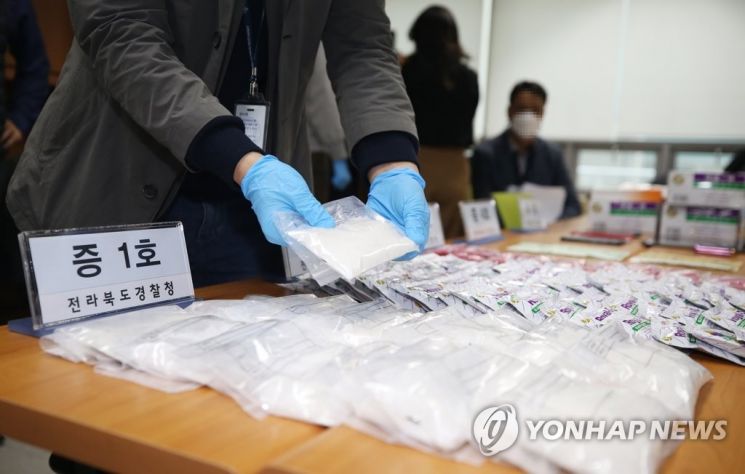 On the 8th, the Jeonbuk Provincial Police Agency's Narcotics Investigation Unit seized 4.88 kg of methamphetamine and 7,600 yaba pills from seven Thai nationals who smuggled drugs disguised as vitamins and distributed them domestically.
 [Image source=Yonhap News]
[Asia Economy Reporter Kim Choyoung] Recently, a Korean Professional Golf Association (KPGA) player who was punished for drug use was sentenced to prison and taken into custody after being caught using drugs again during a probation period. Hwang Hana (33), known as the granddaughter of the founder of Namyang Dairy Products, was sentenced to probation for using methamphetamine three times and once sharing it with an acquaintance in 2015, and was again sent to the prosecution last December on drug use charges.
As cases of drug use detection continue to occur, there are criticisms that only punishments for drug offenders are being implemented, while measures to eradicate drug crimes are insufficient.
According to the "2016?2020 Drug Offender Statistics" released by the National Police Agency, the number of drug offenders arrested by the police last year was 12,209, a 16.9% increase compared to the previous year (10,441). People in their 20s accounted for the highest proportion with 3,211 (36.3%), followed by those in their 30s with 2,803 (23.0%) and 40s with 2,346 (19.2%). Teen drug offenders reached 241 (1.9%), exceeding 200 for the first time since statistics began.
With the development of information and communication technology, drug offenders using the internet and virtual currencies are also increasing. Internet drug offenders numbered 2,608 last year, accounting for 21.4% of the total (12,209). This is about twice the number in 2016 (1,120; 12.7%). Drug offenders using the dark web and virtual currencies also increased significantly to 748 last year from 82 the previous year.
The increase in drug offenders using the internet and virtual currencies confirms that the reasons for the continuous rise in drug crimes include easier access to drugs and the possibility of non-face-to-face transactions. Unlike past direct transactions through drug dealers, it has become easier to find related information, and all processes from purchase to actually obtaining drugs are conducted non-face-to-face, lowering the entry barrier continuously. Along with this, anonymous payments through the dark web and virtual currencies have become possible, leading to an increasing trend in transaction volume.
Despite the high recidivism rate of drug offenders, measures to prevent reoffending are insufficient, which is also cited as a cause. The recidivism rate refers to the proportion of offenders who, after being sentenced to imprisonment or higher and released from correctional facilities, commit crimes again within three years and are re-incarcerated.
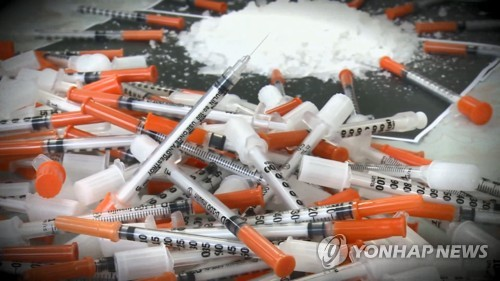
According to the Ministry of Justice's analysis of the 2016 overall recidivism rate of released prisoners, drug crimes had a recidivism rate of 45.8%, the second highest after theft (50.0%). This was followed by violence (31.3%), negligence (25.1%), and robbery (22.8%). Notably, among inmates released after drug-related crimes, 88.8% were found to have committed drug crimes again and were sentenced to imprisonment.
Drugs are highly addictive and difficult to quit once started. Drugs act on the central nervous system of our brain, causing changes in the function of brain nerve cells. When abused, they paralyze reason, leading to loss of self-control and impulsive behavior. Even small amounts cause strong stimulation and excitement, and repeated administration to maintain pleasure leads to addiction.
Withdrawal symptoms from drugs are also severe. They cause anxiety, depression, and insomnia, and in severe cases, may be accompanied by shock. Failure to satisfy these cravings can lead to loss of self-control and a higher likelihood of committing other serious crimes, requiring more careful attention.
Because drugs are highly addictive, quitting on one's own is almost impossible. This is why government-level support is necessary for treating drug addiction. However, facilities and budgets for drug addiction treatment are severely insufficient.
There are 21 designated treatment protection institutions nationwide (including national and public hospitals), but only about 4 or 5 are known to be effectively operating. In particular, 14 institutions have had fewer than 5 treatment protection cases in the past 5 years, and 4 national and public hospitals have had no cases at all, raising concerns that treatment protection institutions are not fulfilling their roles properly.
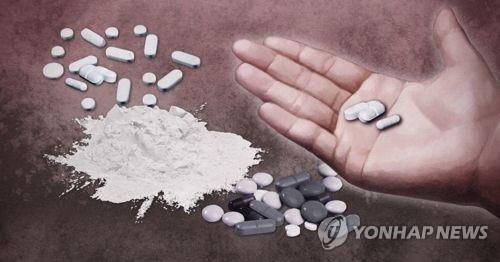
The budget has also significantly decreased. According to the "Report on the Actual Condition and Measures of Drug Abuse" released last year by the Korean Academy of Science and Technology, government support, which was about 130 million KRW from 2008 to 2011, sharply dropped to 84 million KRW in 2012 and further decreased to 60 million KRW in 2016. It then increased again to 72 million KRW in 2017, 92 million KRW in 2018, and 120 million KRW in 2019, but the budget remains lower compared to 10 years ago.
Meanwhile, the police announced that from March 1 to May 31, they will conduct an "Intensive Crackdown on Drug Offenders" to block drug crimes. They plan to focus on cracking down on non-face-to-face drug distribution through the internet and applications, as well as drug crimes committed by foreigners.
Plans were also announced to establish specialized dark web investigation teams in the Incheon, Busan, and Northern Gyeonggi Police Agencies during the first half of the year to eradicate drug crimes. The Seoul, Southern Gyeonggi, and Gyeongnam Police Agencies have been operating dark web investigation teams since August last year. Through this plan, the police will continue strong crackdowns on various drug transactions conducted anonymously via the dark web and virtual currencies.
Experts suggest that drug crimes can be eradicated only by approaching them with changed investigative methods. Professor Lee Sujeong of the Department of Criminal Psychology at Kyonggi University said, "There are limits to current investigative methods," and recommended, "Just as efforts were made to conduct undercover investigations online to solve child sexual exploitation issues, drug crimes should also focus on transactions within cyberspace."
© The Asia Business Daily(www.asiae.co.kr). All rights reserved.
![Clutching a Stolen Dior Bag, Saying "I Hate Being Poor but Real"... The Grotesque Con of a "Human Knockoff" [Slate]](https://cwcontent.asiae.co.kr/asiaresize/183/2026021902243444107_1771435474.jpg)

















