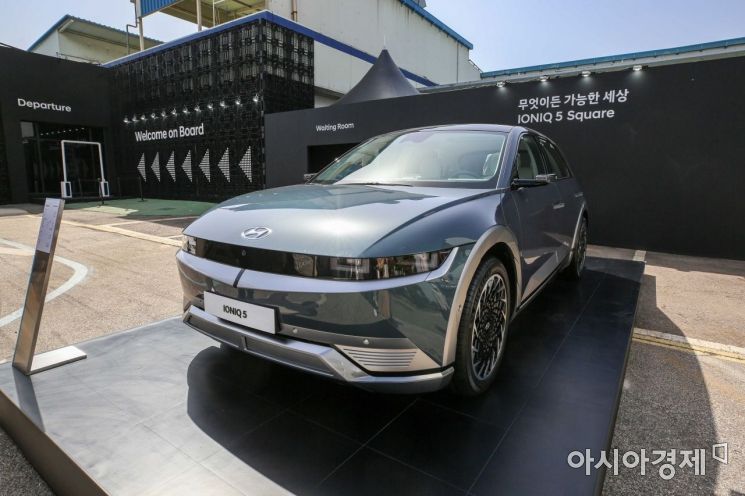
 On the 17th, the 'Ioniq 5' was unveiled at Hyundai Motor Company's Wonhyo-ro building in Yongsan-gu, Seoul. Photo by Jinhyung Kang aymsdream@
[Asia Economy Reporter Changhwan Lee] Hyundai Motor Company's first dedicated electric vehicle, the Ioniq 5, has officially entered mass production starting this week. Hyundai plans to increase Ioniq 5 production to the maximum extent once mass production stabilizes.
However, due to overwhelming orders to the point that no more reservations are possible, it is expected that customers with later queue numbers will find it difficult to receive their vehicles within this year.
According to the automotive industry on the 23rd, Hyundai began mass production of the Ioniq 5 at Ulsan Plant 1 starting the day before. Currently, production is focused mainly on export models, and domestic vehicles will be produced in earnest starting next month. The hourly production target is 27.5 units, and an increase in production will be considered depending on yield stabilization.
However, due to the current surge in orders, customers who reserved their vehicles late are expected to face difficulties in receiving their cars within this year. Hyundai's initial domestic sales target for the Ioniq 5 this year was 26,500 units, but it is understood that over 40,000 domestic pre-orders have already been placed.
Hyundai dealerships across the market also responded that pre-ordering the Ioniq 5 is currently meaningless due to the overwhelming backlog of orders. A representative from a Hyundai dealership in Mapo-gu, Seoul, said, "There are so many Ioniq 5 reservations that even if you place a waitlist now, it is likely impossible to receive the vehicle within this year."
Electric vehicle subsidy issues are also an obstacle. Whether electric vehicles can receive subsidies from the government and local governments is crucial. Subsidies can reach up to 10 million KRW. However, this year, the government is only providing subsidies for about 75,000 passenger electric vehicles.
Besides Hyundai, several brands such as Kia, Tesla, GM Korea, and Renault Samsung Motors are also releasing electric vehicles, so prospective customers must compete on a first-come, first-served basis for the 75,000 subsidy slots. Customers who fall behind in ranking and do not receive subsidy benefits are likely to give up on vehicle delivery.
There is also a parts supply issue due to a shortage of automotive semiconductors. The automotive industry is currently experiencing an extreme semiconductor supply shortage. Hyundai is also checking semiconductor supply daily due to the poor situation. Although Hyundai wants to increase Ioniq 5 production, it is analyzed that a lack of parts could make this impossible.
A representative from the automotive industry said, "The popularity of the Ioniq 5 is higher than expected, which is encouraging within Hyundai," but added, "Due to many external variables, customers' waiting times may be longer than anticipated."
© The Asia Business Daily(www.asiae.co.kr). All rights reserved.

















