Marine Corps Amphibious Assault Helicopter 'Domestic Development VS Overseas Procurement' Fierce Tensions
Last Year's National Assembly Audit Saw Marine Corps Commander Lee Seung-do's "Helicopter Down Helicopter" Response Stir Controversy
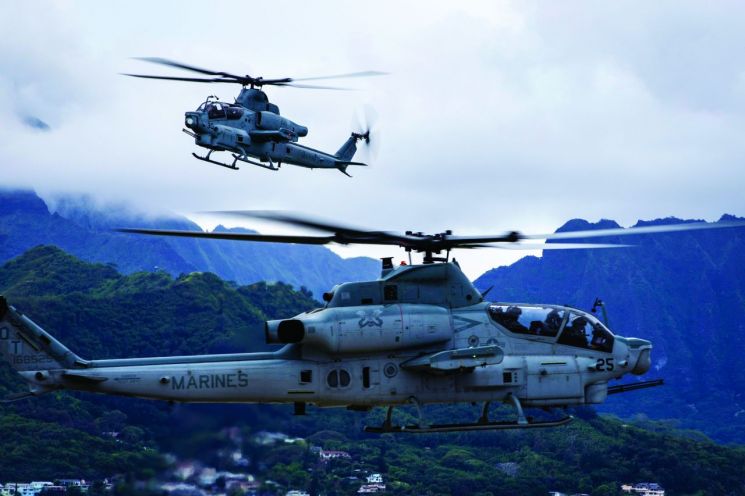
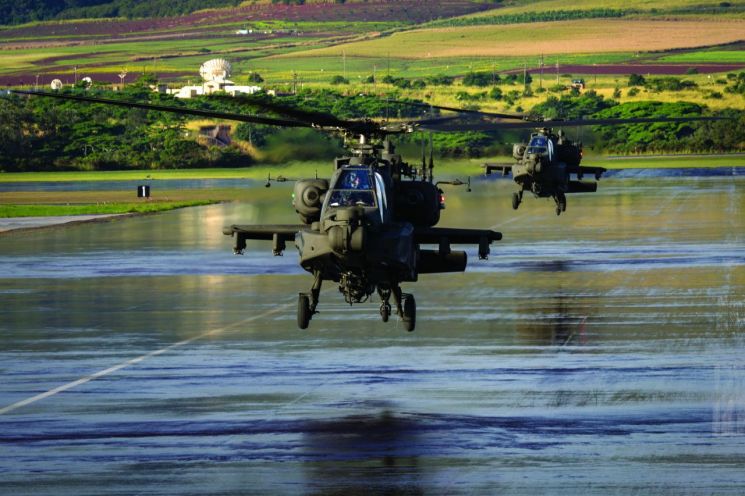
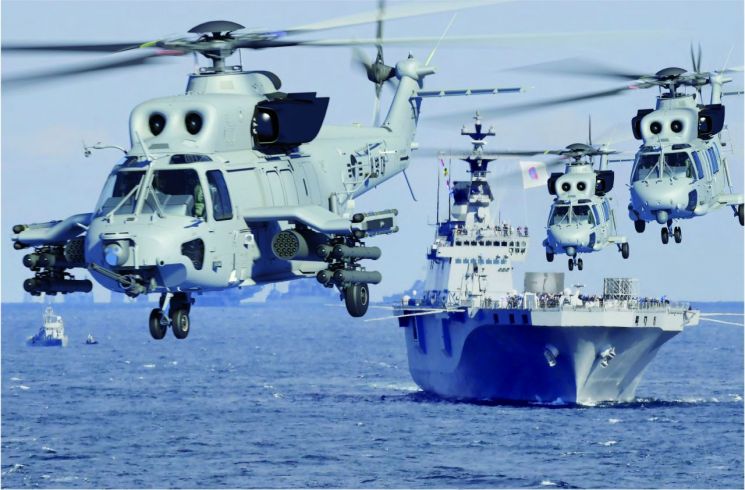
[Monthly Aviation Editor-in-Chief Kim Jae-han] The Marine Corps' ongoing amphibious attack helicopter acquisition project has recently become a hot topic of debate. The amphibious attack helicopter project aims to acquire 24 amphibious attack helicopters starting in 2026. Currently, there is a fierce debate over the acquisition method: whether to develop domestically based on the amphibious mobility helicopter Marineon, or to procure American-made attack helicopters such as the AH-64E or AH-1Z. Especially as the acquisition plan is expected to be decided within the first half of this year, additional project analyses related to domestic development are underway, drawing even more attention to the results.
▲The Marine Corps Commander's candid remarks= In fact, according to prior preliminary research results, the acquisition plan based on domestic development was expected to be prepared by last year. However, ongoing debates about domestic development have delayed the decision on the acquisition plan. Notably, on October 26 last year, Marine Corps Commander Lee Seung-do's remarks during the National Assembly Defense Committee's comprehensive audit reignited the debate on domestic development.
On that day, when Assemblyman Han Ki-ho of the People Power Party asked the commander what type of amphibious attack helicopter was targeted, he replied, “Although everything is specified in the ROC (Required Operational Capability), we requested a helicopter that is truly an attack helicopter,” emphasizing, “The Marine Corps wants an attack helicopter currently in operation that excels in mobility and survivability, not a Marineon equipped with weapons.”
The commander's remarks were unusual in that the highest commander directly mentioned requirements regarding the acquisition project, causing a significant stir. Perhaps for this reason, on the same day, October 26, an urgent bidding notice titled ‘Amphibious Attack Helicopter Project Analysis’ was registered on the Defense Acquisition Program Administration's Defense Electronic Procurement System. The longstanding issues between domestic development and overseas procurement finally surfaced during the national audit.
▲Focus on additional project analysis results= Following the Marine Corps commander's remarks, attention naturally centers on the ‘Amphibious Attack Helicopter Project Analysis’ scheduled for completion at the end of March. Since the analysis was initiated immediately after the commander's statement favoring the acquisition of currently operated attack helicopters, the possibility of shifting from domestic development to overseas procurement cannot be ruled out.
In fact, the project analysis focuses on the issues related to domestic development. The Defense Acquisition Program Administration stated in the request for proposals, “The controversy divided between domestic development and overseas procurement has increased the burden on project promotion, necessitating resolution,” adding, “The Marine Corps, as the user, continuously demands additional analysis regarding whether operational performance and deployment timing can be met if developed domestically, making verification necessary.”
However, the Defense Acquisition Program Administration appears to draw a line regarding the possibility of changing the domestic development policy. In December last year, it released a statement clarifying, “The additional project analysis aims to verify in detail the elements such as performance, safety, cost, and deployment schedule raised by the National Assembly, media, and user units, and is not an analysis to reconsider the project from scratch.”
▲What performance is required for the amphibious attack helicopter?= One of the main reasons for pursuing additional project analysis is the performance of the Marineon-based amphibious attack helicopter. Today, the amphibious attack helicopter plays a crucial role in amphibious operations, providing cover for amphibious mobility helicopters deploying combat troops to contested target areas based on strong armament capacity and maritime operational capability. It also supports firepower to ensure landing ships carrying troops and supplies can safely arrive and unload at the target shore, and timely fire support to ground combat units that must fight with limited resources due to the nature of amphibious operations.
To perform these missions, the amphibious attack helicopter must have excellent mobility and flight performance equal to or better than amphibious mobility helicopters. This is because to cover amphibious mobility helicopters, at least the same level of mobility and range must be guaranteed. Simply put, it must have superior mobility compared to the currently introduced Marineon and be able to fly at least as far or farther.
Of course, armament capability is also important. To provide sufficient cover and suppress the enemy, adequate firepower is required. Especially during amphibious operations, the helicopter must have the armament capacity to perform various missions such as covering amphibious mobility helicopters and suppressing enemy threats in the landing area with a single takeoff, and blocking enemy reinforcements.
Based on these performance criteria, the main issues regarding domestic development are operational performance, project cost, and deployment timing. Specifically, compared to the procurement of American-made attack helicopters, the main concerns are reduced operational performance due to domestic development, high acquisition costs due to research and development, and delays in deployment.
▲Operational performance compared to dedicated attack helicopters= The debate on operational performance stems from a strong perspective based on existing amphibious attack helicopters as a benchmark. Typical amphibious attack helicopters have tandem cockpits with pilots seated front and back, a narrow fuselage width, a sleek shape, and various armament capabilities covering air-to-air and air-to-ground missions.
Applying this benchmark to the Marineon-based amphibious attack helicopter, the external shape deviates from the standard. It features a side-by-side cockpit with pilots seated next to each other, a wider fuselage, and additional weapon mounts attached separately to the existing fuselage, showing significant differences compared to dedicated attack helicopters. Because of this, the prevailing view is that the Marineon-based amphibious attack helicopter will have inferior mobility and armament capacity compared to dedicated attack helicopters.
Korea Aerospace Industries (KAI) holds a different view on this. Choi Jong-ho, head of KAI's rotary-wing business division, explained, “The core concern about inferior flight performance compared to dedicated attack helicopters means that if the amphibious attack helicopter's performance is worse than the amphibious mobility helicopter, operational limitations will occur. However, performance analysis of the domestically developed amphibious attack helicopter predicts superiority over the amphibious mobility helicopter in all aspects except maximum cruising speed.”
He added, “The difference in maximum cruising speed is due to increased drag from weapon mounts. The same difference occurs between the US Marine Corps' mobility helicopter (UH-1Y) and attack helicopter (AH-1Z), and Bell, the manufacturer, officially states that this difference is insignificant for joint operations between mobility and attack helicopters.”
Regarding design limitations due to side-by-side cockpits and development based on mobility helicopters, he stated, “Discussing mobility and armament capacity limits based solely on shape is inconsistent with recent technological trends. In modern battlefield environments, it is important to detect and strike unseen enemies first using advanced technology, and the domestically developed amphibious attack helicopter can guarantee equal or superior strike power and survivability through cutting-edge avionics and weapon systems.”
In response to media claims that the operational effectiveness and performance gap between American-made attack helicopters and the domestic amphibious attack helicopter exceeds twice, the Defense Acquisition Program Administration directly clarified. On December 15 last year, it released a statement saying, “According to the second preliminary research conducted by the Defense Technology Quality Institute, involving about 30 experts from the Joint Chiefs of Staff, user units, and the Agency for Defense Development, mission effectiveness analysis showed that the Apache is approximately 1.09 times and the Viper approximately 1.07 times superior to the Marineon-based amphibious attack helicopter.”
Regarding criticisms that the domestic helicopter has inferior protection compared to dedicated attack helicopters, it explained, “Only some key parts of the Apache are resistant to 23mm armor-piercing rounds, and other parts are at a similar level to the domestic helicopter and AH-1Z, AH-64E helicopters.” Furthermore, concerning the criticism that the vertical climb rate of the domestic helicopter is 7 m/s compared to 14.2 m/s for the AH-1Z, it stated, “Attack helicopter performance is determined by various factors such as all-weather target acquisition, precision strike capability, mobility, and survivability, so viewing vertical climb rate as the decisive factor is inappropriate. In fact, the vertical climb rate of the AH-1Z is analyzed to be below 10 m/s when equipped with the main mission armament required by the military.”
Domestic Development Argument ? Economically advantageous in acquisition and maintenance costs, but performance remains controversial
Overseas Procurement Argument ? Unified logistics support with existing helicopters, proven performance emphasized
▲Increased project cost due to research and development= Another major issue is the expected increase in project cost due to separate research and development. However, the second preliminary research disclosed by the Defense Acquisition Program Administration analyzed domestic development as the most cost-effective. According to the unit prices disclosed, the domestic helicopter was the cheapest at approximately 30.2 billion KRW, followed by the AH-1Z at about 41.6 billion KRW, and the AH-64E being the most expensive at about 45.2 billion KRW.
Along with acquisition costs, the total life-cycle cost was also analyzed as economical for the domestic helicopter. Especially, domestic development is expected to be advantageous for maintaining continuous target availability through timely repair parts and technical support. Regarding this, KAI's Choi Jong-ho said, “According to the US Government Accountability Office, when estimating aircraft life at 30 years, 28% of total life-cycle cost is acquisition cost, and 72% is operation and maintenance cost,” emphasizing, “Operation and maintenance costs during the total life cycle are important considerations along with acquisition costs.”
Regarding operation and maintenance, he added, “The domestically developed amphibious attack helicopter, using the same platform as the mobility helicopter, is advantageous for pilot and mechanic training compared to foreign models,” and “Considering the Marine Corps' conditions, this is the optimal choice.” He also noted, “Domestic development allows timely application of new technologies due to technological advancement, facilitates performance upgrades, and provides a foundation for future weapon system development.”
▲Deployment schedule delays= Deployment schedule delays are expected to be somewhat inevitable with domestic development. On this, Choi said, “If domestic development is decided, the development period is expected to take 46 months, including design and prototype production, ground and flight testing, and obtaining combat suitability certification,” adding, “Since it integrates verified airframes and weapons, development is judged feasible within the proposed schedule.”
He particularly noted, “Compared to overseas procurement, delays in acquisition timing are unavoidable due to government procedures for domestic weapon system deployment, but it is necessary to understand why the government operates these administrative procedures separately for domestic development,” and “Instead, the user unit participates in the development process for customized development, which is expected to provide significant advantages in combat power acquisition and maintenance for the user unit operating the weapon system after deployment.”
▲Intense competition among overseas manufacturers= Although the Defense Acquisition Program Administration has leaned toward domestic development after the second preliminary research, competition with Boeing and Bell, proposing the AH-64E and AH-1Z respectively, remains intense. First, Boeing's AH-64E Apache Guardian is recognized as the world's best attack helicopter, with the latest specifications being a strong advantage. Notably, the recent ‘Version 6’ enhances maritime operational capability through marinization, doubles the detection range of the AN/APG-78 Longbow Fire Control Radar (FCR) from 8 km to 16 km, and supports unmanned aerial vehicle operations.
Additionally, the AH-64E is currently being introduced and operated by the Army, which is advantageous. If the Marine Corps operates the same model as the Army, it can unify subsequent logistics support systems, reducing required personnel and operation and maintenance costs. According to an industry source, Boeing's proposal reportedly includes plans to integrate with the Army's large attack helicopter second phase project, expected to start next year.
As is known, the Army is pursuing a second phase project to acquire 24 additional AH-64Es following the first phase acquisition of 36 units. Since both projects are expected to start around next year, Boeing is considering integrating both projects with the AH-64E to reduce acquisition costs through economies of scale, the source said.
Bell, which has exclusively supplied attack helicopters to the US Marine Corps, emphasizes that the AH-1Z is optimized for Marine Corps operations. Nate Green, Bell's Global Military Sales and Strategy Manager and a former pilot of the US Marine Corps AH-1W and AH-1Z, said, “Marine Corps equipment must operate reliably in any environment,” adding, “The AH-1Z is designed to operate even in the worst environments, such as saltwater corrosion that critically affects platforms or severe electromagnetic interference that disrupts operations.”
He emphasized, “For military aircraft to be truly effective, they must survive in today's threat environments during conflicts,” and “The AH-1Z is designed for this purpose.” He also said, “The AH-1Z features armor design and testing, dual installation of all critical components, and an integrated threat detection and response system, all designed to ensure the aircraft and pilots safely return from every mission.”
Furthermore, he added, “The Marine Corps of both Korea and the United States maintain a close cooperative relationship to counter regional and global threats,” and “Through a total package approach, the Marine Corps of both countries can gain greater benefits through close cooperation to further enhance attack helicopter capabilities.”
© The Asia Business Daily(www.asiae.co.kr). All rights reserved.
![Clutching a Stolen Dior Bag, Saying "I Hate Being Poor but Real"... The Grotesque Con of a "Human Knockoff" [Slate]](https://cwcontent.asiae.co.kr/asiaresize/183/2026021902243444107_1771435474.jpg)

















