"Vaccination After Thorough Patient Condition Check"
300-400 Daily Cases on Day 50
[Asia Economy reporters Seo So-jeong and Kim Ji-hee] The government will hold a meeting of the Vaccination Expert Committee under the Korea Disease Control and Prevention Agency this week to decide whether to administer the AstraZeneca COVID-19 vaccine to the elderly aged 65 and over. As of midnight on the 8th, three additional death reports after vaccination were added, bringing the total to 11 cases. Some experts emphasized the need to establish guidelines reflecting the health conditions of patients in nursing hospitals, where many have underlying diseases, before vaccinating the elderly.
On the 8th, Ji Young-mi, a member of the Vaccination Expert Committee and advisor at the Global Infection Center of Seoul National University College of Medicine, said in a phone interview with Asia Economy, "The UK recently released data proving the effectiveness of the vaccination, and countries like Germany and France have decided to vaccinate the elderly with the AstraZeneca vaccine, so we plan to positively consider vaccinating the elderly." She added, "Since the elderly aged 65 and over have high rates of severe cases and mortality, the vaccination schedule can be advanced."
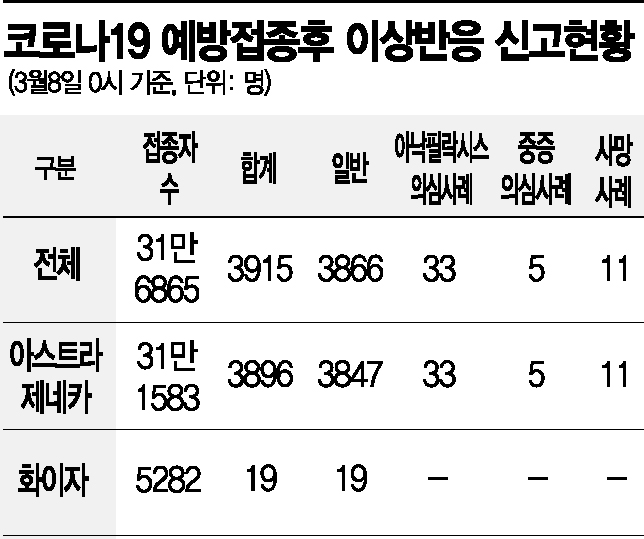
◆"Vaccination deadlines and intervals need to be reconsidered"= Experts weigh that the direct link between the vaccine and deaths is likely minimal, but as deaths among nursing hospital patients with underlying diseases have occurred after vaccination, they suggest the need to more closely check their health status and establish guidelines for vaccination. Professor Chun Eun-mi of the Department of Respiratory Medicine at Ewha Mokdong Hospital said, "The government issued guidelines to vaccinate within five days after receiving the AstraZeneca vaccine, but in some nursing hospitals, if the vaccination order is missed, patients are pushed to later priority, so vaccinations are sometimes forced even when the patient's health condition is not optimal." She added, "We need to specify ways to postpone the vaccination deadline so that patients with underlying diseases can be vaccinated when they are in optimal health." Professor Chun pointed out, "If there are no specific symptoms like fever, patients may appear normal externally. If the patient's condition is carefully checked through blood tests, X-rays, and inflammation tests before vaccination, it will help reduce the post-vaccination mortality rate." Recently, Roh Dong-hoon, director of Carnation Nursing Hospital, which has completed all vaccinations within the hospital, said, "Since there are no specific guidelines yet, we completed all vaccinations within five days, but if the vaccination date is postponed, it will help patients be vaccinated when their health condition is better."
The Vaccination Expert Committee currently recommends the second dose of AstraZeneca vaccine eight weeks after the first dose, but there are calls to extend this interval to 12 weeks ahead of full-scale elderly vaccination. A preprint paper by Oxford University researchers published last month in the international journal The Lancet showed that the group vaccinated twice with AstraZeneca at intervals of 12 weeks or more had the highest preventive effect of 82.4%. Professor Chun said, "According to the paper, the effectiveness drops to 59.9% when vaccinated at intervals of 6 to 8 weeks." She added, "Extending the vaccination interval to 12 weeks not only improves effectiveness but also provides more opportunities for nursing hospital patients with underlying diseases to be vaccinated when their health condition is better." Regarding this, Professor Ji Young-mi said, "While the speed of vaccination is important, safety is also crucial. We will propose related discussions to the committee."
◆Daily tests to increase to 500,000= While accelerating vaccination, the government is also preparing for a possible fourth wave of COVID-19. Although the daily new confirmed cases, which had exceeded 1,000, dropped to the 300-400 range as of January 18, the numbers have plateaued for over 50 days. Yoon Tae-ho, head of the Central Disaster and Safety Countermeasure Headquarters' quarantine team, emphasized the importance of quarantine, saying, "At the end of last year, the daily average number of patients in the 400s rose to over 1,000 within four weeks." The 'Fourth Wave Suppression and Preparedness Plan' announced by the quarantine authorities focuses on ▲early detection and containment of confirmed cases ▲establishment of medical response systems ▲strengthening compliance with facility and individual quarantine rules.
First, the authorities plan to more than double COVID-19 diagnostic testing capacity from the current 230,000 to 500,000 tests per day. Periodic testing will be conducted in vulnerable facilities such as nursing hospitals, using appropriate testing methods according to the situation to enhance quarantine effectiveness. Additionally, to block variant viruses, considered the greatest risk factor for the fourth wave, the number of analysis institutions will be expanded to eight, and the analysis time will be reduced to 3-4 days.
Along with blocking the spread, preparations for a resurgence will be strengthened. The authorities aim to establish a medical system capable of treating 2,000 patients daily. To this end, they plan to pre-designate and manage base hospitals and residential treatment centers and expand the pool of medical personnel.
© The Asia Business Daily(www.asiae.co.kr). All rights reserved.
![Clutching a Stolen Dior Bag, Saying "I Hate Being Poor but Real"... The Grotesque Con of a "Human Knockoff" [Slate]](https://cwcontent.asiae.co.kr/asiaresize/183/2026021902243444107_1771435474.jpg)















