Food Waste Photo Verification Triggers Review Terror
Delivery App Ratings and Reviews Affect Restaurant Sales
Expert: "Reviews Greatly Influence Consumer Choices"
 Recently, self-employed business owners have been complaining about damages caused by malicious reviews. Photo by Baedal Minjok delivery app screen capture.
[Asia Economy Reporter Heo Midam] "It's my child's birthday, so please make the fried rice extra large," "The toilet said it was hungry, so I fed it."
Recently, self-employed business owners have been complaining about damages caused by a series of 'malicious reviews.' For example, customers order a single serving but demand more than the standard amount, or blame the store for their own ordering mistakes, engaging in so-called 'star rating terrorism.' In particular, some customers have gone beyond simple criticism of the food's taste and posted photos of food being dumped into the kitchen sink drain or toilet, sparking public outrage.
Such malicious reviews affect store sales. Especially for small restaurants, the impact is even greater. Experts point out that malicious reviews can negatively influence consumer choices.
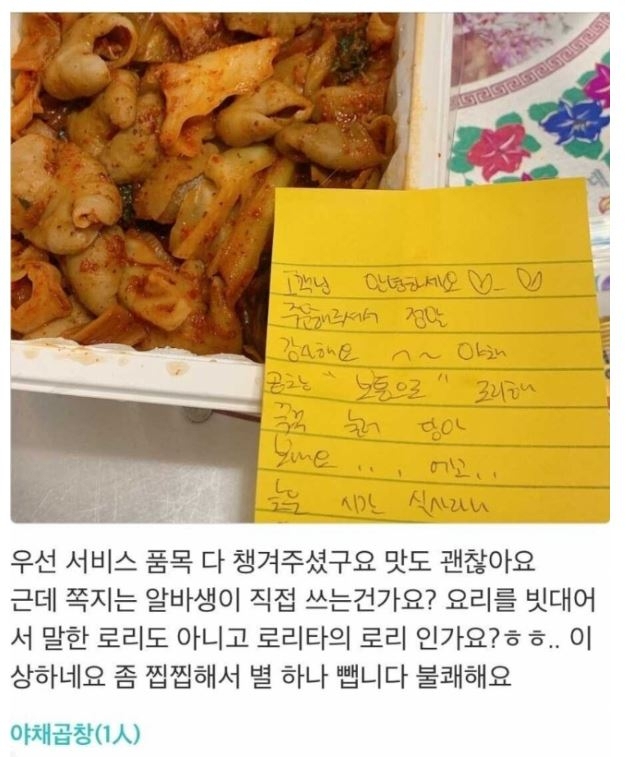
Recently, the owner of a gopchang (grilled intestines) restaurant shared a case of malicious reviews they experienced on an online community. According to the post, the owner sent a handwritten note along with the food, containing messages like "Dear customer, hello. Thank you very much for your order," and "We prepare the vegetable gopchang at 'regular' level, pressing it tightly."
However, the customer who received the note misread '조리' (jori, meaning 'cooking') as '로리' (lori) and said, "It's not 'lori' as in cooking, but 'loli' (a term referring to child sexual attraction). It's unsettling, so I deducted one star. It's unpleasant."
The owner apologized, saying, "Sorry for my poor handwriting," but added, "It was a note written to convey a warm heart even during busy times. I feel more unsettled seeing such a review."
 Recently, a customer caused controversy by requesting a double portion of fried rice. Photo by Baedal Minjok delivery app screen capture.
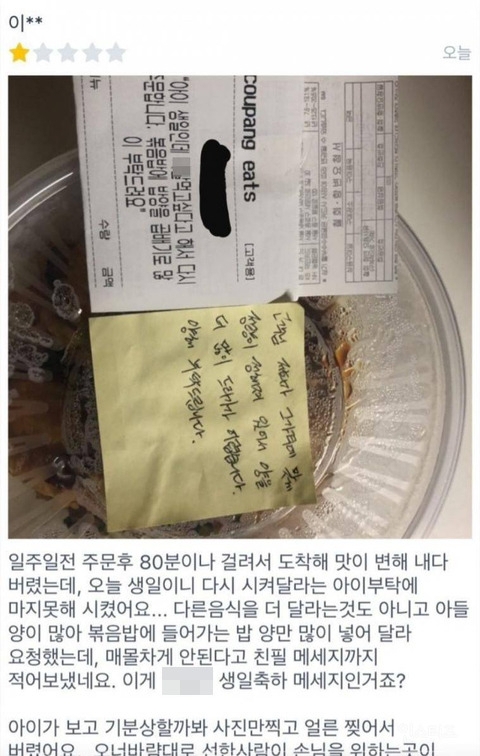
Earlier, a story about a customer who requested extra fried rice for their child's birthday also sparked controversy. This customer said through a delivery app, "I only asked for more rice in the fried rice, not for extra dishes, but they coldly sent a handwritten message saying it was not possible," adding, "I just took a photo of the (receipt) to avoid upsetting my child and quickly tore it up and threw it away."
The photo the customer shared shows the owner responding to the request with, "We have a fixed quantity set for that price, so it's difficult to provide more. We ask for your understanding." The customer then gave the store a one-star rating.
The problem is that such defamatory reviews can cause mental and financial damage to self-employed business owners. Consumers usually decide their orders based on reviews of food and service when using delivery apps. Especially with the intensified competition in delivery services due to COVID-19, the importance of reviews and star ratings has increased.
However, some customers have caused problems by posting photos of food being dumped into kitchen sink drains or toilets simply because the food did not suit their taste. Store owners who see this cannot hide their bitterness over the fact that food they prepared with their best effort is being discarded.
One store owner who saw their handmade hamburger thrown into the sink said, "Of course, tastes and preferences can differ. But seeing comments that customers were not satisfied with food we made with our best effort makes me feel sad," adding, "I accept responsibility for making food that was discarded."
The owner also said, "Still, it's shocking to see photos of food thrown into the trash bin (sink)," and lamented, "It feels like our efforts have been thrown into the trash. It's a really tough day."
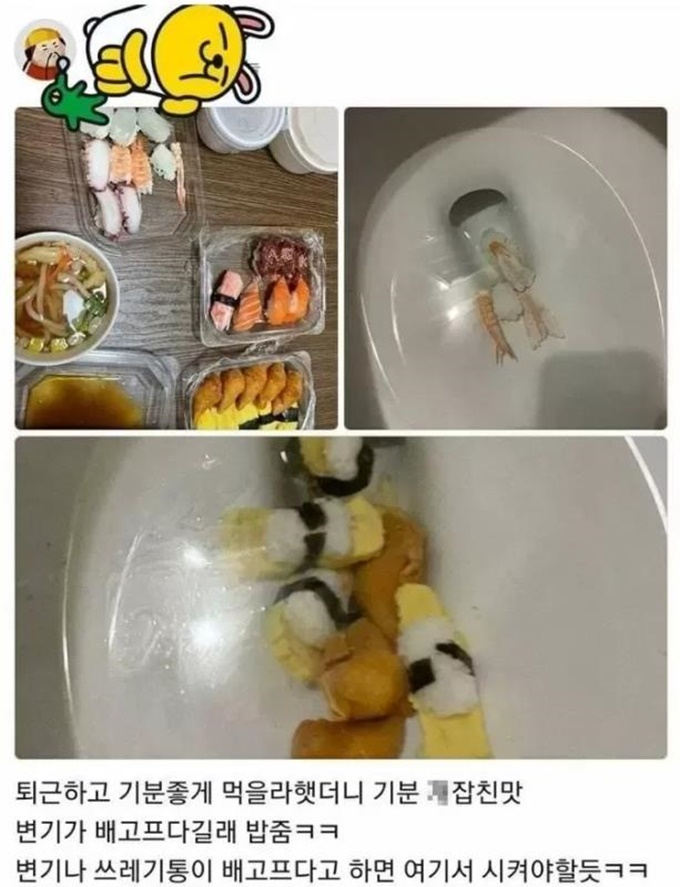 A customer recently recorded a scene of disposing food in the toilet and uploaded it to a delivery app. Photo by a screen capture of the delivery app 'Baedal Minjok'.
The controversy over malicious reviews continues in the self-employed community 'Apeunikka Sajangida' (Because It Hurts, I'm a Boss). They said they understand criticism of food but that customer complaints have been expressed in excessively extreme ways.
One self-employed person said, "It's the customer's right to write a review saying the food is bad and give one star, but taking photos of food thrown into the trash bin or stuffed into the drain and posting them online shows a problem with their character," adding, "Malicious review terrorism should be done within limits. Writing malicious reviews like that is like trying to kill the business."
In response to this situation, 'Woowa Brothers,' the operator of the delivery app Baemin, and the National Franchise Store Owners Association recently announced measures to eradicate malicious reviews. The main point is that if a store owner reports an unjust malicious review, Baemin can review it and make the review private for 30 days. After 30 days, the review is made public again but will be pushed down by newer reviews. This effectively has the same effect as deleting the review.
However, some argue that such measures could also label reasonable customer complaints as malicious reviews, potentially hindering legitimate consumer activity.
Office worker Kim (28) said, "Malicious reviews like dumping food into the sink should be improved," but added, "Store owners who receive malicious reviews or star rating terrorism should also continuously consider why they received such evaluations. From a consumer's perspective, if you pay expensive delivery fees and the food tastes bad, it's natural not to leave a positive review."
Experts point out that malicious reviews can greatly influence consumer choices. Professor Lee Eunhee of Inha University's Department of Consumer Studies said, "Consumers refer to reviews and photos to choose one option among many they have not experienced. In such cases, malicious reviews have a significant impact on consumer choices," adding, "Operating a complaint center where excessive malicious or false reviews can be reported is one possible solution."
© The Asia Business Daily(www.asiae.co.kr). All rights reserved.
![Clutching a Stolen Dior Bag, Saying "I Hate Being Poor but Real"... The Grotesque Con of a "Human Knockoff" [Slate]](https://cwcontent.asiae.co.kr/asiaresize/183/2026021902243444107_1771435474.jpg)

















